On this page
The textbook answer: an object stays up while the vertical line through its centre of gravity passes inside its base. The Leaning Tower of Pisa passes that test easily. Yet by 1990 it was close to falling, and the reason was the ground, not the stone.
The numbers below come from three engineers on the committee that stabilised it, John Burland, Michele Jamiolkowski and Carlo Viggiani, in Leaning Tower of Pisa: Behaviour after Stabilization Operations (International Journal of Geoengineering Case Histories, 2009).
Why does the Leaning Tower of Pisa not fall over?
The tower is about 60 m tall, its foundation is 19.6 m across, and it weighs about 142 MN, according to Burland and colleagues.
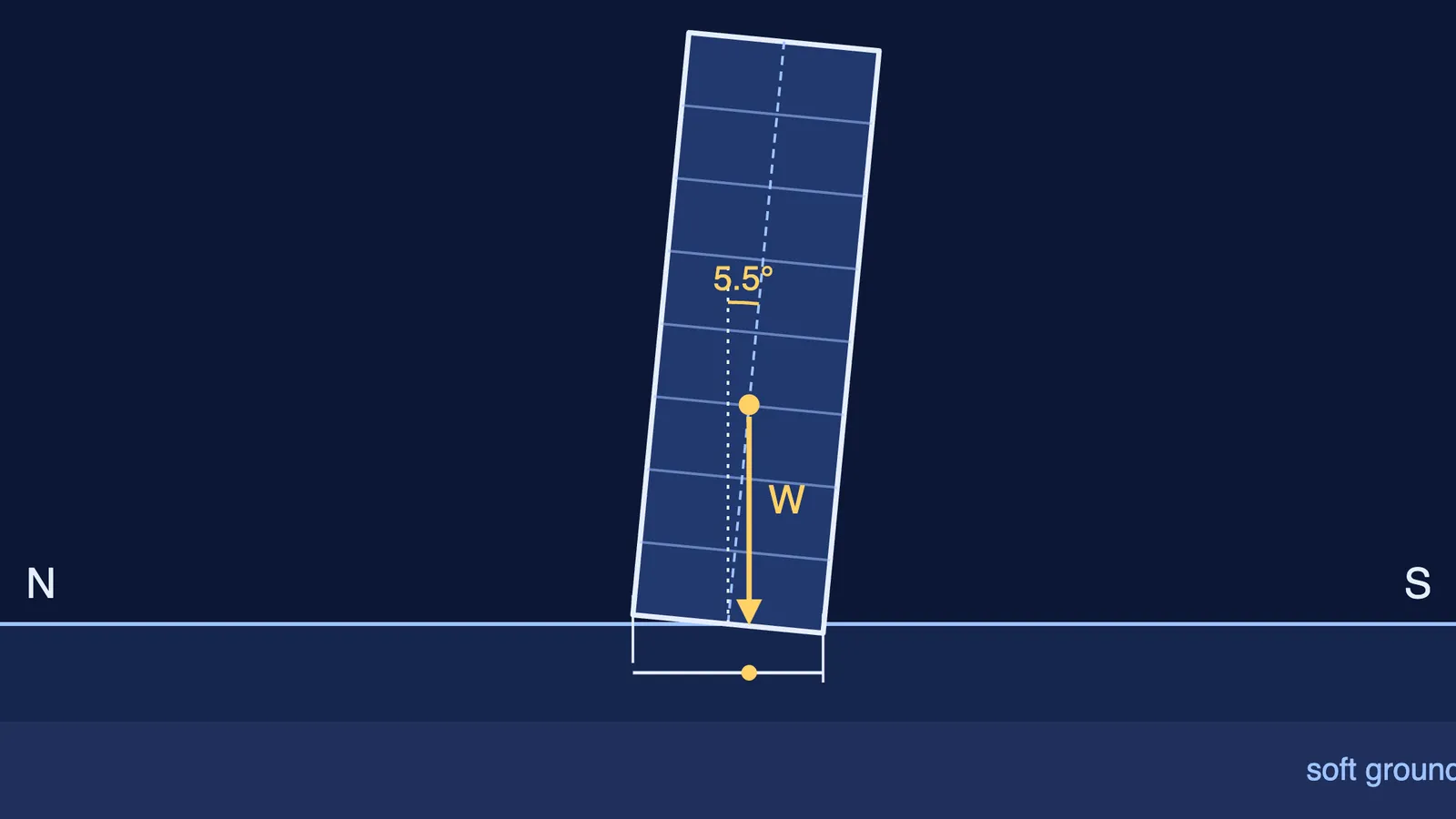
In 1993 the foundation was tilted southwards at about 5.5°, and the tower's centre of gravity sat 22.6 m above the base (same paper).
Where does the tower's weight actually land?
Try this in a notebook with the paper's numbers (Burland et al., 2009).
Horizontal shift of the weight line: e = h × tan α = 22.6 m × tan 5.5° ≈ 2.2 m.
Overturning moment: W × e ≈ 142 MN × 2.2 m ≈ 310 MN·m. The paper gives 327 MN·m, which means e ≈ 2.3 m. The real tower is not a straight block: "It is like a banana," Burland told Scientific American. "The thing was never straight."
Distance to the edge: the foundation's radius is 19.6 / 2 = 9.8 m, so the weight line is about 9.8 − 2.3 = 7.5 m inside the edge.
Tipping angle on hard rock: the weight line reaches the edge when tan α = 9.8 / 22.6 ≈ 0.43, which gives α ≈ 23°.
On rigid ground, then, a block of this shape could lean about four times further. Yet the paper reports that in 1990 the tilt was growing by about 6 arc seconds a year. The pressure under the foundation was about 1000 kPa at the south edge, where the soil was locally yielding, and close to zero at the north edge. Step 4 assumed rigid ground. Pisa's ground is not rigid.
Engineers call this leaning instability. Burland and colleagues say it sets in at a critical height "when the overturning moment generated by a small increase in inclination is equal to or larger than the resisting moment generated by the foundations". They quote the engineer E.C. Hambly: leaning instability "is not due to lack of strength of the ground but is due to insufficient stiffness".
If torque and centre of gravity are easier to understand when you can tilt something yourself, the Fermi Simulation Lab has interactive simulations for ideas that are easier to see than to read.
Why did the soft ground make it lean in the first place?
The ground under the tower has three layers (Burland et al., 2009). The top 10 m or so is soft sandy and clayey silt laid down under tidal conditions. Below that, soft marine clay runs down to about 40 m, then dense sand. The top of the clay is dished beneath the tower, which shows the tower has settled by between 3.0 m and 3.5 m on average.
Construction began in 1173 and ran, with two long interruptions, for about two hundred years: 1173 to 1178, 1272 to 1278 and 1360 to 1370 (same paper). The lean began during the second stage.
Surveys back to 1911 showed that the slow rotation came from the top silty layer, not the deep clay as long assumed. Heavy autumn rain added to it: in 1995, each storm turned the tower about one arc second further south.
How did engineers reduce the tilt?
Working on the south side was too dangerous: the paper says any slight disturbance to the ground there "would almost certainly trigger collapse" (Burland et al., 2009). So the committee worked from the north.
In the second half of 1993 they placed 600 tonnes of lead weights on the north side as a temporary counterweight, raised to 900 tonnes in 1995.
Tests found a "critical line" about half a radius in from the north edge. Removing soil north of that line always moved the tower the right way.
From 9 February to early June 1999 a trial removed soil through 12 bore holes, and the tower rotated north by about 80 arc seconds.
Full soil extraction through 41 holes began on 21 February 2000 and ended on 6 June 2001. By then the tower had rotated north by about 1800 arc seconds, the half a degree the committee had aimed for.
In April and May 2002 a drainage system on the north side steadied the water table and turned the tower a little further north.
By mid-2002 the tilt was about 10% less than at its 1993 peak (same paper). In 2018 Scientific American reported that engineers expect the tower to last at least 200 years before it needs another intervention.
What can a physics student take from Pisa?
For any toppling question, check three things:
Where does the vertical line through the centre of gravity meet the ground?
How far is that point from the edge the object would pivot about?
Is the support rigid? If it gives way, the weight line moves as the object tilts.
Textbook problems usually stop at the first two. Pisa shows why engineers can't. If you aren't sure where to start on topics like torque and equilibrium, Fermi's AI tutor works out what you already know and builds a plan for the session.