

On this page
When you mix a strong acid and a strong base in an aqueous solution, the amount of heat released is nearly always the same. However, hydrofluoric acid (HF) breaks this fundamental rule.
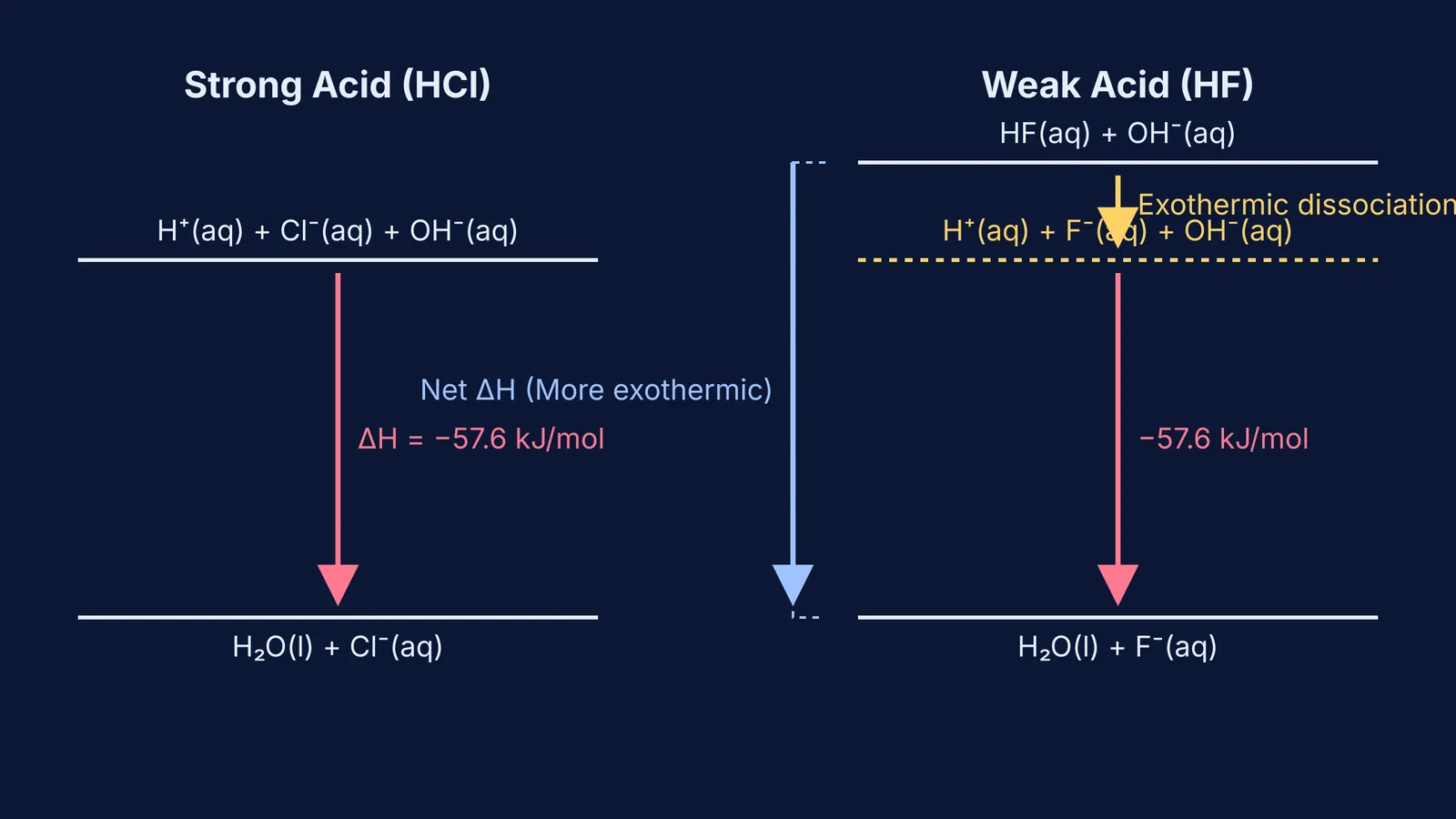
The standard enthalpy of neutralisation for a strong acid reacting with a strong base is −57.6 kJ/mol (source). Because HF is a weak acid, you might expect it to release less heat. Instead, the enthalpy of neutralisation of HF with sodium hydroxide (NaOH) is significantly more exothermic.
This anomaly appears frequently in chemistry exams like JEE Main and NEET-UG. Here is the reason behind the extra heat and how the energy balance works out.
Why is the enthalpy of neutralisation of HF more than strong acids?
The high enthalpy of neutralisation for HF is caused by the exceptionally high hydration enthalpy of the fluoride ion (F⁻) (source).
When an acid neutralises a base, hydrogen ions (H⁺) react with hydroxide ions (OH⁻) to form liquid water. In the case of strong acids like hydrochloric acid (HCl), the acid is already fully dissociated in solution. The reaction is a simple pairing of ions that releases −57.6 kJ/mol of heat (source).
Because HF is a weak acid, its H–F bond does not break completely in water. For most weak acids, like acetic acid, dissociating the acid requires an input of energy (an endothermic step). This energy cost means their overall neutralisation releases less heat than the standard strong acid value.
HF is unique because its dissociation in water actually releases heat. The fluoride ion is extremely small and carries a concentrated negative charge. Once it separates from hydrogen, surrounding water molecules are strongly attracted to it. This process of hydration releases a massive amount of energy. The energy released by hydrating the small fluoride ion is so large that it pays back the initial energy cost of breaking the H–F bond and adds extra heat on top.
This leaves you with a net heat release that is greater than the standard strong acid value.
How do you calculate the net enthalpy change?
To see exactly where the extra heat comes from, you can break the reaction down using Hess's law. The total enthalpy change (ΔH) of the neutralisation process is the sum of two distinct steps:
Ionisation of HF: HF → H⁺ + F⁻. This step is exothermic because the massive heat released by hydrating the F⁻ ion outweighs the energy needed to break the strong covalent bond.
Formation of water: H⁺ + OH⁻ → H₂O. This releases the standard −57.6 kJ/mol of heat.
When you add the heat released in step one to the heat released in step two, the final tally is more negative than the standard strong acid value.
If you struggle to picture how these competing energy steps stack up in a cycle, the Fermi Concept Library has every concept in physics, chemistry, biology, mathematics and computing, each with its own lesson and its place in the map.
How should you tackle exception questions in chemistry?
Thermochemistry is built on broad rules, but competitive exams often test your knowledge of the exceptions. Here is a practical framework for answering questions about unexpected enthalpy values:
Check the size and charge: If an ion is unusually small (like Li⁺ or F⁻), its charge density will be very high. This almost always leads to a high hydration enthalpy, which can skew the expected energy output.
Look for opposing energy steps: Identify what bonds are breaking (which takes in energy) and what bonds or physical attractions are forming (which gives out energy). The final enthalpy value is always a tug-of-war between these steps.
Compare it to a standard benchmark: Always anchor your answer to the standard value first. State clearly that a strong acid-base neutralisation releases −57.6 kJ/mol, and then explain why the specific case being tested differs from that baseline.
Similar logic applies across physical and inorganic chemistry. For example, comparing the enthalpies of atomisation of different elements often requires checking their atomic radius and the strength of their metallic bonds. You will also use this reasoning when dealing with conjugate acid-base pairs to understand why some weak acids hold onto their protons so tightly while others let them go.
If you keep getting stuck on these energy cycles during your revision, having a tool that walks you through the underlying reasoning helps. The Fermi Problem Library has worked problems with a step-by-step solver that explains the reasoning rather than printing an answer.
Understanding the delicate balance between bond strength and hydration energy will ensure you do not get caught out when the HF exception shows up on your next paper.


