

On this page
When you mix dilute hydrochloric acid (HCl) with sodium hydroxide (NaOH), the thermometer jumps noticeably. If you substitute nitric acid (HNO₃) or potassium hydroxide (KOH), the temperature jump per mole of water formed remains practically unchanged. Standard thermochemical tables, such as those compiled in Chemguide, record the standard enthalpy change of neutralisation for strong acids with strong bases at -57.1 kJ/mol (often cited between -57.1 and -57.9 kJ/mol). Yet when you repeat the test with acetic acid, the reaction generates less heat. Understanding that difference reveals one of the most practical measurement techniques in thermochemistry.
Why is the heat of neutralisation constant for strong acids?
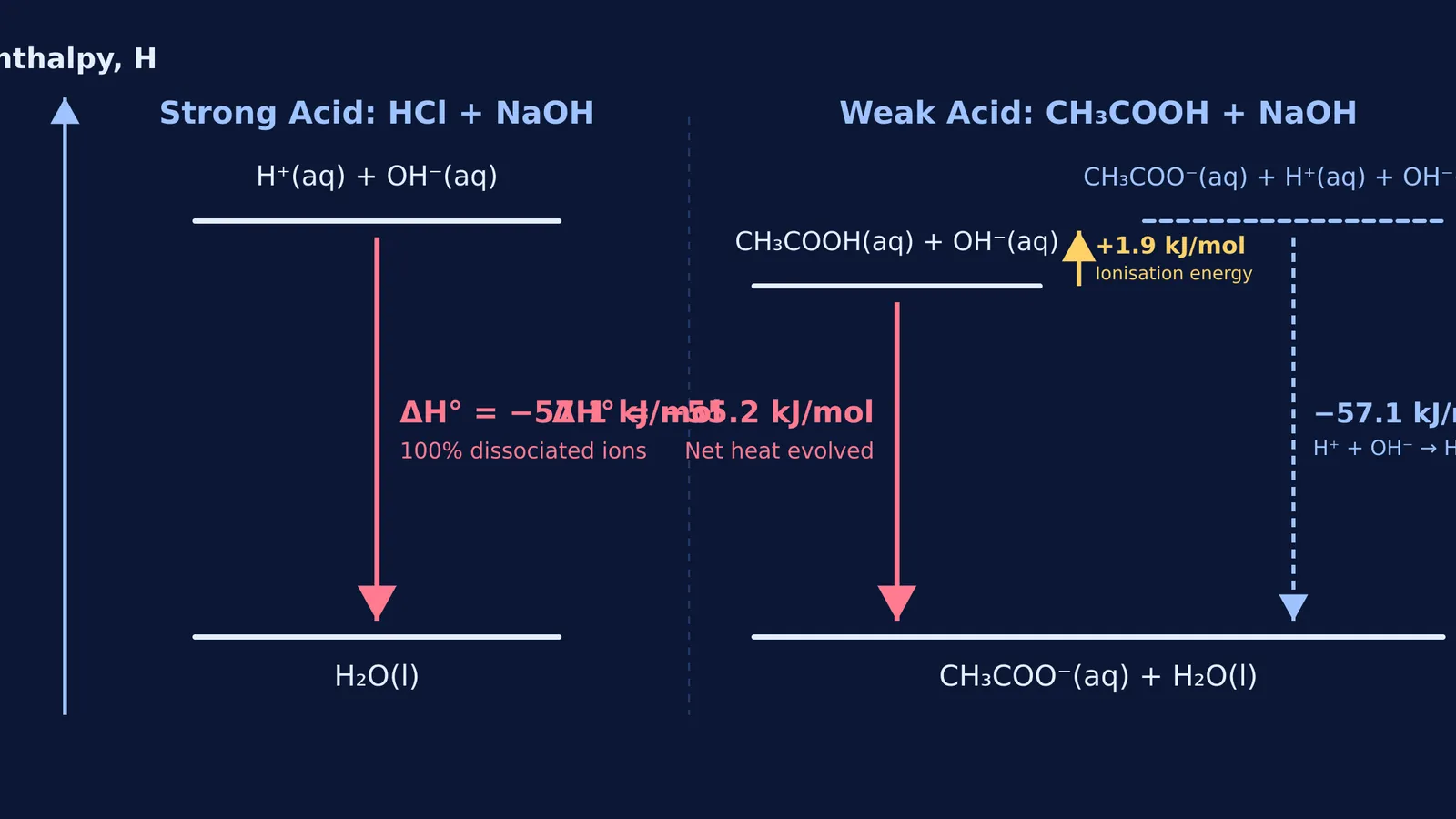
In his 1903 Nobel Lecture, Swedish chemist Svante Arrhenius explained why this figure never wavers across different strong acid-base combinations. In dilute water solutions, strong acids and strong alkalis are already 100% dissociated into free ions. Sodium ions and chloride ions take no part in the chemical change; they remain spectator ions floating in solution. The only chemical transformation taking place is the combination of aqueous hydrogen ions and hydroxide ions to form liquid water:
H⁺(aq) + OH⁻(aq) → H₂O(l) ΔH° = -57.1 kJ/mol
Because every strong acid and strong base pair executes the identical net ionic reaction, the energy released per mole of water produced must be identical. To see how these ionic steps fit into broader thermochemical networks, examine Hess's law thermochemical cycles.
Why does neutralising a weak acid release less heat?
When you repeat the measurement using an equal concentration of acetic acid (ethanoic acid, CH₃COOH) and sodium hydroxide, the heat evolved is lower. Standard calorimetry measurements show that neutralising acetic acid yields approximately -55.2 kJ/mol (or -56.1 kJ/mol in dilute laboratory conditions documented by Chemguide). Why does replacing HCl with acetic acid make the reaction less exothermic?
The difference lies in how weak acids behave before the base is poured. Unlike hydrochloric acid, acetic acid is a weak electrolyte. In a typical 0.1 M or 1.0 M aqueous solution, more than 98% of the acetic acid molecules remain intact and unionised. They exist as neutral CH₃COOH molecules rather than separate ions.
When hydroxide ions are added, they rapidly consume the few existing H⁺ ions. By Le Chatelier's principle, the remaining undissociated CH₃COOH molecules must split apart to replenish the supply of protons. Breaking covalent O-H bonds and separating charged ions requires energy. This bond cleavage is an endothermic process called ionisation (or dissociation). Part of the 57.1 kJ/mol generated by forming water is directly diverted to pay for breaking apart the undissociated acid molecules.
How do you calculate the enthalpy of ionisation?
Because enthalpy is a state function—as tabulated in thermochemical references like Chemguide—we can break the overall neutralisation of a weak acid into two distinct, sequential thermodynamic stages:
Ionisation of the undissociated weak acid:
CH₃COOH(aq) → CH₃COO⁻(aq) + H⁺(aq) ΔH°_ion
Neutralisation of protons by hydroxide ions:
H⁺(aq) + OH⁻(aq) → H₂O(l) ΔH°_neut(strong) = -57.1 kJ/mol
Summing these two equations yields the overall neutralisation reaction: CH₃COOH(aq) + OH⁻(aq) → CH₃COO⁻(aq) + H₂O(l)
The net enthalpy of neutralisation is therefore: ΔH°_neut(weak) = ΔH°_ion + ΔH°_neut(strong)
Rearranging this relation allows you to determine the enthalpy of ionisation directly from calorimetric measurements: ΔH°_ion = ΔH°_neut(weak) - ΔH°_neut(strong)
Plugging in our reference values: ΔH°_ion = -55.2 kJ/mol - (-57.1 kJ/mol) = +1.9 kJ/mol
The positive sign confirms that ionising acetic acid in water is endothermic, requiring an input of 1.9 kJ per mole. When an acid is even weaker and holds its protons tighter, this required energy climbs dramatically. For instance, data from Chemguide shows that hydrocyanic acid (HCN) has an enthalpy of neutralisation of only -11.7 kJ/mol, meaning its enthalpy of ionisation is a steep +45.4 kJ/mol. You can review how dissociation constants govern these equilibria in our guide on conjugate acid-base equilibrium.
If you get stuck manipulating signs or setting up thermochemical cycle equations, the Fermi Problem Library has worked problems with a step-by-step solver that explains the reasoning rather than printing an answer.
What does an experimental test reveal in the lab?
You can verify this thermodynamic prediction directly at a school lab bench. In educational research published in the Journal of Chemical Education, A. M. R. P. Bopegedera and K. Nishanthi R. Perera detailed how coffee-cup calorimetry reliably measures reaction enthalpies using everyday insulation.
Here is a worked experimental test:
Take 100 mL of 1.0 M HCl and 100 mL of 1.0 M NaOH, both stabilised at 25.0 °C.
Mix them rapidly in an insulated calorimeter cup. The reaction forms 0.10 mol of water in 200 g of solution (density ≈ 1.0 g/mL, specific heat c = 4.184 J/(g·°C)).
Heat released: q = 0.10 mol × 57.1 kJ/mol = 5.71 kJ = 5710 J.
Predicted temperature rise: ΔT = q / (m × c) = 5710 / (200 × 4.184) = 6.82 °C.
Now repeat the run under identical conditions using 100 mL of 1.0 M CH₃COOH instead of HCl:
Heat released: q = 0.10 mol × 55.2 kJ/mol = 5.52 kJ = 5520 J.
Predicted temperature rise: ΔT = 5520 / (200 × 4.184) = 6.60 °C.
The difference in temperature rise (6.82 °C - 6.60 °C = 0.22 °C) directly tracks the 190 J absorbed to ionise 0.10 mol of acetic acid molecules. Dividing 190 J by 0.10 mol gives 1.9 kJ/mol. Compare this method with the standard protocol in our enthalpy of neutralisation practical.
If you want to observe dynamic equilibrium shifts and molecular dissociation before running physical bench tests, the Fermi Simulation Lab provides interactive simulations for the ideas that are easier to see than to read.


