On this page
Your NCERT book gives Cu²⁺ a spin-only magnetic moment of 1.73 BM, because a d⁹ ion has one unpaired electron. Measured values for copper(II) compounds usually come out a little higher. In 1955, a physicist printed as Miss K. Sundaramma, at the Indian Institute of Science, Bangalore, measured the number that explains the gap. She put copper(II) oxalates and other cupric salts in a microwave cavity and found their g values, about 2.07 to 2.13 for the oxalate powders. A g value above 2 is the sign that a little orbital motion survives, and that is enough to push the moment above 1.73 BM.
Who was Miss K. Sundaramma, and where is the paper?
The paper is "Paramagnetic resonance in some cupric salts", received on 18 November 1955 and communicated by Professor R. S. Krishnan. It was printed in the Proceedings of the Indian Academy of Sciences, Section A, vol. 42, pp. 292–302 (doi:10.1007/BF03053531). The byline reads "Miss K. Sundaramma", Department of Physics, Indian Institute of Science, Bangalore, and the running heads repeat it. She thanks Krishnan for his interest, Dr. G. Suryan for suggesting the problem, and Dr. R. V. G. Sundara Rao for the X-ray cell dimensions of one crystal. We have not verified anything about her life beyond what the paper prints, so we leave it out.
What is paramagnetic resonance?
Her introduction credits Zavoisky with discovering, in 1945, that paramagnetic substances absorb very high frequency waves at a particular magnetic field. In a magnetic field, an unpaired electron's spin can point with the field or against it, and these two states differ in energy. Microwaves of the right frequency flip it. The condition she writes is
hν = gβH
where ν is the microwave frequency, β is the Bohr magneton, H is the field at resonance, and g is the spectroscopic splitting factor. For a free electron, g is about 2.0023 (standard value, not from her paper). Any departure from that tells you something about the electron's surroundings.
Her set-up, as described:
A klystron fed microwaves through a waveguide into a cavity resonator, at 8820–8970 megacycles per second (about 8.8–9.0 GHz).
At resonance the sample absorbed energy, and the galvanometer reading the cavity output dipped.
The magnet was calibrated with proton magnetic resonance and checked against manganous salts of known g.
What g values did she find for copper(II) salts?
Her Table I, for powders:
Cupric oxalate: g = 2.12, line width 720 gauss.
Cupric sodium oxalate: g = 2.07, 325 gauss.
Cupric potassium oxalate dihydrate: g = 2.13, 270 gauss.
Cupric ammonium oxalate dihydrate: g = 2.1, 200 gauss.
For cupric formate tetrahydrate powder she found g = 2.2 with a 400 gauss width, against 2.2 and 500 gauss from Lancaster and Gordy in 1951. For cupric oxalate, Lancaster and Gordy had reported 2.07 and 120 gauss, so her 2.12 did not match theirs.
Single crystals told more. In one plane of a cupric formate tetrahydrate crystal, g changed from 2.09 to 2.28. A g value that depends on direction means the copper ion does not sit in a perfectly symmetric field; she describes the six oxygens round each Cu²⁺ as a slightly stretched octahedron.
Cupric butyrate monohydrate gave no resonance at all between 0 and 4500 gauss. She compared it with copper acetate, which Bleaney and Bowers had found anomalous in 1952, and left it for further work. Today copper(II) acetate is taught as a dimer in which the two Cu²⁺ spins couple strongly; that is modern background, not her claim.
How did she make the oxalato complexes?
Her preparations show a ligand-excess effect, like Cu²⁺ with ammonia. Adding an oxalate to a cupric salt first precipitates cupric oxalate. With excess oxalate, the precipitate redissolves to a blue solution, from which the double salts crystallise. In modern notation (our writing, not hers):
Cu²⁺ + C₂O₄²⁻ → CuC₂O₄(s)
CuC₂O₄ + C₂O₄²⁻ → [Cu(C₂O₄)₂]²⁻
Oxalate is a bidentate ligand, so two of them fill four positions round copper. The formula she prints for the ammonium salt is Cu(NH₄)₂(C₂O₄)₂·2H₂O, which you would name ammonium bis(oxalato)cuprate(II) dihydrate. She reports the potassium dihydrate as isomorphous with it.
Why does Cu²⁺ read above the spin-only 1.73 BM?
The spin-only formula, μ = √[n(n + 2)] BM, assumes the electron's orbital motion is completely quenched by the ligands. For n = 1, μ = √3 = 1.73 BM. The background is in the spin-only magnetic moment.
Spin-orbit coupling mixes a little orbital motion back in. Her introduction says g moves away from 2 by an amount set by the ratio of the spin-orbit coupling to the crystal-field splitting. For Cu²⁺ the shift is upward, and she measured g between about 2.07 and 2.2 for these powders.
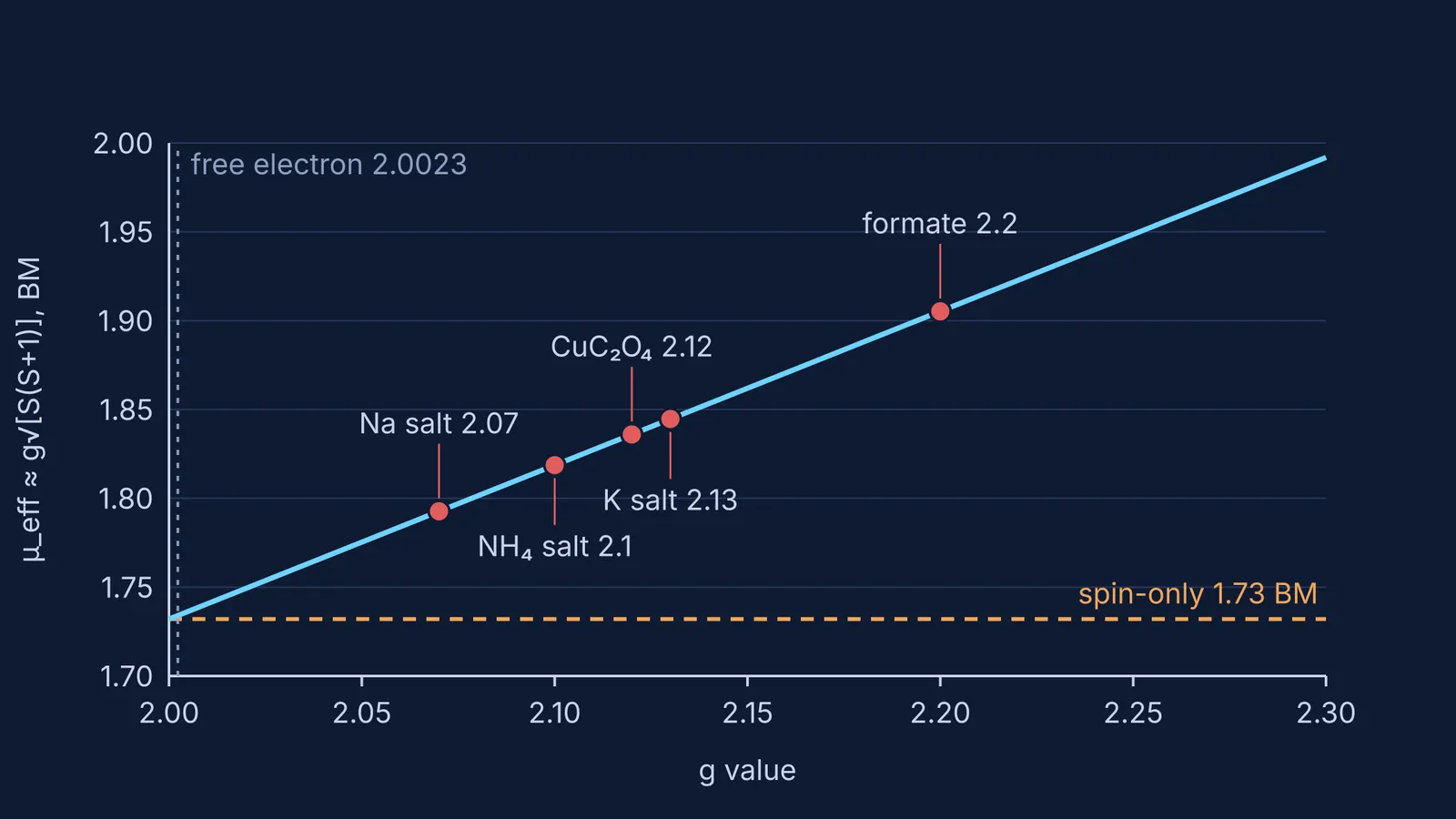
To turn g into a moment we use a standard approximation that is not in her paper: μ_eff ≈ g√[S(S + 1)] BM, with S = ½ for one unpaired electron. It is an approximation because the g from resonance and the moment from a susceptibility balance are not always identical. Check: g = 2 gives 2 × √0.75 = 1.73 BM, exactly the spin-only value. So the spin-only formula is the g = 2 case.
Worked example: from microwave field to magnetic moment
Our calculation, using h = 6.626 × 10⁻³⁴ J s, β = 9.274 × 10⁻²⁴ J T⁻¹ and ν = 8.9 GHz (inside her band).
Free electron, g = 2.0023. H = hν ÷ (gβ) = (6.626 × 10⁻³⁴ × 8.9 × 10⁹) ÷ (2.0023 × 9.274 × 10⁻²⁴) = 0.3176 T = 3176 gauss.
Her cupric oxalate, g = 2.12. H = 0.2999 T, about 3000 gauss. A larger g means resonance at a lower field.
Cupric formate, g = 2.2. H ≈ 2890 gauss. All three sit in the 2000–4000 gauss window of her Figure 1.
Moments (approximation above). √0.75 = 0.866. g = 2.07 gives 1.79 BM; g = 2.12 gives 1.84 BM; g = 2.2 gives 1.91 BM.
Compare. g = 2.12 gives a moment 6% above 1.73 BM, because μ_eff scales directly with g (2.12 ÷ 2 = 1.06).
Where does this come up in JEE and NEET?
Class 12 d- and f-block elements and coordination compounds: Cu²⁺ is d⁹ with one unpaired electron and a spin-only moment of 1.73 BM; oxalate is a bidentate ligand; naming K₂[Cu(C₂O₄)₂]. Using moments to decide geometry is covered in how to find hybridisation from a magnetic moment.
Physics overlap: E = hν and the Bohr magneton.
The splitting of d orbitals by ligands, which sets how much orbital motion is quenched, goes back to Hans Bethe's crystal field.
To connect magnetism, crystal fields and electron configuration in one place, the Concept Library gives each idea its own lesson. For d-block practice aimed at the exam, Fermi's AI tutor for JEE prep is part of Fermi Test Prep for JEE Main and Advanced.
Quick checklist
Resonance condition: hν = gβH. Free electron g ≈ 2.0023.
Her copper(II) oxalate powders: g = 2.07–2.13; cupric formate 2.2.
g above 2 means some orbital motion survives.
μ_eff ≈ g√[S(S + 1)] is a standard approximation, not from her paper; g = 2 gives 1.73 BM.
Cu²⁺ is still one unpaired electron even when it reads 1.8–1.9 BM.