On this page
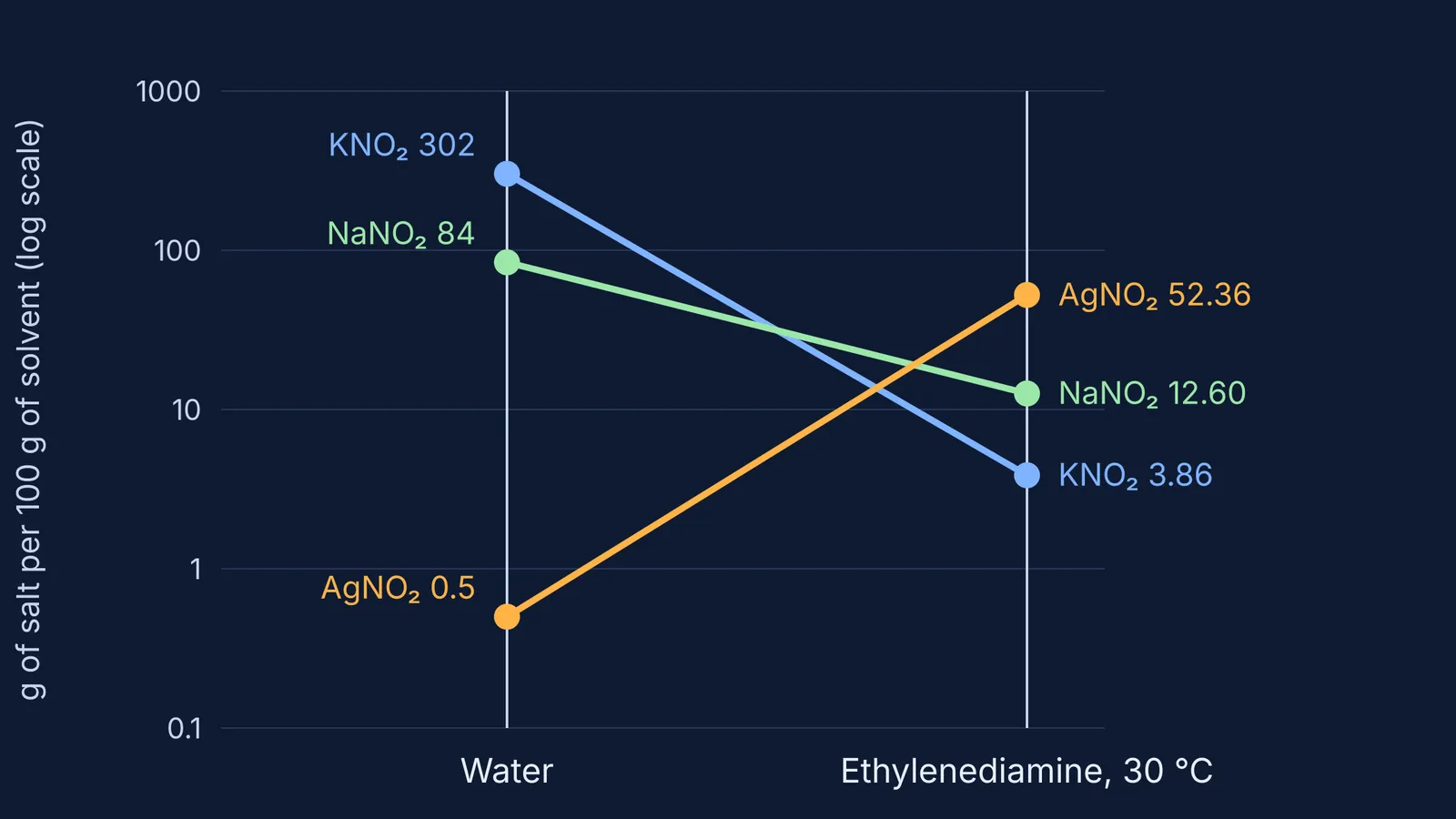
In water, potassium nitrite is far more soluble than silver nitrite. In 1957, T. Muniyappan and B. Anjaneyalu at Presidency College, Madras, changed the solvent to anhydrous ethylenediamine, the same molecule you meet as the ligand "en". The order turned upside down. Silver nitrite, which barely dissolves in water, dissolved more than any of the three nitrites they tested, and potassium nitrite dissolved least. Solubility belongs to a salt and a solvent together.
Who were Muniyappan and Anjaneyalu, and where is the paper?
The paper is T. Muniyappan and B. Anjaneyalu, "Investigations in non-aqueous solvents, Part III. Solubility and conductances of some metal nitrites in ethylenediamine and monoethanolamine", Proceedings of the Indian Academy of Sciences A, vol. 46, pp. 454–461. The byline reads Chemistry Department, Presidency College, Madras. It was received on 29 August 1957 and communicated by T. R. Govindachari. It was Part III of a programme on conductance and electrodeposition in non-aqueous solvents. We know nothing about the two authors beyond the printed byline, so we do not guess.
Their reason for trying amines was hydrogen bonding. Salts with XO₂⁻-type anions dissolve in ethylene glycol, and they argued that NH₂ groups behave much like OH groups, so ethylenediamine (H₂N–CH₂–CH₂–NH₂) and monoethanolamine (H₂N–CH₂–CH₂–OH) might do the same.
Anhydrous ethylenediamine is corrosive, and all their work was done in a dry box. This post covers the results only.
How soluble are the three nitrites in water and in ethylenediamine?
Table II of the paper, in grams of salt per 100 g of solvent:
KNO₂: water 302, ethylenediamine 3.86, monoethanolamine 4.52.
NaNO₂: water 84, ethylenediamine 12.60, monoethanolamine 8.74.
AgNO₂: water 0.5, ethylenediamine 52.36, monoethanolamine 70.53.
The amine values are their own measurements at 30 °C. The water values are literature figures quoted in the same table (20 °C for the sodium and potassium salts, 18 °C for silver nitrite), so they are a rough guide rather than a matched comparison.
In water the order is K > Na ≫ Ag. In both amines it is Ag > Na > K. Converting to molality (our calculation), silver nitrite goes from about 0.032 mol kg⁻¹ in water to 3.40 mol kg⁻¹ in ethylenediamine, about 105 times more. Potassium nitrite goes from 35.5 mol kg⁻¹ to 0.45 mol kg⁻¹, about 78 times less.
Only silver nitrite dissolved in the amines "with evolution of heat", giving a brownish-black solution.
Why does silver nitrite dissolve so well in ethylenediamine?
The authors gave two reasons. Ag⁺ is "acidic": it attracts the lone pairs of a basic solvent. K⁺, by contrast, has a poor tendency to associate with basic solvents. They also pointed to structural differences between silver and alkali nitrites.
Their strongest evidence is a solid. A saturated solution of silver nitrite in ethylenediamine, left to stand, deposited colourless crystals. Analysis fitted the formula AgNO₂·2en, where en is C₂H₄(NH₂)₂. In monoethanolamine a white solid formed as well; they did not analyse it, but noted that traces of moisture turned it into shining metallic silver. Their conclusion was that the very high solubility comes from the solid in contact with the solution being a solvate.
Here is the same idea in modern terms (our reasoning, not the paper's):
Dissolving is a trade. A salt dissolves when the energy released as the solvent binds the ions can pay back the lattice energy. See lattice enthalpy versus hydration enthalpy.
Water does not pay enough for Ag⁺. In water, hydration of Ag⁺ and NO₂⁻ does not beat the AgNO₂ lattice, so very little dissolves.
Amine nitrogen binds Ag⁺ strongly. You have seen this before: AgCl dissolves in aqueous ammonia because Ag⁺ forms [Ag(NH₃)₂]⁺, as in why AgCl dissolves in ammonia solution. Ethylenediamine is the textbook didentate N-donor, as explained in ligands, denticity and the chelate effect.
K⁺ and Na⁺ bind amines weakly. Water solvates them far better than an amine does, so they dissolve well in water and poorly in ethylenediamine.
The paper gives only the formula and analysis of AgNO₂·2en, not a structure, so we do not draw one. It also mentions the ammonates AgNO₂·nNH₃, with n = 1, 2 and 3.
What did the conductance measurements show?
Three findings:
Except for KNO₂, the salts conducted better in ethylenediamine than in the far more viscous monoethanolamine (15.4 against 193.5 millipoise).
Silver nitrite conducted better than sodium nitrite, and potassium nitrite least, in both solvents.
For sodium nitrite in ethylenediamine, the equivalent conductance did not rise steadily on dilution. It passed through a minimum at 0.0676 equivalents per litre.
Their explanation follows Fuoss and Kraus. Ethylenediamine has a low dielectric constant, 12.9 (water is about 78), so ions stick together as neutral ion pairs that carry no current. At higher concentration, triple ions such as + − + form; they carry a charge, so conductance rises again. In monoethanolamine (dielectric constant 37.72) Walden's rule puts the minimum at 0.0676 × (37.72 ÷ 12.9)³ = 1.69 equivalents per litre, beyond the 1.284 that dissolves, so none was seen. In water, molar conductivity rises on dilution just as Class 12 teaches; this is a low-dielectric solvent.
Worked example: does the analysis fit AgNO₂·2en?
Question. The crystals contained 39.16% Ag and 43.11% ethylenediamine by mass. Show that this fits AgNO₂·2en, and find how much of 100 g of ethylenediamine a saturated solution would tie up if every dissolved AgNO₂ held two en. (Ag = 107.87, N = 14.01, O = 16.00, C = 12.01, H = 1.008.)
M(en). C₂H₈N₂ = 2 × 12.01 + 8 × 1.008 + 2 × 14.01 = 60.10 g mol⁻¹.
M(AgNO₂). 107.87 + 14.01 + 2 × 16.00 = 153.88 g mol⁻¹.
M(solvate). 153.88 + 2 × 60.10 = 274.08 g mol⁻¹.
Calculated %Ag. 107.87 ÷ 274.08 × 100 = 39.36%. The paper calculated 39.37% and found 39.16%.
Calculated %en. 120.20 ÷ 274.08 × 100 = 43.86%. The paper calculated 43.84% and found 43.11%.
Mole ratio from the found values. en : Ag = (43.11 ÷ 60.10) : (39.16 ÷ 107.87) = 0.7173 : 0.3630 = 1.98 : 1. Two en per silver.
How much solvent is bound? 52.36 g of AgNO₂ is 52.36 ÷ 153.88 = 0.3403 mol. Two en each is 0.6805 mol, or 0.6805 × 60.10 = 40.9 g. So about 41 of every 100 g of solvent would be held by silver. That is our calculation; the paper does not say how the dissolved silver is bound.
For more percentage-composition and formula problems, the Fermi Problem Library has a step-by-step solver that explains the reasoning.
Where does this come up in JEE and NEET?
Exam line: Class 12 Coordination Compounds (en as a didentate ligand, silver–amine complexes, complex formation raising solubility), Class 11 Equilibrium (solubility depends on the solvent as well as the salt) and Class 12 Electrochemistry (conductance and dilution). The Concept Library on Fermi Test Prep covers each of these ideas, for JEE Main and Advanced revision.
Quick checklist
Water: KNO₂ 302 > NaNO₂ 84 ≫ AgNO₂ 0.5 g per 100 g.
Ethylenediamine at 30 °C: AgNO₂ 52.36 > NaNO₂ 12.60 > KNO₂ 3.86 g per 100 g.
Silver nitrite dissolves with heat and crystallises as AgNO₂·2en (Ag 39.36% calculated, 39.16% found).
Ag⁺ binds amine nitrogen strongly; K⁺ and Na⁺ do not.
Low dielectric constant means ion pairs and a conductance minimum for NaNO₂ in en.
Solubility is a property of the salt and the solvent together.