On this page
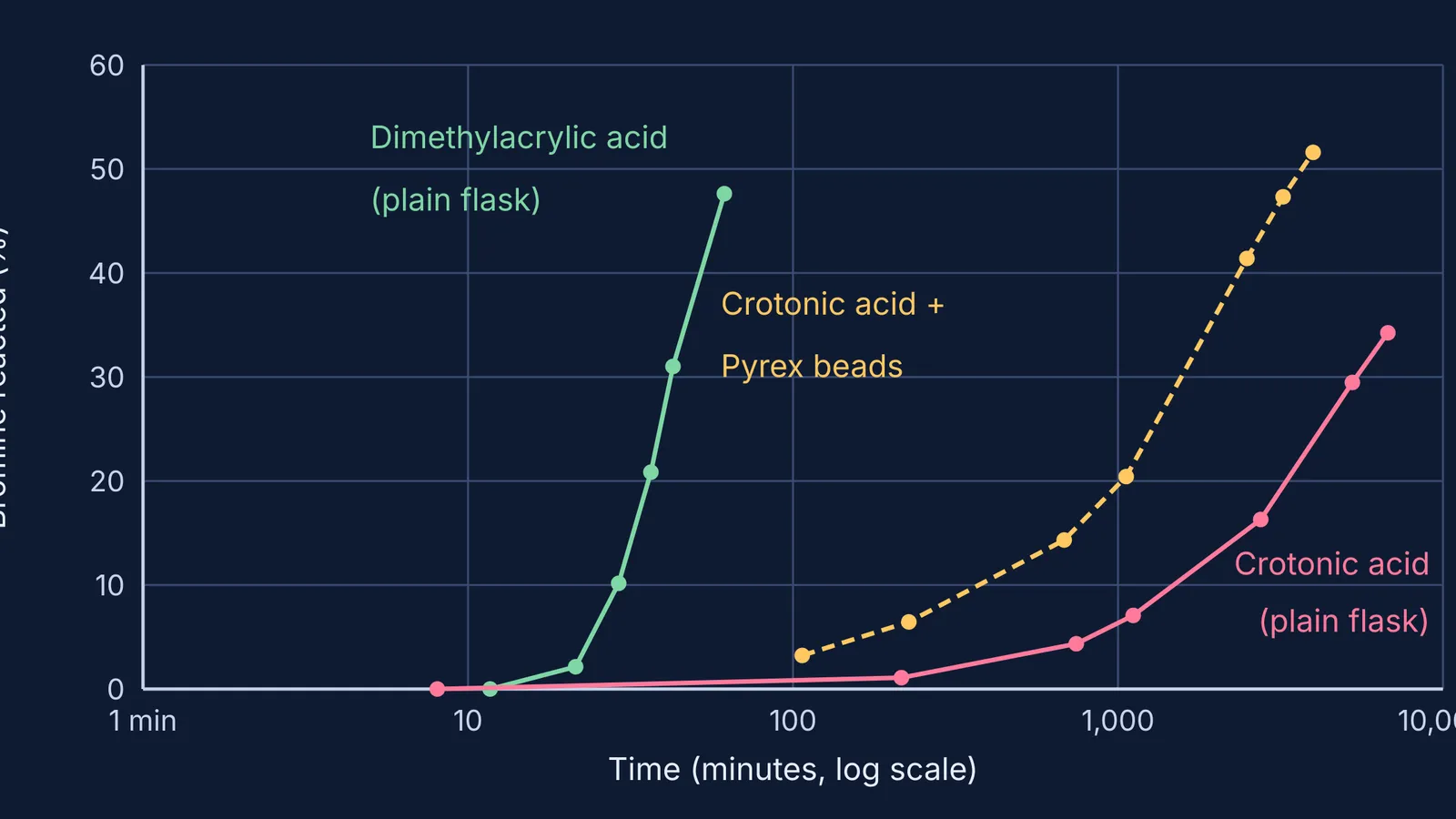
Bromine decolourising an alkene looks instant in a test tube. In 1954 two chemists at Madras Christian College, Tambaram, timed the same reaction with two unsaturated acids in carbon tetrachloride, in the dark. With crotonic acid it took days to get a third of the way. With dimethylacrylic acid, which has one extra methyl group on the double bond, nearly half the bromine was gone in an hour. Packing the flask with glass beads also made the slow reaction faster.
Who ran the experiment and what did they measure?
The paper is I. M. Mathai and S. V. Anantakrishnan, "Kinetics of the olefine-bromine reaction, Part VII", Proceedings of the Indian Academy of Sciences A, 40, 47–56 (1954). The full text is on the Academy's site. The byline is the Department of Chemistry, Madras Christian College, Tambaram, and a footnote says the work is based on Mathai's M.Sc. thesis for Madras University. We have written about an earlier paper by the same group in Anantakrishnan's 1941 work on chloro esters.
The two alkenes were:
trans-Crotonic acid, CH₃CH=CHCOOH (trans-but-2-enoic acid). The C=C carries one methyl group and one COOH.
Dimethylacrylic acid, (CH₃)₂C=CHCOOH (3-methylbut-2-enoic acid). The paper calls it "2 : 2 dimethyl acrylic acid". The C=C carries two methyl groups and one COOH.
The authors followed each reaction by taking out samples and titrating the unreacted bromine with iodide and thiosulphate.
How slow was bromine with crotonic acid?
All the figures below are from the paper's Tables I and II, at 35.1 °C, for the runs with no beads added.
Crotonic acid, 0.1 M: 42.6% of the bromine had reacted after 8,102 minutes, about 5.6 days.
Crotonic acid, 0.05 M: nothing measurable after 8 minutes and about 1% after 215 minutes. It reached 34% after 6,768 minutes, about 4.7 days.
Dimethylacrylic acid, 0.05 M: 47.6% after 61.5 minutes.
The slow start is an induction period. The authors saw it with both acids and found it sensitive to concentration and to the structure of the alkene.
Why do the extra methyl groups speed up bromine addition?
The paper itself says "consideration of structural factors may be deferred", so the explanation in this section is the standard textbook reasoning, not the authors' own.
Bromine adds to a C=C by electrophilic addition. The π electrons attack Br₂, a bromide ion leaves, and a positively charged intermediate forms (a bromonium ion; see why bromine adds anti through the bromonium ion). Anything that makes the π bond richer in electrons, or that stabilises the positive charge building up on carbon, makes this step faster.
Methyl groups donate electrons by the +I effect and by hyperconjugation. Dimethylacrylic acid has two methyls on the same alkene carbon, crotonic acid only one. The positive charge in the intermediate is better stabilised on a carbon carrying two methyls.
The COOH group withdraws electrons. It pulls π density away from the double bond by its –I and –M effects, so both acids react far more slowly than a simple alkene would. In crotonic acid there is less alkyl donation to offset it.
This matches the textbook order: a trisubstituted alkene (dimethylacrylic acid) adds faster than a 1,2-disubstituted one (crotonic acid).
Why did the glass wall matter?
Carbon tetrachloride is non-polar. Breaking Br–Br into Br⁺-like and Br⁻ parts is a polar step, and a non-polar solvent does little to help it. The authors concluded that "the reaction requires a polar environment for initiation". In this solvent, the walls of the flask supply that environment.
They tested this by packing the flask with beads:
Beads removed the induction period and made the reaction faster.
The order of effectiveness was Pyrex glass > fused silica > fused alumina.
Dry crystals of sodium bromide or barium sulphate also sped it up.
From the bead results they suggested that having both cations and anions on the surface helps.
For crotonic acid at 0.05 M, the plain flask had reached 16.3% after 2,749 minutes. With Pyrex beads it was at 41.4% after 2,494 minutes.
They suggested that a bromine molecule polarised at the surface might then start reaction in the solution too, but could not separate the two with their data.
Why is there no simple rate law here?
Their summary says the reaction "is found to be quite a complex one involving both homogeneous and heterogeneous phases". Two observations show why:
Dimethylacrylic acid speeds up with temperature in the usual way. With Pyrex beads at 0.05 M, the time for 50% reaction fell from 70.8 minutes at 30 °C to 30.4 minutes at 35 °C. That is 70.8 ÷ 30.4 = 2.3 times faster for 5 °C.
Crotonic acid showed "a small negative temperature coefficient". It was slightly slower when warmer, which a simple one-step reaction would not do.
So treat this paper as evidence about alkene reactivity and surface effects. Do not use it to practise finding an order.
Worked example: reading the bromine data
These are our calculations from the paper's tables.
Step 1. Per cent reacted from titres. The titre is proportional to the bromine left. For crotonic acid at 0.1 M, the titre fell from 9.40 mL at the start to 5.40 mL at 8,102 minutes. Per cent reacted = (9.40 − 5.40) ÷ 9.40 × 100 = 42.6%, as printed.
Step 2. Minutes to days. 8,102 ÷ 1,440 = 5.6 days. 6,768 ÷ 1,440 = 4.7 days.
Step 3. Compare at equal conversion. How long did dimethylacrylic acid take to reach 34.25%, the figure crotonic acid reached at 6,768 minutes? Its data bracket that value: 31.01% at 42.74 min and 47.62% at 61.50 min. By linear interpolation, t = 42.74 + (34.25 − 31.01) ÷ (47.62 − 31.01) × (61.50 − 42.74) = 46.4 minutes. Ratio: 6,768 ÷ 46.4 = 146. One extra methyl group made the reaction roughly 150 times faster in these conditions. (The printed titres for that crotonic acid row give 35.3% rather than 34.25%. Using 35.3% gives a ratio of about 142, so the conclusion does not change.)
Step 4. The surface effect. With Pyrex beads, crotonic acid reached 16.3% between 683 min (14.32%) and 1,060 min (20.43%). Interpolating gives about 805 minutes, against 2,749 minutes in the plain flask: about 3.4 times faster.
To revise inductive effects, hyperconjugation and electrophilic addition side by side, the Fermi Concept Library covers each idea. For practice on organic reactivity order questions, Fermi Test Prep offers JEE Main and Advanced preparation with an AI tutor.
Where does this fit in JEE and NEET chemistry?
Class 11 Hydrocarbons: electrophilic addition of halogens and the bromine test. Our post on testing for a double bond with bromine water and Baeyer's reagent covers what you see.
Class 11 Organic basics: +I effect, hyperconjugation and –I/–M effects.
Class 12 Kinetics: induction periods and surface (heterogeneous) catalysis.
Checklist
Crotonic acid has one methyl on the C=C; dimethylacrylic acid has two.
In CCl₄ at 35 °C, bromine took about 4.7 days to get 34% of the way with crotonic acid, and under an hour for the dimethyl acid.
Extra alkyl groups speed up electrophilic addition; COOH slows it (textbook reasoning).
In a non-polar solvent, a polar surface (Pyrex > silica > alumina) helped start the reaction.
The authors called the kinetics complex, so do not assign an order from this data.