On this page
Add hydrogen peroxide to a titanium(IV) solution and it turns yellow to orange. That colour is the textbook titanium test for H₂O₂. In 1956 D. P. Kharkar and C. C. Patel, of the Department of General Chemistry at the Indian Institute of Science, Bangalore, made a solid orange-red compound of this kind with oxalate, and asked two questions. Is the peroxide really bonded to titanium, or just H₂O₂ sitting in the crystal? And what is its molar mass in water? Their paper, "Peroxy titanium oxalate", is in the Proceedings of the Indian Academy of Sciences, Section A, volume 44, pages 287 to 306 (full text at the Indian Academy of Sciences). It was received on 14 September 1956.
What did Kharkar and Patel make?
Titanium hydroxide dissolved in excess oxalic acid gave an orange-red solution with H₂O₂. (The preparation used 30% H₂O₂ and titanium tetrachloride, both hazardous; we describe the chemistry only.)
The solid's composition depended on how much H₂O₂ was there; their Table I lists ten preparations. With a large excess of H₂O₂ (experiments 8 to 10), the solid came out as TiO₂C₂O₄·3.5H₂O. Here Ti : peroxide = 1 : 1, so you can read it as Ti(O₂)(C₂O₄)·3.5H₂O: one titanium, one peroxide group O₂²⁻ and one oxalate C₂O₄²⁻. With less H₂O₂ they got solids poorer in peroxide.
A spectrophotometer agreed: at the 425 nm absorption maximum, more H₂O₂ stopped changing the transmittance once Ti : peroxide reached 1 : 1.
The orange solid also faded on storage, to yellow and then to a yellowish-white basic oxalate, TiOC₂O₄·3.4H₂O, as it lost its peroxide oxygen.
Is it a true peroxide or H₂O₂ of crystallisation?
Many "per" salts are perhydrates: ordinary salts with H₂O₂ held in the crystal like water of crystallisation. A true peroxo compound has –O–O– bonded to the metal. Kharkar and Patel ran three tests:
Ether extract. Free H₂O₂ partly passes into ether. An ether extract of the solution gave no test for H₂O₂.
Vapour in vacuum. They pumped vapour off the solid at room temperature and froze it out. The condensate contained no H₂O₂ by the titanium sulphate test.
Iodide at pH 7.5 to 8. In a test credited to Krauss and Oettner and modified by Liebhafsky, a true peroxo compound liberates iodine from KI at this pH, while H₂O₂ of crystallisation gives oxygen. The complex gave iodine.
So the peroxide is bonded to titanium. The solid is also diamagnetic, which they checked with a Gouy balance; why peroxides behave this way in a magnet is covered in Savithri's 1942 Gouy-balance study of peroxides.
How does freezing point give the molar mass?
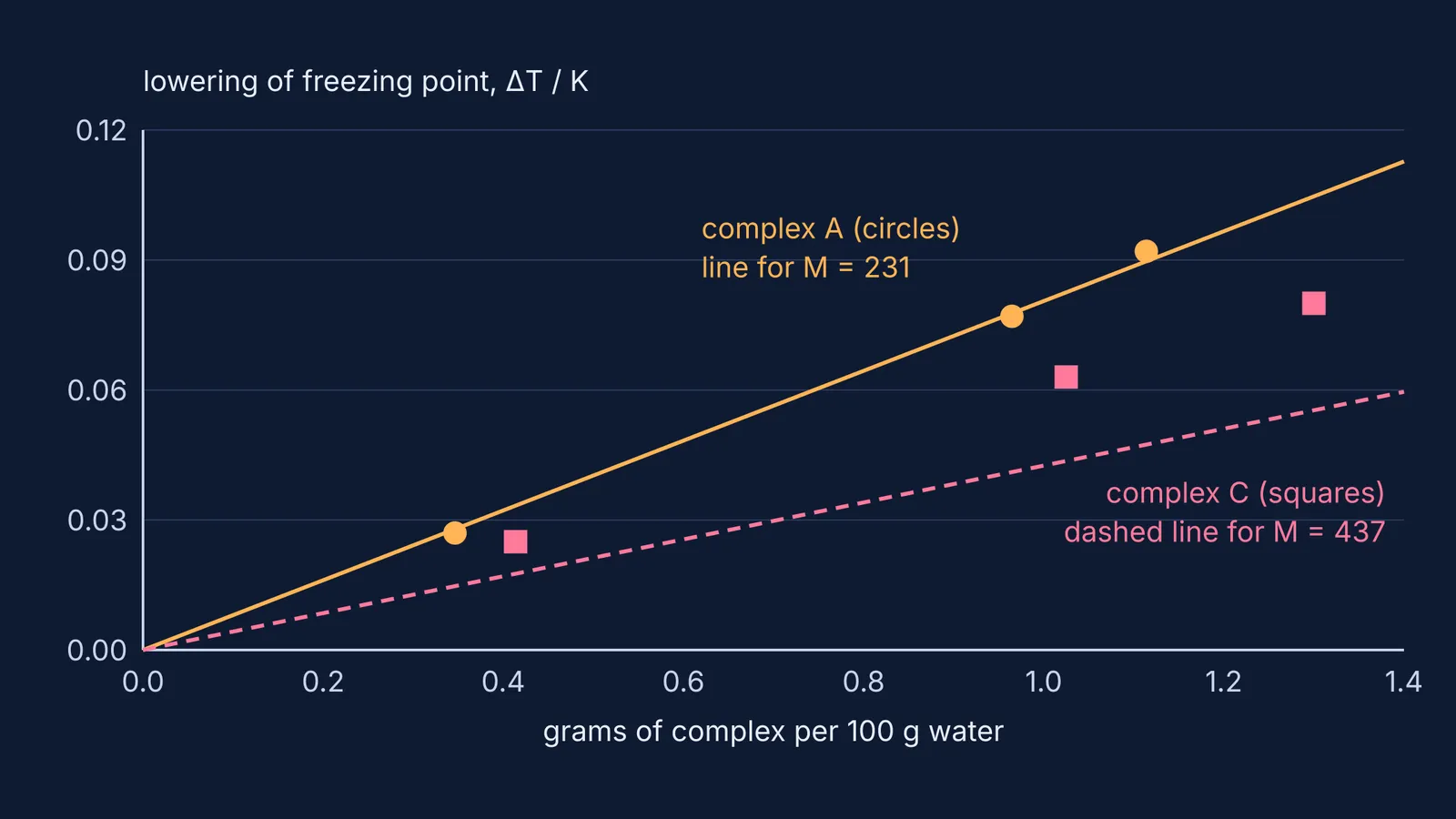
They measured the freezing-point depression of water with a Beckmann apparatus. For complex A, the purest sample, one run had 0.9647 g of complex per 100 g of water and ΔT = 0.077 K.
Worked example.
Formula mass (our calculation). Ti(O₂)(C₂O₄)·3.5H₂O = 47.87 + 32.00 + 88.02 + 63.05 = 230.9 g mol⁻¹. The paper gives 231.0.
Molality. 0.9647 g in 100 g water is 9.647 g per kg.
Use ΔT = Kf × m. m = ΔT/Kf, and M = (g per kg) ÷ m = Kf × 9.647/ΔT.
Put in numbers. With Kf = 1.86 K kg mol⁻¹, M = 1.86 × 9.647/0.077 = 233 g mol⁻¹.
Compare. The paper prints 231.5 for this run and a mean of 230.0 from three runs, against 231 for the formula. One particle per formula unit fits.
Our recalculation shows that complex A's printed values need Kf of about 1.83 to 1.85, while complexes B and C reproduce exactly with 1.86. The gap is only 1 to 2%, but it is there.
Samples made with less H₂O₂ did not fit. Complex C, written as Ti₂O₃(C₂O₄)₂·6.5H₂O, has a formula mass of 437, but its mean apparent molar mass was 304. Complex B gave 293 (its formula Ti₁.₅O₂.₅(C₂O₄)₁.₅·5.5H₂O works out to about 343 by our calculation; the table prints 243, which looks like a misprint, since the text says B came out lower than its formula). A low apparent molar mass means more particles than the formula suggests. The authors read B and C as mixtures of the peroxo complex with the basic oxalate, not single compounds.
One puzzle remained. Conductivity at 25 °C suggested the complex is about 50% dissociated (they compared its dissociation constant, about 4.5 × 10⁻², with oxalic acid's first constant, 5.9 × 10⁻²), yet the freezing point showed almost none. They suggested the lower temperature and the roughly 20 times higher concentration in the freezing-point runs suppressed dissociation. The method is the one in how to find molar mass from depression in freezing point.
How do you titrate peroxide and oxalate in one sample?
In dilute sulphuric acid the complex releases H₂O₂ and oxalic acid. Their analysis used two titrations.
Iodometry for peroxide. H₂O₂ + 2I⁻ + 2H⁺ → I₂ + 2H₂O, then I₂ + 2S₂O₃²⁻ → 2I⁻ + S₄O₆²⁻. They checked that iodine did not oxidise the oxalic acid under their conditions.
Permanganate for both. 2MnO₄⁻ + 5H₂O₂ + 6H⁺ → 2Mn²⁺ + 5O₂ + 8H₂O and 2MnO₄⁻ + 5H₂C₂O₄ + 6H⁺ → 2Mn²⁺ + 10CO₂ + 8H₂O.
The difference gives the oxalate.
A student problem built on their method (our numbers). Take 0.2310 g of pure complex, which is 1.000 mmol.
Peroxide: 1.000 mmol H₂O₂ gives 1.000 mmol I₂, which needs 2.000 mmol S₂O₃²⁻. With 0.1 M thiosulphate, that is 20.0 mL.
Permanganate: peroxide gives 2 electrons and oxalate gives 2 electrons, so 4.000 meq in all. MnO₄⁻ takes 5 electrons, so 0.800 mmol, or 40.0 mL of 0.02 M KMnO₄.
One side note. The permanganate titration of oxalate usually needs heating, but here it ran at room temperature, 23 °C. The authors put this down to Mn²⁺ formed quickly by the peroxide reaction, which then catalyses the oxalate step. That is the same autocatalysis behind why KMnO₄ fades slowly at first in oxalic acid titration.
Why is it coloured if Ti(IV) has no d electrons?
Ti⁴⁺ is d⁰, so there is no d–d transition. Our modern reading, not the paper's: the colour comes from charge transfer, where light moves an electron from the peroxide ligand to empty titanium orbitals. With every electron paired, a diamagnetic result is what you expect.
The structure they proposed in 1956 has titanium bound to the peroxide, a bidentate oxalate and water, with coordination number 6. Of the 3.5 H₂O, 1.5 were lost on evacuation (an 11.7% mass loss by our calculation) and 2 held firmly. Treat the structure as their proposal, not a settled result.
Exam line: for Class 12 Solutions and Redox, this paper shows molar mass from ΔT = Kf × m, an "abnormal" molar mass read as evidence of a mixture, and an n-factor titration of peroxide plus oxalate.
If n-factor and colligative numericals cost you marks, Fermi Test Prep is JEE Main and Advanced preparation with an AI tutor. For the ideas behind charge transfer and peroxo bonding, see the Concept Library.
Quick checklist
With excess H₂O₂ the orange solid is Ti(O₂)(C₂O₄)·3.5H₂O, M = 230.9 g mol⁻¹.
Ether extract, vacuum vapour and iodide at pH 7.5 to 8 showed a true peroxide, not a perhydrate.
Freezing point gave M = 230 against 231 for the formula; low apparent masses meant mixtures.
Iodometry counts peroxide; permanganate counts peroxide plus oxalate.
Ti(IV) is d⁰: the colour is charge transfer and the solid is diamagnetic.