On this page
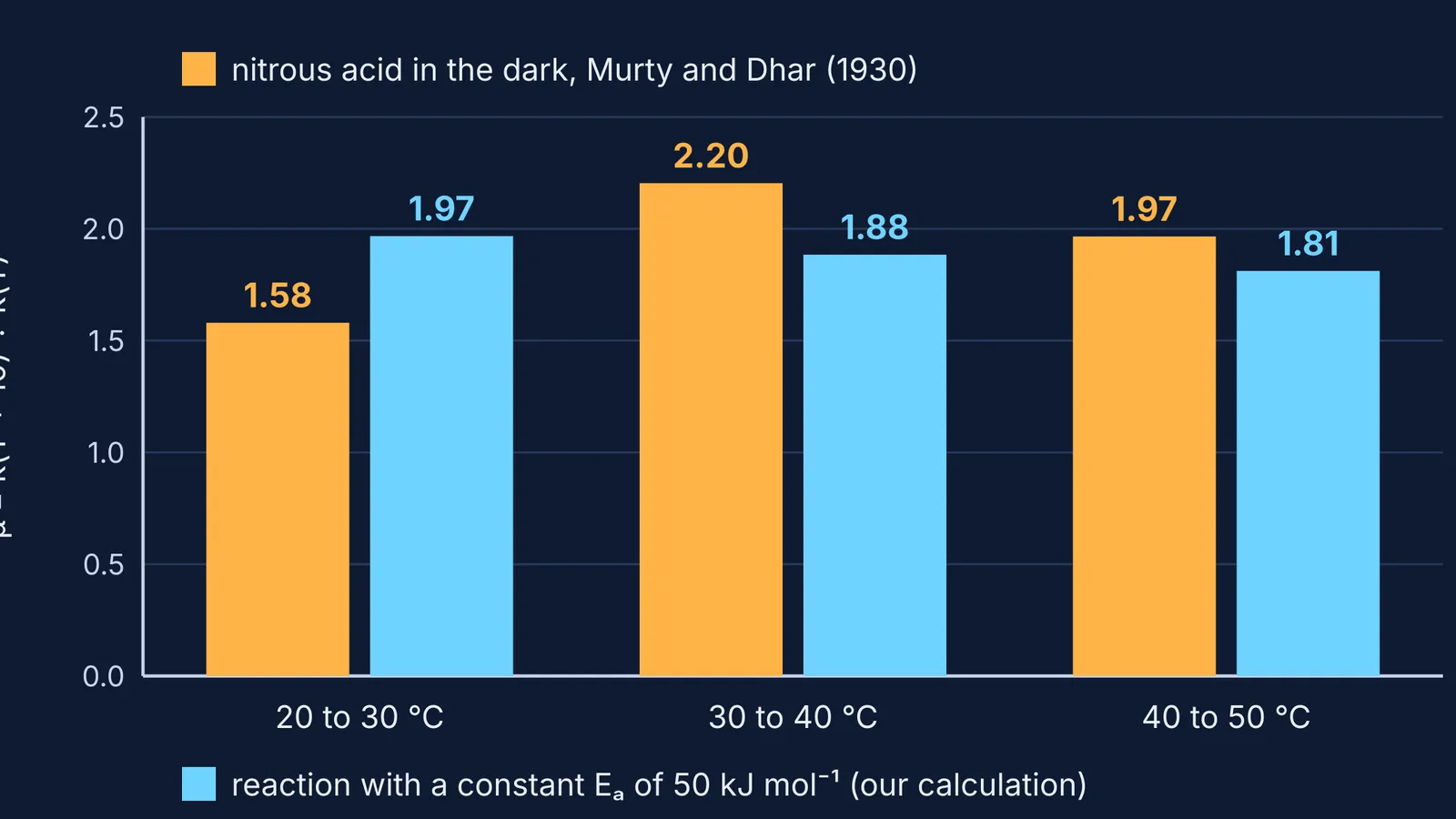
In 1930, K. S. Murty and N. R. Dhar, at the Chemical Laboratory of Allahabad University, timed how fast nitrous acid breaks down in the dark at 20, 30, 40 and 50 °C. For most reactions, each 10-degree step speeds things up slightly less than the one before. Murty's numbers went the other way: the rate grew 1.58 times from 20 to 30 °C, then 2.21 times from 30 to 40 °C. The explanation joins two chapters you study separately, kinetics and Le Chatelier's principle. One product is a gas, and it escapes faster from warm water.
Who were K. S. Murty and N. R. Dhar, and where is the paper?
The paper is K. S. Murty and N. R. Dhar, "The photochemical decomposition of nitrous acid", Journal of the Indian Chemical Society, vol. 7 (1930), pp. 985–990. The byline reads "K. S. Murty and N. R. Dhar", from the Chemical Laboratory, Allahabad University, received on 27 October 1930. We have found nothing about K. S. Murty beyond that byline, so we do not guess. His co-author is the subject of our profile of Nil Ratan Dhar's work on photochemistry and soil nitrogen.
As the title says, most of the paper is about light: how sunlight and lamp light of different colours speed the reaction up. This post uses only the experiments done in the dark. The tables for the light experiments could not be checked reliably in the scanned copy, so we leave them out.
What happens when nitrous acid decomposes?
Nitrous acid exists only in solution and breaks down on its own. The paper writes the reaction as reversible:
3HNO₂ ⇌ HNO₃ + 2NO + H₂O
It balances: 3 H, 3 N and 6 O on each side. It is a disproportionation. Nitrogen starts at +3 in HNO₂. One nitrogen rises to +5 in HNO₃, losing 2 electrons, and two fall to +2 in NO, gaining 1 each. If that pattern is new, see disproportionation and comproportionation reactions.
They used a cubical quartz cell with 4 cm sides and followed the reaction by measuring the nitrous acid left with permanganate. The standard textbook equation for that titration, not printed in the paper, is 2MnO₄⁻ + 5HNO₂ + H⁺ → 2Mn²⁺ + 5NO₃⁻ + 3H₂O. It balances in atoms and in charge (−1 on each side).
What did the dark experiments show?
Their Table I gives first-order ("monomolecular") rate constants:
20 °C: 0.001882
30 °C: 0.002973
40 °C: 0.006552
50 °C: 0.012880
The units of time are not printed. Below the constants they print temperature coefficients of 1.58, 2.21 and 1.95. Their discussion gives the last one as 1.96. Dividing their own constants, we get 1.580, 2.204 and 1.966, so the printed 2.21 and 1.95 are slightly off in the last digit.
They cite the same pattern in earlier work: Ray, Dey and Ghosh in 1917, and Mukerji and Dhar in 1925, whose ratios they quote as 1.1 (10 to 20 °C), 1.5 (20 to 30 °C) and 1.9 (30 to 40 °C). The 1925 work, as they describe it, also found rate constants 200 to 400 per cent greater in open vessels than in closed ones, and put this down to nitric oxide escaping.
Why does the temperature coefficient usually fall as temperature rises?
The temperature coefficient is μ = k(T + 10) ÷ k(T). From the Arrhenius equation, ln μ = (Eₐ/R)[1/T − 1/(T + 10)]. The bracket equals 10 ÷ [T(T + 10)], which shrinks as T grows. So for a reaction with a fixed activation energy, each 10-degree step gives a slightly smaller boost than the one before. Our calculation for Eₐ = 50 kJ mol⁻¹ over the same three intervals gives μ = 1.97, 1.88 and 1.81. The background is in why rates roughly double every 10 °C.
Murty and Dhar knew this. They wrote that the rise "would seem anomalous, as the temperature coefficient of most thermal reactions falls with temperature".
Why did warm nitrous acid speed up more than expected?
Their answer, in their own words: "Any factor facilitating the escape of nitric oxide will produce an increase in the rate of decomposition of nitrous acid. The solubility of nitric oxide diminishes with the temperature." So two effects add up as the solution warms:
The ordinary effect. More molecules have enough energy to react, as in any reaction.
The extra pull. NO is a gas that is less soluble in warm water, so more of it leaves the solution. Removing a product drags the equilibrium to the right, which is Le Chatelier's principle.
In modern terms (our framing, not theirs), the "rate constant" they measured is an apparent one. It describes how fast HNO₂ disappears under their conditions, and those conditions change with temperature because the gas escapes more easily. That is why you should not say the Arrhenius equation fails here. It describes one step with a fixed Eₐ; this measurement mixes kinetics with a shifting equilibrium. The paper also notes a "slight fall" in μ from 40 to 50 °C, without explaining it, and we do not either.
Worked example: what activation energy does each interval imply?
Use Eₐ = R ln μ ÷ (1/T₁ − 1/T₂), with R = 8.314 J mol⁻¹ K⁻¹ and T in kelvin. Our calculation.
20 to 30 °C. μ = 0.002973 ÷ 0.001882 = 1.580. 1/293.15 − 1/303.15 = 1.125 × 10⁻⁴ K⁻¹. Eₐ = 8.314 × ln 1.580 ÷ (1.125 × 10⁻⁴) = 8.314 × 0.457 ÷ (1.125 × 10⁻⁴) = 33.8 kJ mol⁻¹.
30 to 40 °C. μ = 2.204, and 1/303.15 − 1/313.15 = 1.053 × 10⁻⁴ K⁻¹. Eₐ = 62.4 kJ mol⁻¹.
40 to 50 °C. μ = 1.966, giving Eₐ = 56.9 kJ mol⁻¹.
Compare. A single step has a single Eₐ. Three values from 34 to 62 kJ mol⁻¹ tell you something besides the ordinary temperature effect is changing.
Predict and check. Using 33.8 kJ mol⁻¹ from the first interval, the Arrhenius equation predicts k at 50 °C as 0.00682. The measured value, 0.01288, is 1.89 times larger.
Half-life. From 20 to 50 °C, k rises 0.01288 ÷ 0.001882 = 6.84 times. For a first-order reaction, t½ = 0.693 ÷ k, so the half-life falls by the same factor, whatever the time unit.
Where does this come up in JEE and NEET?
Exam line: this links Class 12 Chemical Kinetics (temperature coefficient and Eₐ from two temperatures) with Class 11 Equilibrium (Le Chatelier's principle) and Redox (disproportionation of HNO₂).
To see how each of these ideas works on its own, the Concept Library gives each one its own lesson. For kinetics practice aimed at the exam, Fermi's AI tutor for JEE prep is part of Fermi Test Prep for JEE Main and Advanced.
Quick checklist
3HNO₂ ⇌ HNO₃ + 2NO + H₂O: N goes from +3 to +5 and +2.
Murty and Dhar's dark rate constants rose 6.84 times from 20 to 50 °C.
μ went 1.58, then 2.20, then 1.97 (recalculated), instead of falling steadily.
Their reason: NO is less soluble when warm, escapes faster and pulls the reaction forward.
Apparent Eₐ of 34, 62 and 57 kJ mol⁻¹ for the three intervals.
The Arrhenius equation still holds for one step; this rate mixes kinetics with equilibrium.