On this page
In 1963 a laboratory in Bombay began dating Indian archaeological sites in India. The first author of both papers that reported it is printed as "S. Kusumgar (Miss)". Every date in them rests on the first-order rate law from your Class 12 kinetics chapter, and on a chain of reactions that turns charcoal into acetylene.
Who were Kusumgar, Lal and Sarna, and where are the papers?
Two papers appeared together in the Proceedings of the Indian Academy of Sciences, Section A, vol. 58 (1963), both received on 31 May 1963:
Radiocarbon dating: Techniques, by S. Kusumgar (Miss), D. Lal and V. K. Sharma, pp. 125–140.
Radiocarbon dating: Results, by S. Kusumgar (Miss), D. Lal and R. P. Sarna, pp. 141–152.
The printed affiliation is the Tata Institute of Fundamental Research (TIFR), Bombay. The laboratory was set up "primarily as a national facility for archaeological studies", began work in August 1960 and was running by the end of August 1961. The first date list covers samples measured up to December 1962. The papers say nothing more about the authors, and we have not verified their careers elsewhere, so we leave biography out.
How did they turn charcoal into a gas they could count?
Carbon-14 is hard to count: living carbon gives only about 14 disintegrations per minute per gram, and the beta particles are weak (at most 156 keV). So the sample's carbon was turned into a gas inside the counter. They chose acetylene: each molecule carries two carbon atoms, and the counter tolerates small impurities in it far better than in CO₂.
The chain they used, as printed (each equation checked for balance):
Charcoal or wood is burnt to CO₂; for bone, acid releases CO₂ from carbonate.
CO₂ + 2NH₄OH → (NH₄)₂CO₃ + H₂O
(NH₄)₂CO₃ + SrCl₂ → SrCO₃ + 2NH₄Cl
2SrCO₃ + 5Mg → SrC₂ + SrO + 5MgO, at 600 °C in a closed vessel
SrC₂ + 2H₂O → C₂H₂ + Sr(OH)₂
Step 4 is a redox step (our electron count): carbon goes from +4 in carbonate to −1 in the carbide ion C₂²⁻, gaining 10 electrons for two carbons, and five Mg atoms give exactly 10. Step 5 is the reaction you learn for preparing ethyne from calcium carbide, with strontium instead.
The water for step 5 was distilled sea-water from one stock, to keep tritium contamination low and uniform, and the acetylene was stored for 2–3 weeks so any radon in it would decay. Acetylene is explosive, so the counter was filled only to 500 mm Hg.
How did the counter ignore cosmic rays?
The counter had two zones filled with the same gas: a central volume of 1.5 litres and an outer ring of 1.2 litres, separated by a thin plastic film. A carbon-14 beta particle is too weak to cross the film. A cosmic-ray muon is not, and fires both zones at once. The electronics kept only pulses from the centre with no matching pulse in the ring, and the whole counter sat inside mercury, borated paraffin, steel and lead.
Willard Libby's first tests of radiocarbon dating used the same idea, a ring of guard counters around the sample.
How is a radiocarbon age worked out from a count rate?
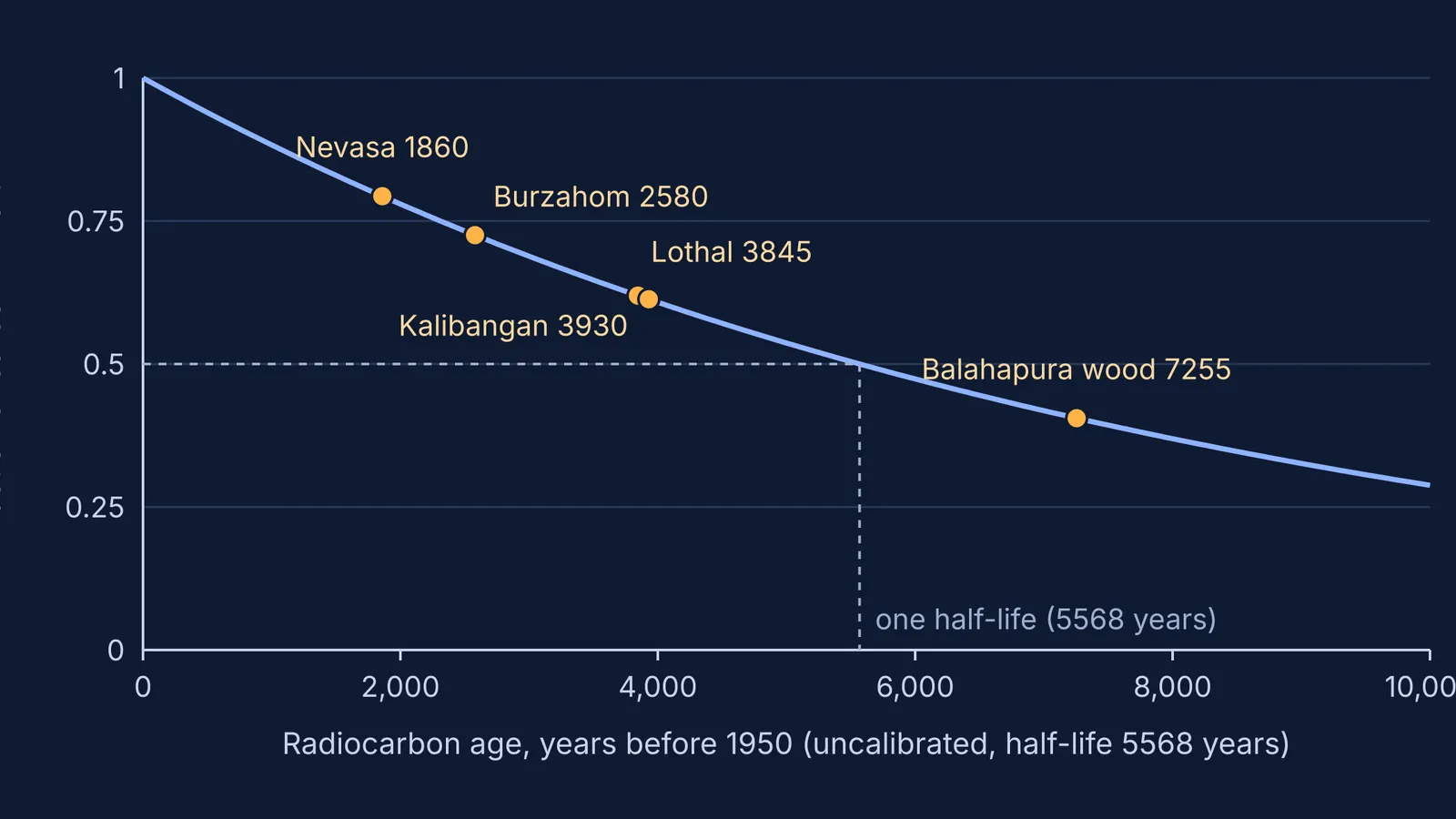
The papers use T = (T½/ln 2) × ln(0.95 Oₙ/Sₙ), where Oₙ is the net count rate of the international oxalic acid standard and Sₙ that of the sample. The factor 0.95 converts the standard to "modern" carbon, as agreed internationally in 1959. This is the NCERT first-order equation t = (2.303/k) log(A₀/A), with k = 0.693/T½.
With T½ = 5,568 years, the mean life T½/ln 2 is 8,033 years. So a 1% error in the measured activity moves the date by about 80 years, as the paper says.
Worked example: the Kalibangan date
The paper prints the date (3,930 ± 110 years) and the oxalic acid rate (12.25 counts per minute), but not the sample's count rate, so steps 2–3 are our back-calculation.
Modern rate. 0.95 × 12.25 = 11.64 counts per minute.
Fraction left. A/A₀ = e^(−0.6931 × 3930/5568) = 0.613.
Expected sample rate. 0.613 × 11.64 = 7.13 counts per minute.
Back to the age. T = 8,033 × ln(1/0.613) = 8,033 × 0.489 = about 3,930 years.
Other half-life. For 5,730 years, multiply by 5730/5568 = 1.029: 3,930 × 1.029 = 4,044. The paper prints 4,040.
As a "B.C." figure. 3,930 − 1,950 = about 1,980 radiocarbon years B.C. This is an uncalibrated radiocarbon age, not a calendar date.
The same check works on their modern standard (our calculation). Rosewood from about 1885–1895 counted 11.48 against 12.25 for oxalic acid, a ratio of 0.937. Corrected for about 70 years of decay, that is 0.945; the paper reports 94.6 ± 1.0%, against the agreed 95%.
For more first-order problems, see carbon-14 dating calculations step by step, or practise with Fermi's AI tutor for JEE prep, part of Fermi Test Prep for JEE Main and Advanced.
What did the dates say about Lothal and other Indian sites?
All figures are uncalibrated radiocarbon years before 1950 with T½ = 5,568; the 5,730-year values are in brackets.
Lothal, Harappan (six samples): 3,650 ± 135 to 3,845 ± 110 (3,750 to 3,960). Archaeologists had placed Period I at about 2500–1500 B.C. and Period II at 1500–1000 B.C. The authors comment that the upper levels of Period I and all of Period II had been dated too young.
Kalibangan, Harappan: 3,930 ± 110 (4,040 ± 115).
Burzahom, Kashmir, neolithic: 2,580 to 3,690.
Ahar, Rajasthan, copper age: 3,130 to 3,570. A sample from the top layer gave only 190 ± 90. Later digging found glass bangles and Muslim burials, which showed the mound had been reoccupied after the 14th–15th century A.D.
Nevasa, early historic: 1,675 to 1,860.
They concluded that the central Indian chalcolithic cultures, placed at about 1000 B.C., belong to the latter half of the second millennium B.C., and the Harappa culture ended appreciably earlier than archaeologists had estimated.
One misprint is worth knowing. Lothal sample TF-19 is printed "3650 ± 135 (3750 ± 40)". Converting the error, 135 × 1.029 = 139, so the bracket should read about ±140 (our check).
Could other laboratories reproduce the TIFR dates?
Yes, within the errors. For the same levels, the University of Pennsylvania got 3,936 ± 51 at Kalibangan (TIFR 3,930 ± 110) and 1,846 ± 106 at Nevasa (TIFR 1,860 ± 100).
TIFR also dated wood from the tomb of King Zoser in Egypt, the same sample (C-1) that Libby's Chicago group had dated. Chicago got 3,979 ± 350; TIFR got 3,990 ± 110. The paper also prints 4,650 ± 75 years from Egyptian chronology, without comment. Our gloss: radiocarbon years are not calendar years, and modern tree-ring calibration closes such gaps. The paper does not calibrate; calibrated Harappan dates would be older.
Quick checklist
First Indian radiocarbon date list: S. Kusumgar (Miss), D. Lal and R. P. Sarna, TIFR, 1963.
Carbon → CO₂ → (NH₄)₂CO₃ → SrCO₃ → SrC₂ → C₂H₂, counted with cosmic-ray pulses rejected.
Age = (T½/ln 2) ln(A₀/A); mean life 8,033 years, so 1% in activity ≈ 80 years.
Lothal: 3,650 to 3,845 uncalibrated radiocarbon years before 1950.
Convert half-lives by multiplying by 5730/5568 = 1.029.
Uncalibrated radiocarbon years are not calendar years.