On this page
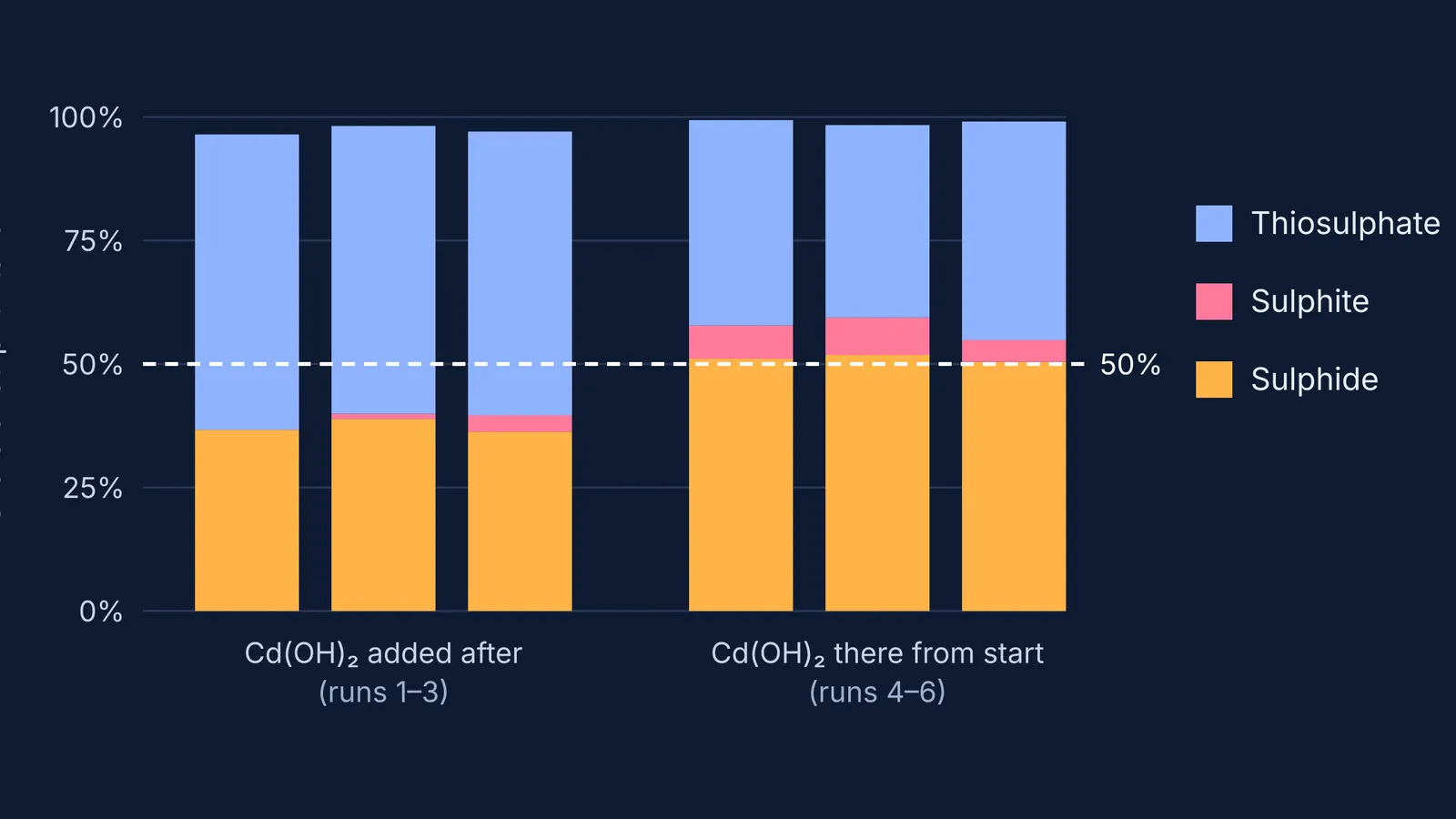
The standard textbook equation for sulphur in alkali, used in redox chapters, is S₈ + 12OH⁻ → 4S²⁻ + 2S₂O₃²⁻ + 6H₂O. Read it as a count of atoms: four of the eight sulphur atoms end up as sulphide and four end up in thiosulphate. In 1962 C. G. Ramachandran Nair, at the Indian Institute of Science, Bangalore, measured that split. When the sulphide was trapped the moment it formed, 50.4–51.8% of the sulphur became sulphide.
Where was this measured, and by whom?
The paper is "Hydrolysis of elemental sulphur in a homogeneous medium" by C. G. Ramachandran Nair and A. R. Vasudeva Murthy, Department of Inorganic and Physical Chemistry, Indian Institute of Science, Bangalore. It was received on 24 November 1961 and printed in the Proceedings of the Indian Academy of Sciences, Section A, vol. 55, pp. 168–173 (1962). The second author's earlier work is in Vasudeva Murthy and Sanjiva Rao, 1951: why H₂S and SO₂ need water.
How do you balance sulphur in alkali as a disproportionation?
Sulphur starts at 0. In S²⁻ it is −2. In S₂O₃²⁻ the average is +2 (two S, three O at −2, total charge −2). So some atoms are reduced and some oxidised: a disproportionation reaction.
Reduction half: S + 2e⁻ → S²⁻.
Oxidation half: 2S + 6OH⁻ → S₂O₃²⁻ + 3H₂O + 4e⁻. Each of the two S atoms rises from 0 to +2, so 4 electrons are lost. Check: O 6 = 3 + 3, H 6 = 6, charge −6 = −2 − 4.
Match electrons: double the reduction half and add: 4S + 6OH⁻ → 2S²⁻ + S₂O₃²⁻ + 3H₂O.
Scale to S₈: multiply by 2 to get S₈ + 12OH⁻ → 4S²⁻ + 2S₂O₃²⁻ + 6H₂O. Atoms and charge (−12 each side) balance.
Two sulphur atoms out of four go to sulphide, so the equation predicts 50% sulphide and 50% thiosulphate.
Why does sulphur hardly react with cold alkali?
The paper reports that solid sulphur left in 0.5 N or even 2 N alkali at room temperature for 24 hours showed "practically no reaction". Sulphur dissolved in carbon tetrachloride, shaken with aqueous alkali as two layers, also gave a negligible reaction in 24 hours. With chloroform a little sulphide formed, which they put down to chloroform mixing slightly better with water.
The fix was contact. They dissolved the sulphur in an organic solvent (carbon tetrachloride, chloroform or benzene), added aqueous sodium hydroxide, and then added ethanol until the two layers became one. The mixture turned intensely yellow, which they suggest was polysulphide, and then faded. The reaction was over in 5–10 minutes in the stronger alkali and in about 30 minutes in dilute alkali. Homogenised acids (HCl or acetic acid) gave no reaction at all.
The kinetics lesson is general: a reaction between a solid and a solution only happens at the surface, so bringing both reactants into one phase can turn a day into minutes. These solvents are toxic and the reaction can give H₂S, so this is not a school experiment.
What did the 1962 measurements show?
Sulphide was removed with cadmium hydroxide as CdS and estimated by iodometry, and sulphite and thiosulphate were then titrated. Table I of the paper (we read it from the page image) has two series, as percentages of the sulphur taken:
Series A, Cd(OH)₂ added after the reaction: sulphide 36.7, 38.9 and 36.3%; sulphite 0–3.3%; thiosulphate 57.5–59.8%.
Series B, Cd(OH)₂ present from the start: sulphide 51.1, 51.8 and 50.4%; sulphite 4.4–7.6%; thiosulphate 39.0–44.2%.
Between 96.5% and 99.4% of the sulphur was accounted for in every run. Their reading: without the trap, some sulphide and sulphite go on to form extra thiosulphate before the analysis. Air oxidation was ruled out: the alcohol inhibits oxidation of sulphite, and runs under nitrogen or hydrogen gave the same results.
So the textbook 50 : 50 split is what you see when the sulphide is caught at once. The small amount of sulphite is not in the overall equation, and the paper's own account explains why: sulphite is an intermediate that sulphur converts into thiosulphate.
Where does the sulphite come from?
The authors proposed, as a 1961 suggestion, that OH⁻ opens the S₈ ring and that the reaction runs through HSOH, in which sulphur is 0:
S₈ + 8H₂O → 8HSOH
3HSOH → 2H₂S + H₂SO₃ (S goes to −2 twice and to +4 once: 4 electrons each way)
S + SO₃²⁻ → S₂O₃²⁻
Written for basic solution (our rewriting), step 2 is 3S + 6OH⁻ → 2S²⁻ + SO₃²⁻ + 3H₂O. Step 3 is the reaction used to make sodium thiosulphate from sodium sulphite and sulphur. Add the two and you get back 4S + 6OH⁻ → 2S²⁻ + S₂O₃²⁻ + 3H₂O. The authors add that radical routes may also play a part, so treat the HSOH path as their proposal.
Worked example: testing their mechanism on run 4
Run 4 (benzene, 0.50 N alkali, cadmium present from the start) gave sulphide a = 51.05%, sulphite b = 6.77% and thiosulphate c = 41.56%.
Total found. 51.05 + 6.77 + 41.56 = 99.38% of the sulphur taken.
Sulphite made first. Each thiosulphate holds one S that came from sulphite and one from elemental sulphur. So the sulphite sulphur formed first is ½c + b = 20.78 + 6.77 = 27.55%.
Prediction. Step 2 gives two sulphide S for every sulphite S, so a should be 2 × 27.55 = 55.10%. The paper prints this column: 55.10.
Compare. Measured 51.05 against 55.10; the authors call the agreement approximate. Runs 5 and 6 give 51.83 against 54.10 and 50.44 against 53.08.
Without the trap. Run 1: 2(½ × 59.78 + 0) = 59.78 against a measured 36.69. The test fails, because sulphide was lost before it was caught.
Now a textbook-style version (our numbers). Take 1.60 g of sulphur, 1.60/32.06 = 0.0499 mol S, in excess alkali with the ideal split:
Sulphide: 0.0499/2 = 0.0250 mol S²⁻.
Thiosulphate: 0.0250 mol S atoms, two per ion, so 0.0125 mol S₂O₃²⁻.
Titration with iodine, 2S₂O₃²⁻ + I₂ → S₄O₆²⁻ + 2I⁻: 0.0125/2 = 0.00624 mol I₂. The reaction itself is explained in sodium thiosulphate and iodine.
For practice with redox balancing and n-factors, Fermi Test Prep for JEE Main and Advanced pairs questions with an AI tutor. To see how oxidation states and disproportionation link to the rest of the p-block, use the Concept Library.
Quick checklist
S₈ + 12OH⁻ → 4S²⁻ + 2S₂O₃²⁻ + 6H₂O: half the sulphur to −2, half to an average of +2.
Measured in 1962 with sulphide trapped at once: 50.4–51.8% sulphide.
Without the trap: only 36–39% sulphide, because extra thiosulphate forms.
Sulphite (up to about 8%) appears as an intermediate.
S + SO₃²⁻ → S₂O₃²⁻ links the steps.
One phase instead of two turned a 24-hour non-reaction into minutes.