On this page
Class 12 students learn that sulphur dioxide oxidises moist hydrogen sulphide to sulphur: 2H₂S + SO₂ → 2H₂O + 3S. The word "moist" matters. In 1951 A. R. Vasudeva Murthy and B. Sanjiva Rao of the Indian Institute of Science, Bangalore measured how much water the reaction needs, and then timed it with nothing more than a pressure reading. Their paper is "The chemical behaviour of sulphur compounds, Part III. Kinetics of the gaseous reaction between hydrogen sulphide and sulphur dioxide", Proceedings of the Indian Academy of Sciences, Section A, volume 34, pages 283 to 298 (full text at the Indian Academy of Sciences). A footnote says it was part of Vasudeva Murthy's M.Sc. thesis for Mysore University. Both gases are toxic, so this post is history and kinetics only, not something to try.
Why do H₂S and SO₂ need water to react?
The paper opens with a surprise. Mixing the two gases with water present was "a common lecture-room experiment as early as 1812", and Cluzel had noticed that "no combination would result if the gases were first dried over calcium chloride".
Two earlier results set up the 1951 study:
H. A. Taylor and W. A. Wesley ran the reaction in Pyrex tubes at 370 to 730 °C and found the rate proportional to the surface area of the vessel. The glass was acting as a catalyst.
Sanjiva Rao had found that silver sulphide, Ag₂S, is an efficient catalyst "provided it was activated by a certain amount of moisture". Glass needed far more water.
So the pair kept the water too low for glass but enough for the sulphide. Their explanation: moisture adsorbed on the catalyst has an "avidity for sulphur dioxide" and gathers SO₂ at the surface. Weighing the catalyst on a McBain–Bakr spring balance, they found it took up more SO₂ as the water vapour pressure rose; H₂S was adsorbed much less. They proposed a short-lived first product, thiosulphurous acid (H₂S + SO₂ → H₂S₂O₂).
How did they control the amount of water vapour?
They used hygrostats: a salt hydrate mixed with its lower hydrate or anhydrous salt. At a fixed temperature such a pair holds the water vapour pressure at one value, the same idea as blue vitriol's efflorescence and its Kp = p(H₂O)². The paper's values at 25 °C:
Oxalic acid dihydrate / anhydrous: 2.20 mm Hg
NaBr·2H₂O / NaBr: 5.47 mm Hg
BaBr₂·2H₂O / BaBr₂·H₂O: 10.56 mm Hg
MgSO₄·7H₂O / MgSO₄·6H₂O: 12.46 mm Hg
Na₂SO₄·10H₂O / Na₂SO₄: 19.15 mm Hg
Our own calculation, not the paper's: water's vapour pressure at 25 °C is about 23.8 mm Hg, so these are roughly 9%, 23%, 44%, 52% and 81% relative humidity.
What happened at each humidity?
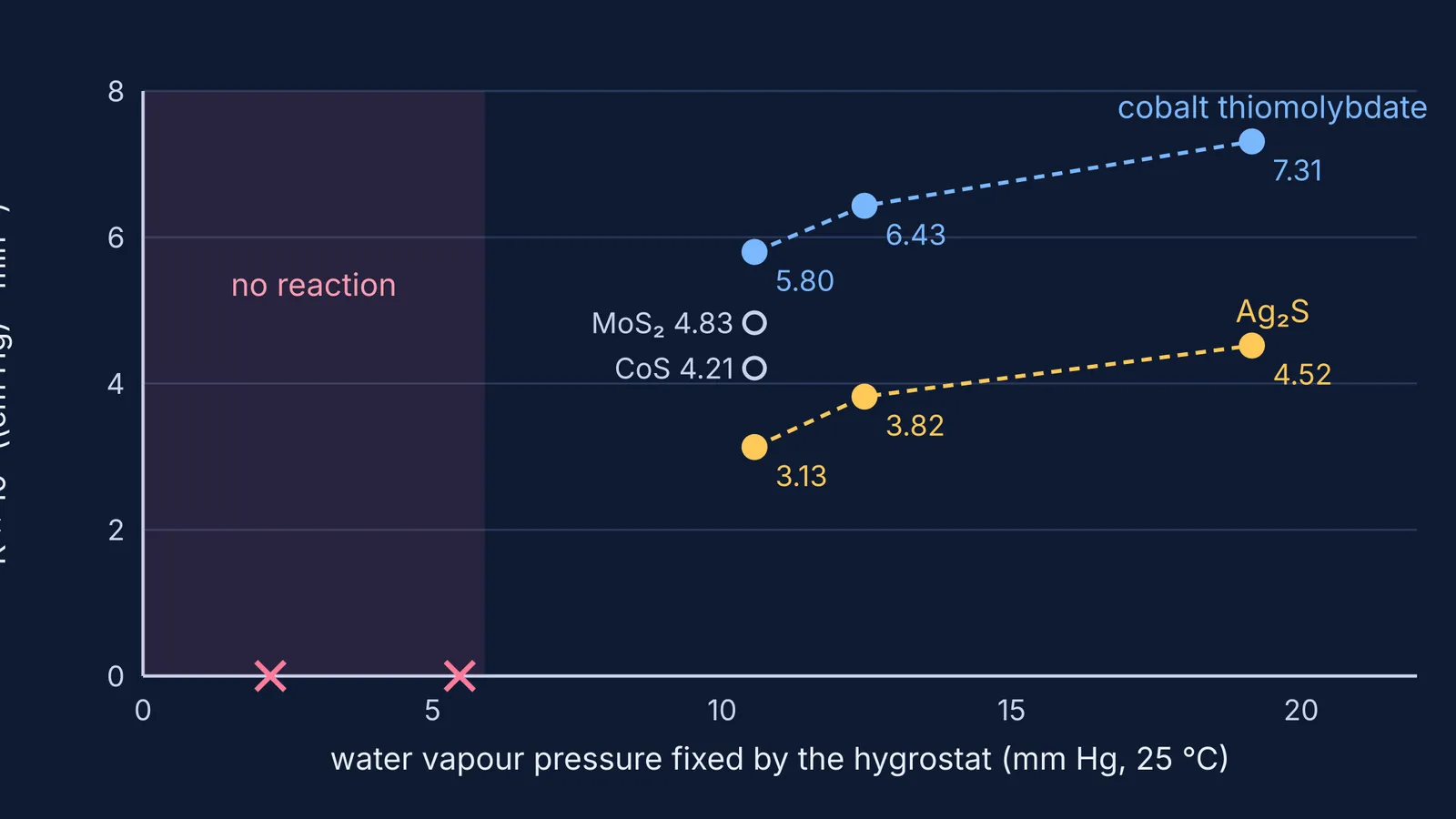
With the two driest hygrostats there was "no indication of any reaction in presence of the various catalysts". From the barium bromide hygrostat upward the gases reacted, and faster the wetter the system was. The paper's rate constants, K × 10³ in (cm Hg)⁻¹ min⁻¹:
Ag₂S: 3.13 at 10.56 mm, 3.82 at 12.46 mm, 4.52 at 19.15 mm.
Cobalt thiomolybdate: 5.80, 6.43 and 7.31 at the same three pressures.
At 10.56 mm only: cobalt sulphide 4.21, molybdenum sulphide 4.83.
Cobalt thiomolybdate was the most active catalyst and Ag₂S the least. Boron trifluoride and anhydrous aluminium chloride gave no reaction even after 24 hours, and did not help Ag₂S either.
How can a pressure reading follow this reaction?
The gases circulated in a closed glass apparatus of about 400 mL. Sulphur stayed on the catalyst. Water went into the hygrostat, so its vapour pressure never changed, and the paper subtracts it to give a "net pressure".
That leaves a clean count. If x (in cm Hg) of SO₂ reacts, 2x of H₂S goes with it, and no gas is formed. So the total pressure falls by 3x. Contrast the SO₂Cl₂ case in finding k from total pressure data, where the pressure rises because gas moles are gained.
They found the order from the time taken to use up a fixed fraction, t₂/t₁ = (C₁/C₂)ⁿ⁻¹, which gave n = 2. Rate constants worked out as first order or third order drifted, so they wrote
dx/dt = K(a − x)(b − 2x)
where a and b are the starting pressures of SO₂ and H₂S. Integrated, this gives the form printed in the paper:
K = [2.303 ÷ t(2a − b)] × log[(a − x)b ÷ ((b − 2x)a)]
Note that the equation has three molecules on the left but the measured order is two. Order comes from experiment, not from the balanced equation.
Worked example: K from Experiment 1
Experiment 1 used Ag₂S with the barium bromide hygrostat at 25 °C. The starting pressures were a = 4.75 cm Hg of SO₂ and b = 7.18 cm Hg of H₂S, a net 11.93 cm Hg. After 45 minutes the net pressure was 5.33, a fall of 6.60 cm Hg.
SO₂ used. x = 6.60 ÷ 3 = 2.20 cm Hg.
What is left. a − x = 4.75 − 2.20 = 2.55. b − 2x = 7.18 − 4.40 = 2.78.
The constant term. 2a − b = 9.50 − 7.18 = 2.32.
The ratio. (2.55 × 7.18) ÷ (2.78 × 4.75) = 18.31 ÷ 13.21 = 1.386. Its log is 0.1419.
K. 2.303 × 0.1419 ÷ (45 × 2.32) = 3.13 × 10⁻³ (cm Hg)⁻¹ min⁻¹.
The paper prints 3.13 for this row. The 5-minute row (fall 1.44) gives 3.19 against a printed 3.18.
A cleaner version from Experiment 2. With the magnesium sulphate hygrostat they started at a = 4.1 and b = 8.2, exactly 2a. The formula above now divides by zero, so write the rate in one variable: b − 2x = 2(a − x), so dx/dt = 2K(a − x)², and 1/(a − x) − 1/a = 2Kt. At 30 minutes the fall was 6.00, so x = 2.00 and 1/2.10 − 1/4.10 = 0.2323. Then K = 0.2323 ÷ 60 = 3.87 × 10⁻³, the paper's value. Our own check: the half-life of SO₂ is 1/(2Ka) = 31.5 minutes, and by 30 minutes x was 2.00, close to half of 4.1.
K is in (cm Hg)⁻¹ min⁻¹; converting to L mol⁻¹ s⁻¹ would need the volume and temperature. To practise integrated rate laws with unequal starting amounts, the Fermi Problem Library has a step-by-step solver that explains the reasoning.
Does this change the textbook reaction?
No. The equation is right, and the textbook already says moist. The paper puts a number on "moist": under their conditions, at 5.47 mm Hg of water or less, the reaction did not go on any of their catalysts. Industry runs a hot, catalysed version of the same chemistry in the Claus process for sulphur recovery. For more JEE Main and Advanced practice on kinetics and p-block reactions, Fermi Test Prep is built for exam preparation, with an AI tutor.
Quick checklist
2H₂S + SO₂ → 2H₂O + 3S. SO₂ is the oxidant, sulphur goes −2 → 0 and +4 → 0.
Vasudeva Murthy and Sanjiva Rao (IISc, 1951): no reaction at 2.20 or 5.47 mm Hg of water, reaction from 10.56 mm up.
Fall in pressure = 3x, because no gas is formed.
Rate = K(a − x)(b − 2x), second order, even though three molecules appear in the equation.
If b = 2a, use 1/(a − x) − 1/a = 2Kt.