On this page
What happens if you pull on the chlorine of benzyl chloride from outside? In 1958 (Miss) K. Saramma and R. Anantaraman, of the Applied Chemistry Division, Kerala University, added mercuric chloride to benzyl chloride in aqueous ethanol and timed how fast hydrochloric acid appeared. The rate rose in a straight line with the amount of HgCl₂. Their paper, "Catalysed solvolysis of benzyl chloride", is in the Proceedings of the Indian Academy of Sciences, Section A, volume 49, pages 111 to 116 (full text at the Indian Academy of Sciences).
Who were K. Saramma and R. Anantaraman?
The byline reads "(Miss) K. Saramma and R. Anantaraman", and the same "(Miss)" is printed in the running heads and the reference list. The paper was received on 21 October 1958 and communicated by S. V. Anantakrishnan. The authors thank the University of Kerala for "a scholarship to one of us (K. S.)". It says nothing else about her life, and we have not found a verified biography. The work was part of a series on "electrophilic catalysis in nucleophilic aliphatic substitution".
Why is benzyl chloride on the SN1–SN2 border?
Benzyl chloride, C₆H₅CH₂Cl, is a primary halide. Its CH₂ carbon is open to backside attack, which suits SN2. If the chloride leaves first, the benzyl cation C₆H₅CH₂⁺ is stabilised by resonance with the ring, which suits SN1. Why that cation is so stable is covered in why allylic and benzylic halides react fast by the SN1 route. The authors put it "on the SN2–SN1 border line".
For their solvents, they argued that the uncatalysed reaction goes chiefly by SN2. Their evidence: adding 0.08 M hydroxide made the normal solvolysis in 50% aqueous ethanol about five times faster. An SN1 rate should barely notice a stronger nucleophile, so a fivefold jump points to SN2. That was their reading for aqueous ethanol, not a universal rule.
How does mercuric chloride help the C–Cl bond break?
Their scheme, where HOX is water or ethanol (X = H or C₂H₅):
C₆H₅CH₂Cl + HgCl₂ → C₆H₅CH₂⁺ + HgCl₃⁻ (slow)
C₆H₅CH₂⁺ + HOX → C₆H₅CH₂OX + H⁺ (fast)
HgCl₃⁻ then gives back its extra chloride (HgCl₃⁻ → HgCl₂ + Cl⁻), so the overall change is C₆H₅CH₂Cl + HOX → C₆H₅CH₂OX + HCl. HgCl₂ is not used up, so it is a catalyst.
HgCl₂ can take on one more chloride to form HgCl₃⁻, so it tugs on the chlorine, which leaves as part of HgCl₃⁻ instead of as a bare Cl⁻. The benzyl cation left behind is captured by the solvent: an SN1 path with a helper on the leaving group.
Our modern reading: HgCl₂ acts as a Lewis acid toward chlorine. It is the same idea as AlCl₃ pulling chloride off an alkyl halide in Friedel–Crafts alkylation, or Ag⁺ helping a halide ionise in the silver nitrate test that tells benzyl chloride from chlorobenzene. Mercuric chloride is highly toxic; this post is about the kinetics, not a procedure.
How did they measure the rate?
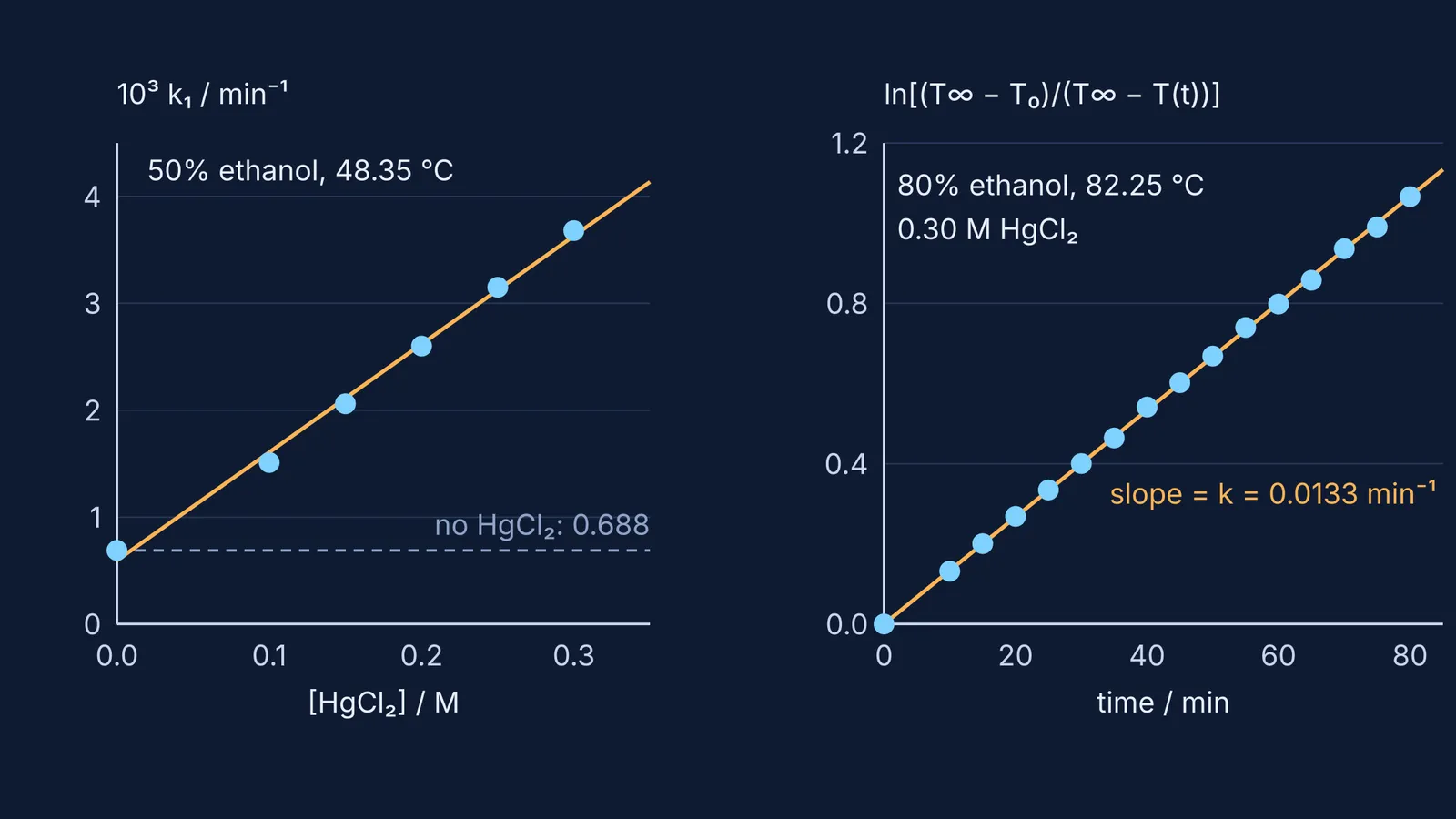
They titrated the hydrochloric acid formed with alkali at intervals; each mole of benzyl chloride that reacts gives one mole of HCl. Table IV of the paper gives one full run: 80% aqueous ethanol, 82.25 °C, 0.0750 M benzyl chloride and 0.300 M HgCl₂. Titres are mL of 0.0375 N NaOH per 5.0 mL.
Worked example. Start titre T₀ = 0.36 mL. After 30 min, 3.54 mL. After 80 min, 6.68 mL. Final titre T∞ = 10.00 mL.
Check the final titre (our check). 10.00 mL × 0.0375 mmol/mL = 0.375 mmol of acid. A 5.0 mL sample holds 5.0 × 0.0750 = 0.375 mmol of benzyl chloride. The reaction goes to completion.
Choose the law. For first order, k = (1/t) ln[(T∞ − T₀)/(T∞ − Tₜ)]. Titre differences are proportional to unreacted benzyl chloride.
At 30 min. (10.00 − 0.36)/(10.00 − 3.54) = 9.64/6.46 = 1.492. ln 1.492 = 0.400. k = 0.400/30 = 0.0133 min⁻¹.
At 80 min. 9.64/3.32 = 2.904. ln 2.904 = 1.066. k = 1.066/80 = 0.0133 min⁻¹.
Compare. The paper prints 10³k₁ = 13.2 to 13.5 min⁻¹ at all fifteen times, and our recalculation agrees. Constant k means first order.
Half-life. t½ = 0.693/0.0133 = about 52 min.
This k is the total of normal and catalysed reactions.
Why did the rate rise in a straight line with HgCl₂?
In 50% ethanol at 48.35 °C (Table I), 10³k₁ in min⁻¹ went 0.688, 1.51, 2.06, 2.60, 3.15 and 3.68 as HgCl₂ went 0, 0.100, 0.150, 0.200, 0.250 and 0.300 M. Our least-squares line is 10³k₁ = 0.60 + 10.1 × [HgCl₂].
At 0.3 M the total rate is 3.68/0.688 = 5.35 times the normal rate. The catalysed part alone is 3.68 − 0.688 = 2.99, or 4.35 times the normal rate. The paper's Table II ratio of normal to catalysed rate, 0.230, matches 0.688/2.99.
They gave two reasons to think the catalyst is the HgCl₂ molecule itself, not Hg²⁺ or HgCl⁺:
The rate is linear in total HgCl₂, which fits a covalent, largely un-ionised molecule.
Added chloride slows it only a little. With 0.150 M NaCl, 3.68 fell to 3.12, about 15% lower. Chloride at that level would suppress any Hg²⁺ or HgCl⁺, so if those were the catalysts the rate should have fallen much further toward 0.688.
What do the Arrhenius numbers show?
In 50% ethanol the paper gives Eₐ = 19.4 kcal mol⁻¹ (about 81.2 kJ mol⁻¹) and ln B = 24.76 with 0.3 M catalyst, against 20.4 kcal mol⁻¹ (85.4 kJ mol⁻¹) and ln B = 24.65 without. B is the pre-exponential factor A.
Our check: at 321.5 K, with R = 1.987 cal mol⁻¹ K⁻¹, k = exp(ln B − Eₐ/RT) gives 0.688 × 10⁻³ and 3.68 × 10⁻³ min⁻¹, the Table I values. So B is in min⁻¹ and the "catalysed" pair is the total rate.
A 1.0 kcal drop in Eₐ is worth exp(1000/(1.987 × 321.5)) = 4.78. The 0.11 rise in ln B is worth 1.12. Together, about 5.3. So almost all the gain comes from the lower activation energy, as the authors concluded: the catalyst lowers "the energy required for heterolysing the C–Cl bond".
At 82.25 °C (Table III) the normal rate fell from 14.55 to 2.90 × 10⁻³ min⁻¹ going from 50% to 80% ethanol. More water, faster reaction, as for SN1 in polar protic solvents. They suggested the normal reaction is already partly SN1 in wetter solvents, and that the change from SN2 to SN1 "is not sharp".
Exam line: for Class 12 Haloalkanes and Chemical Kinetics, this one paper shows a benzylic halide on the SN1–SN2 border, a Lewis acid helping the leaving group go, and k from titres by the first-order law.
For more first-order numericals, the Fermi Problem Library has a step-by-step solver that explains the reasoning. Fermi Test Prep is JEE Main and Advanced preparation with an AI tutor.
Quick checklist
Benzyl chloride sits on the SN1–SN2 border; in aqueous ethanol the authors read the uncatalysed reaction as chiefly SN2.
HgCl₂ pulls chloride off as HgCl₃⁻, giving the benzyl cation: electrophilic, or Lewis acid, catalysis.
Rate grows linearly with [HgCl₂]; 0.3 M gives about 5.3 times the normal rate at 48.35 °C.
Table IV: k = 13.3 × 10⁻³ min⁻¹, t½ about 52 min.
Eₐ falls from 20.4 to 19.4 kcal mol⁻¹, worth a factor of about 4.8.