

On this page
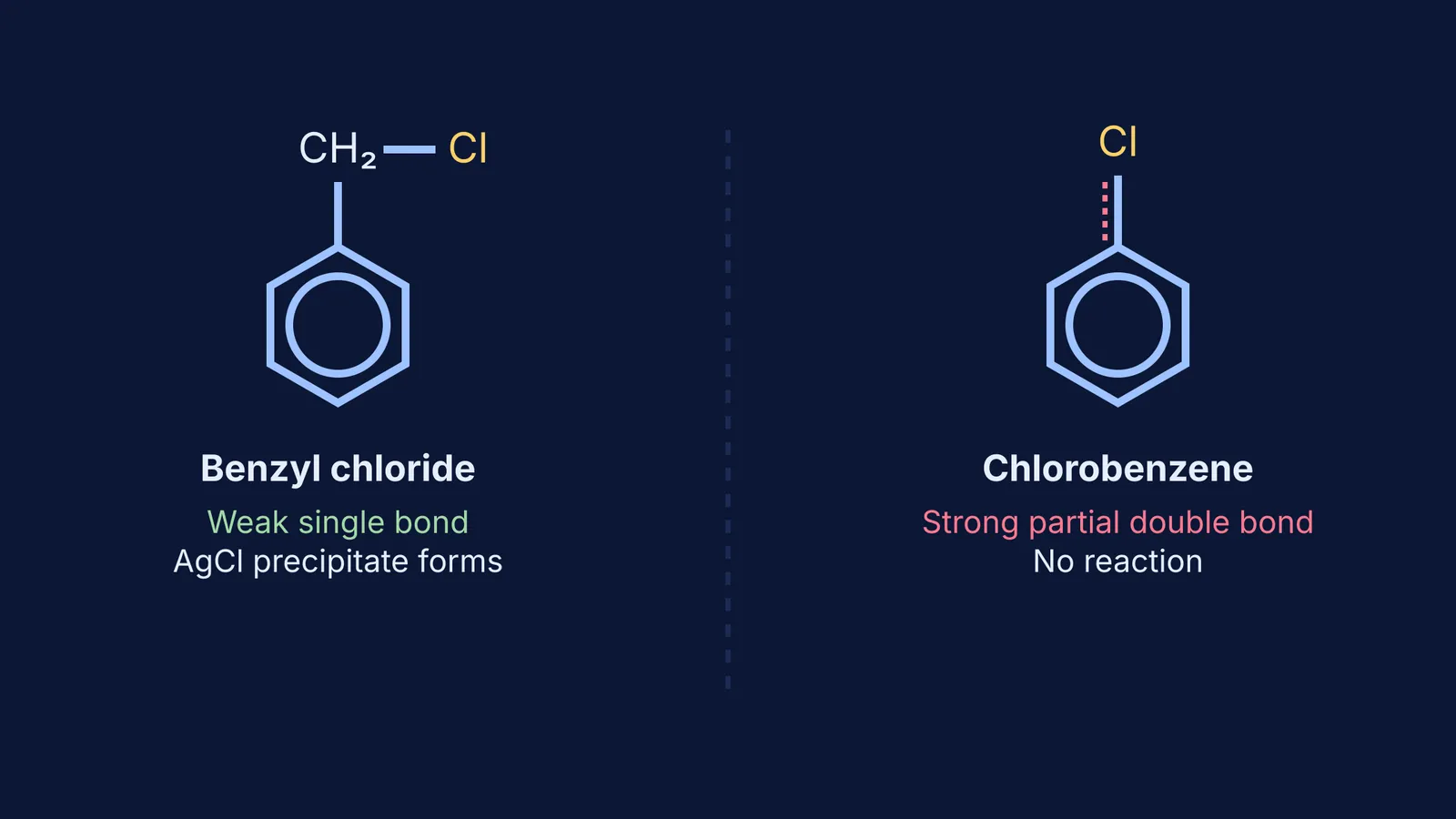
When you look at a bottle of benzyl chloride and a bottle of chlorobenzene side by side, they appear as indistinguishable clear liquids. Both contain a benzene ring, and both contain a single chlorine atom. However, their chemical behaviour is fundamentally different. This difference is so pronounced that you can tell them apart with a simple and rapid precipitation test using silver nitrate.
How does the silver nitrate test work?
To distinguish the two liquids, you add a few drops of ethanolic or aqueous silver nitrate (AgNO₃) solution to a small sample of each and warm them gently.
Benzyl chloride: A thick white precipitate of silver chloride (AgCl) forms immediately (Wikipedia).
Chlorobenzene: The solution remains completely clear, with no reaction taking place even upon further heating.
This simple visual test relies on nucleophilic substitution. In a substitution reaction, a nucleophile (like a water or alcohol molecule) replaces the chlorine atom. For the silver nitrate test to produce a precipitate, the carbon-chlorine bond must break to release a free chloride ion (Cl⁻). The silver ions (Ag⁺) in the solution then immediately bind with these free chloride ions to form the insoluble white solid, silver chloride.
If the carbon-chlorine bond cannot break under these mild conditions, no chloride ions are released, and the solution stays clear. Therefore, the test is actually measuring the strength and reactivity of the carbon-chlorine bond in each molecule.
Why does benzyl chloride give a white precipitate?
In benzyl chloride (C₆H₅CH₂Cl), the chlorine atom is not attached directly to the benzene ring. Instead, it is attached to a carbon atom located just outside the ring. This is known as the benzylic position, and this specific carbon is sp³ hybridized.
When warmed with silver nitrate, this carbon-chlorine bond breaks relatively easily. The reaction releases a chloride ion into the solution and leaves behind a benzyl carbocation (C₆H₅CH₂⁺).
This carbocation intermediate is remarkably stable. Although the positive charge is formally on the carbon atom outside the ring, it does not stay localized there. Through the process of resonance, the positive charge is spread out, or delocalized, across the adjacent benzene ring. The π-electrons of the ring shift to stabilize the empty p-orbital of the benzylic carbon.
Because the resulting carbocation is so stable, the activation energy for breaking the carbon-chlorine bond is low. The chloride ion leaves readily, finds a silver ion, and drops out of the solution as a white precipitate of silver chloride.
Why does chlorobenzene fail the test?
In chlorobenzene (C₆H₅Cl), the structure is different. The chlorine atom is attached directly to one of the carbon atoms that makes up the benzene ring itself. This carbon atom is sp² hybridized.
Because of this direct attachment, the lone pairs of electrons on the chlorine atom interact with the delocalized π-electron system of the benzene ring. This resonance effect pulls the electrons towards the ring, giving the carbon-chlorine bond a partial double bond character.
As a result, the carbon-chlorine bond in chlorobenzene is significantly shorter and stronger than a typical alkyl carbon-chlorine single bond (Wikipedia). Double bonds, even partial ones, require much more energy to break than pure single bonds.
Furthermore, if the bond were to break, it would form a phenyl cation (C₆H₅⁺). This cation is extremely unstable. The positive charge would reside in an sp² orbital that is perpendicular to the ring's π-system, meaning it cannot be stabilized by resonance. Between the strong partial double bond and the highly unstable potential carbocation, the bond in chlorobenzene is simply too strong to break under normal warming with silver nitrate. No chloride ions are released, and no precipitate forms.
Why do we use ethanolic silver nitrate?
In a practical laboratory setting, this test is often performed using ethanolic silver nitrate rather than a purely aqueous solution.
Both haloarenes (like chlorobenzene) and haloalkanes (like benzyl chloride) are non-polar organic molecules. They are mostly insoluble in water. If you were to use an aqueous silver nitrate solution, the organic liquid and the water would form two separate layers, preventing the reagents from mixing effectively.
Ethanol acts as a co-solvent. It can dissolve both the organic halide and the ionic silver nitrate, bringing all the reacting species together into a single, homogeneous phase so the reaction can proceed quickly.
How can you learn the reasoning?
In organic chemistry exams like JEE Main and NEET-UG, memorising tests is only half the battle. Examiners often ask questions that test whether you know why one molecule reacts and another does not. Relying purely on memory can lead to mistakes when faced with new molecules or variations of a classic test.
The Fermi Problem Library has worked problems with a step-by-step solver that explains the reasoning rather than printing an answer. Instead of just confirming which molecule gives a precipitate, the tutor will walk you through drawing the resonance structures and comparing carbocation stabilities, ensuring you understand the underlying concepts that drive the reaction.
*See also: Carbylamine test: detecting primary amines by the isocyanide smell, Hinsberg's reagent: separating 1°, 2° and 3° amines.*",


