On this page
You learn that aluminium chloride is Al₂Cl₆: two AlCl₃ units held together by bridging chlorides, which a donor such as water or ether can break. In 1960, K. N. Venkataraman at the Indian Institute of Science, Bangalore, put a number on this for one donor solvent, nitrobenzene. Working with A. R. Vasudeva Murthy, he measured freezing points and found that AlCl₃ dissolves there as single AlCl₃ units. The same paper showed that AlCl₃ takes up exactly two molecules of phosphorus oxychloride, POCl₃, and that this adduct partly falls apart in solution. Both results are Class 12 colligative-property problems.
Who did this work, and where is the paper?
The paper is K. N. Venkataraman and A. R. Vasudeva Murthy, "Studies on phosphorus oxychloride and aluminium chloride complex", Proceedings of the Indian Academy of Sciences A, vol. 51, pp. 270–279. The byline gives the Department of Inorganic and Physical Chemistry, Indian Institute of Science, Bangalore. It was received on 22 December 1959 and communicated by M. R. A. Rao. We know nothing about K. N. Venkataraman beyond this byline, so we do not guess. His co-author appears in our post on why H₂S and SO₂ need moisture to react.
AlCl₃ and POCl₃ react violently with water and give off HCl, so all the work was done in a dry box. This post covers the numbers, not the method.
Why is AlCl₃ a dimer in benzene but not in every solvent?
Aluminium in AlCl₃ has only six electrons in its valence shell, so it is a strong Lewis acid. It completes its octet by accepting a lone pair. If no better donor is present, the lone pair comes from a chlorine on a second AlCl₃, which gives Al₂Cl₆ with two Cl bridges. The basics are in why aluminium chloride exists as the dimer Al₂Cl₆.
The paper sums up earlier work: in the vapour and in carbon disulphide or benzene, which have no lone pairs to offer, the molar mass fits Al₂Cl₆. In donor solvents such as pyridine and ether, it fits AlCl₃. Nitrobenzene should be a donor too; the paper cites a known addition compound, AlCl₃·C₆H₅NO₂. There was a visible clue as well: pure nitrobenzene is straw yellow, but even a dilute AlCl₃ solution in it is deep yellow.
What molar mass did AlCl₃ show in nitrobenzene?
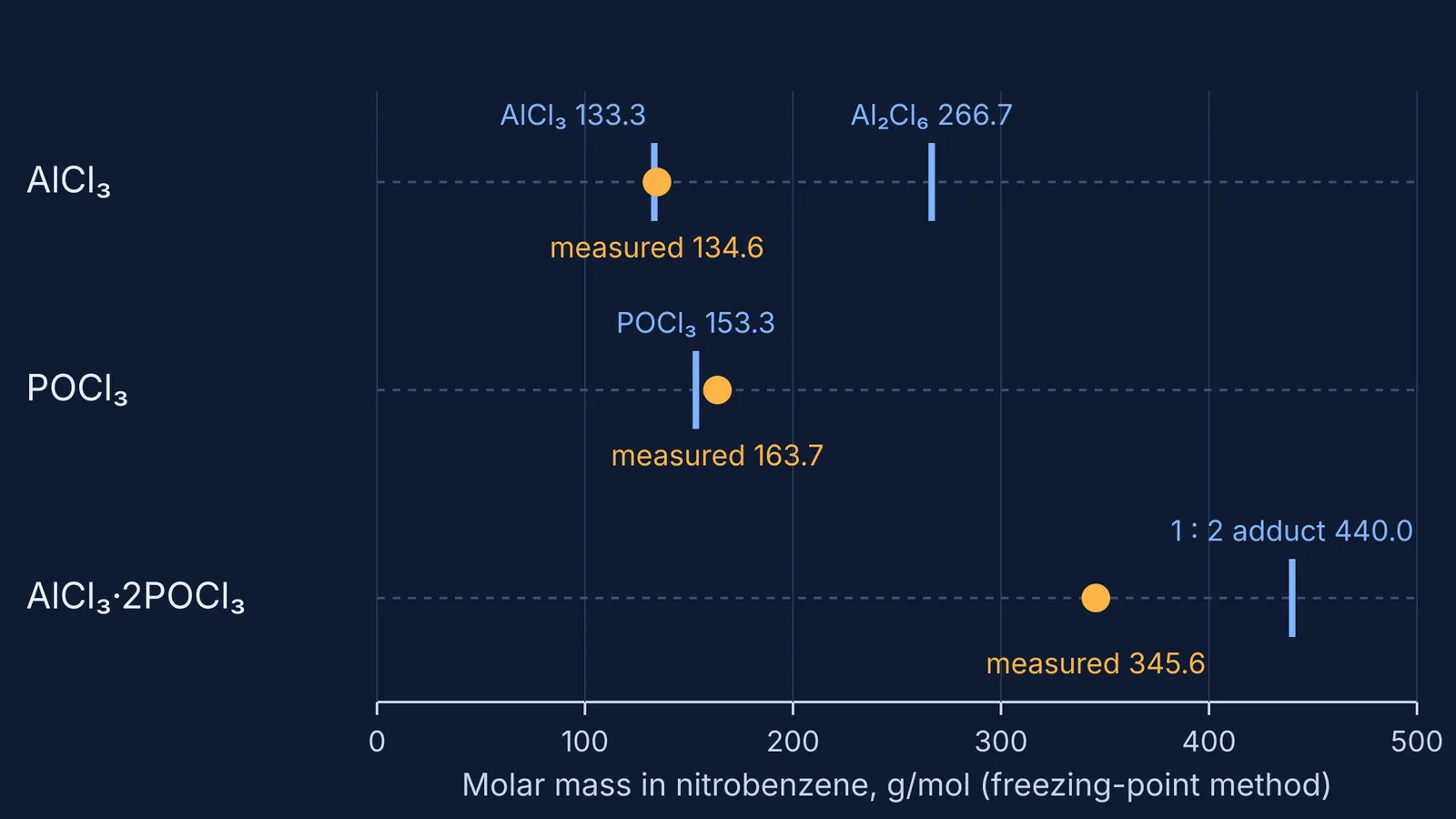
They used ΔTf = Kf × m. Pure nitrobenzene froze at 5.77 °C, and they took Kf = 6.89 K kg mol⁻¹, checked with naphthalene. Our cross-check: Kf = RTf² ÷ (1000 L), with R = 1.987 cal mol⁻¹ K⁻¹, Tf = 278.92 K and their latent heat L = 22.46 cal g⁻¹, gives 6.88.
Their results:
AlCl₃: 134.6 ± 1. The formula AlCl₃ gives 133.3 and Al₂Cl₆ gives 266.7. That is 1.01 times the monomer.
POCl₃: 163.7 ± 3.5, against 153.3; 7% high, a slight tendency to pair up.
The AlCl₃–POCl₃ adduct: 345.6 ± 5. More on this below.
A freezing-point measurement counts particles, not their identity. The authors noted that Al³⁺ + AlCl₆³⁻ would give the same count, and used that ionic picture to explain why the solution conducts. That was a 1960 proposal. For the exam, stick to the donor–acceptor adduct.
What is AlCl₃·2POCl₃, and how was its formula fixed?
POCl₃ can donate a lone pair through oxygen or chlorine. Earlier workers disagreed on whether AlCl₃ takes one POCl₃ or two.
Venkataraman dissolved AlCl₃ in excess POCl₃ ("considerable heat" was given out) and removed the excess in two different ways. Both left a free-flowing powder with an AlCl₃ : POCl₃ ratio of 1 : 2. Three checks in nitrobenzene agreed:
Conductometric titration. When 0.37 M AlCl₃ was titrated with POCl₃, the conductivity rose and then levelled off at a 1 : 2 mole ratio. The method is explained in conductometric titration curves.
Extra conductivity. A mixture that was 0.3 M in each gave 11.04 × 10⁻⁴ S cm⁻¹, against 6.83 × 10⁻⁴ for the two separately (6.75 + 0.079). That is 1.6 times the sum, which the paper calls "nearly double". With 0.2 M AlCl₃ and 0.3 M POCl₃, it was 12.47 × 10⁻⁴ against 4.78 × 10⁻⁴, or 2.6 times. New ions had formed.
A new colour band. Mixtures, and the dissolved solid, absorbed at 6950–7200 Å, where neither component absorbs alone.
Why did the adduct show 345.6 instead of 440?
The formula AlCl₃·2POCl₃ has a molar mass of 440.0 (the paper prints 440.1). The measured value is far lower, even in dilute solution. Their explanation is partial dissociation:
AlCl₃·2POCl₃ ⇌ AlCl₃·POCl₃ + POCl₃
Each adduct that splits gives two particles, so the freezing point drops further and the apparent molar mass falls. They rejected a full breakdown into three particles by comparison with similar zirconium and hafnium tetrachloride adducts.
This is the mirror image of acetic acid showing a molar mass of 120 in benzene, where molecules pair up and i is below 1.
Worked example: the van 't Hoff factor of the adduct
Question. 1.00 g of AlCl₃·2POCl₃ in 100 g of nitrobenzene lowers the freezing point by 0.199 K. Kf = 6.89 K kg mol⁻¹. Find the apparent molar mass, the van 't Hoff factor i, and the fraction dissociated if the adduct splits into two particles. (Al = 26.98, P = 30.97, O = 16.00, Cl = 35.45.) This is our problem, built to match the paper's measured molar mass.
Formula mass. AlCl₃ = 26.98 + 3 × 35.45 = 133.33. POCl₃ = 30.97 + 16.00 + 106.35 = 153.32. Adduct = 133.33 + 2 × 153.32 = 439.97 g mol⁻¹.
Molality from ΔTf. m = ΔTf ÷ Kf = 0.199 ÷ 6.89 = 0.02888 mol kg⁻¹.
Moles present. In 0.100 kg of solvent: 0.02888 × 0.100 = 0.002888 mol of particles.
Apparent molar mass. 1.00 g ÷ 0.002888 mol = 346 g mol⁻¹, close to the paper's 345.6.
Van 't Hoff factor. i = normal M ÷ apparent M = 439.97 ÷ 346.2 = 1.27.
Degree of dissociation. For A ⇌ B + C, i = 1 + α, so α = 0.27. About 27% of the adduct is split.
Check. Undissociated, the drop would be 6.89 × (1.00 ÷ 439.97) ÷ 0.100 = 0.157 K. The larger 0.199 K means more particles.
The 27% holds only near the paper's concentration, which it does not print. For more colligative problems solved step by step, try the Fermi Problem Library, a step-by-step solver that explains the reasoning.
Where does this come up in JEE and NEET?
Exam line: Class 11 p-block and chemical bonding (AlCl₃ as an electron-deficient Lewis acid, Al₂Cl₆ and donor–acceptor adducts), Class 12 Solutions (abnormal molar mass and the van 't Hoff factor), and Class 12 Electrochemistry (conductometric end points). If you are revising these chapters for JEE Main and Advanced, Fermi Test Prep offers practice with an AI tutor.
Quick checklist
AlCl₃ is Al₂Cl₆ where no donor is present, and AlCl₃ bound to a donor where one is.
In nitrobenzene, the freezing-point molar mass of AlCl₃ was 134.6, against 133.3 for the monomer.
Freezing points count particles; they cannot tell you which particles.
AlCl₃ + POCl₃ gives AlCl₃·2POCl₃, fixed by analysis, a conductometric titration and a new absorption band.
The adduct read 345.6 instead of 440: i = 1.27, about 27% split into AlCl₃·POCl₃ + POCl₃.
Low apparent molar mass means dissociation; high means association.