On this page
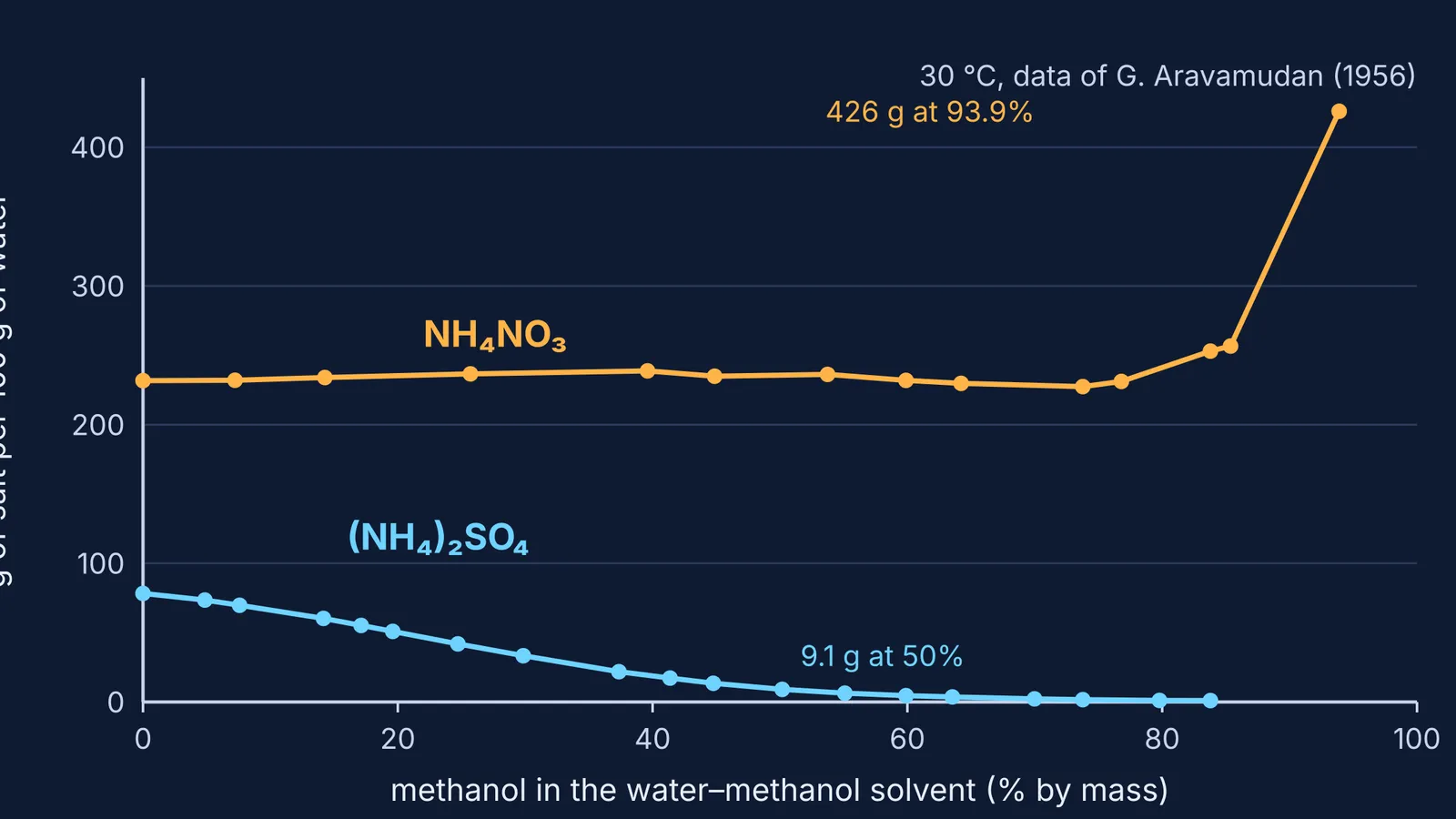
Ammonium sulphate and ammonium nitrate share a cation, and both dissolve freely in water. At 30 °C, 100 g of water holds 78.3 g of the sulphate and 231.8 g of the nitrate. In 1956, G. Aravamudan, of the Department of General Chemistry at the Indian Institute of Science, Bangalore, measured what happens when methanol replaces part of that water. The two salts went opposite ways. Methanol throws most of the ammonium sulphate out of solution, but it hardly touches the nitrate.
Who measured this, and where was it published?
The paper is G. Aravamudan, "Studies in phase rule, Part I", covering the ammonium sulphate–water–methanol and ammonium nitrate–water–methanol systems at 30 °C. It was printed in the Proceedings of the Indian Academy of Sciences, Section A, vol. 44, pp. 375–386 (doi:10.1007/BF03046092), received on 1 October 1956 and communicated by Prof. K. R. Krishnaswami, whom the author thanks. We have not verified anything about Aravamudan beyond what the paper prints.
His thermostat held 30 °C to within 0.02 °C. He reached equilibrium from both sides, from below saturation and from a supersaturated mixture, and the two agreed closely. The salt in each saturated solution was found by evaporation to constant mass, by titrating sulphate with lead nitrate, or by the formol method for ammonium.
The formol reaction he wrote is 2(NH₄)₂SO₄ + 6HCHO → (CH₂)₆N₄ + 6H₂O + 2H₂SO₄. It balances: 6 C, 28 H, 4 N, 14 O and 2 S on each side. The acid set free is titrated with alkali, as explained in how formaldehyde makes NH₄⁺ titratable. Ammonium nitrate is an oxidiser and methanol is flammable, so this post is about the published data, not a procedure to repeat.
How much does methanol lower the solubility of ammonium sulphate?
A lot. In his words, the solubility "undergoes a vast change from 43.92% in water to less than 0.05% in absolute methanol". His Table III gives the same fall per 100 g of water in the solvent:
No methanol: 78.32 g.
25.70% methanol: 39.88 g.
53.73% methanol: 7.4 g.
83.79% methanol: 0.96 g.
He notes that alkali metal sulphates are much more affected by alcohols than the corresponding nitrates. Neither salt formed a solvate, and neither mixture split into two liquid layers at 30 °C. Ethanol and the higher alcohols, by contrast, do give two layers with ammonium sulphate.
Why does ammonium nitrate stay dissolved when methanol is added?
Here the numbers barely move. Per 100 g of water, his Table III gives 231.8 g in pure water, 236.6 g at 25.70% methanol, 238.9 g at 39.60%, 236.2 g at 53.73% and 227.5 g at 73.77%. His conclusion: "ammonium nitrate can scarcely be precipitated out of its solution in water by addition of any amount of methanol."
Our calculation shows how small the effect is. The lowest value, 227.5 g, means that at most 231.8 − 227.5 = 4.3 g, about 1.8% of the salt, could come out. Even that needs about 281 g of methanol for every 100 g of water. He also corrects Fleckenstein (1904), who had said methanol raises the nitrate's solubility continuously: "incorrect by the light of his own results".
Above about 85% methanol, the figure per 100 g of water rises sharply, to 426.3 g at 93.89%. Our reading is that this mostly reflects the unit, not a new effect. Ammonium nitrate dissolves in methanol itself (16.80% by mass in pure methanol, his Table II). Measured per 100 g of total solvent instead, the solubility falls steadily: 231.8 g in water, 59.7 g at 73.77% methanol, 26.0 g at 93.89% and 20.2 g in pure methanol.
He also noted that dissolving ammonium nitrate cools the liquid, even in absolute methanol; ammonium sulphate's temperature changes were "hardly perceptible".
Why do the two salts behave so differently?
The paper reports the data and offers no mechanism. What follows is our modern explanation, not his.
Methanol is a weaker ion solvent. Its dielectric constant is about 33, against about 78 for water at 25 °C (standard approximate values). In a lower dielectric constant, oppositely charged ions attract each other more strongly, so they are more likely to come back together as a solid.
Charge matters. The attraction between two ions grows with the product of their charges. SO₄²⁻ carries two charges, NO₃⁻ only one, so a sulphate lattice gains much more by staying together when the solvent gets poorer.
The lattice is the other half. Ammonium nitrate's lattice is held by singly charged ions, so even a modest solvation energy, including hydrogen bonds from methanol, is enough to break it up.
This is the balance of lattice and hydration enthalpy, with a solvent that gets poorer as methanol is added. "Like dissolves like" alone cannot explain it: both are ionic salts of the same cation.
Worked example: how much ammonium sulphate does methanol throw out?
Start with a saturated solution of ammonium sulphate in 100 g of water at 30 °C, then add 100 g of methanol. Our calculation, using M = 132.13 g mol⁻¹ for (NH₄)₂SO₄, 32.04 for methanol and 18.015 for water.
Saturated in water. His table gives 43.92 g salt and 56.08 g water per 100 g of solution. Per 100 g of water: 43.92 ÷ 56.08 × 100 = 78.32 g. Molality = (78.32 ÷ 132.13) mol ÷ 0.100 kg = 5.93 mol kg⁻¹, and log 5.93 = 0.773, matching his 0.7730.
New solvent. 100 g water + 100 g methanol is 50% methanol by mass. Mole fraction of methanol = (100 ÷ 32.04) ÷ [(100 ÷ 32.04) + (100 ÷ 18.015)] = 3.121 ÷ 8.672 = 0.360.
Read the nearest row. At 50.17% methanol, 100 g of saturated solution contains 4.35 g salt, 47.66 g water and 47.99 g methanol. Per 100 g of water: 4.35 ÷ 47.66 × 100 = 9.13 g. Checks: mole fraction 0.361 (his 0.362), log molality −0.463 (his −0.4630).
Subtract. Only about 9.1 g can stay dissolved, so 78.32 − 9.13 = 69.2 g crystallises. That is 69.2 ÷ 78.32 = 88% of the salt.
Repeat for the nitrate. Start with 231.8 g in 100 g of water. At 44.87% and 53.73% methanol, 100 g of water holds 234.9 g and 236.2 g. At 50% the limit is above 231.8 g, so nothing crystallises.
Interpolating to exactly 50.00% gives about 9.2 g dissolved; the answer stays at 88%.
Where is this in the JEE and NEET syllabus?
It sits in Class 12 Solutions: solubility of a solid, saturated solutions, and converting mass per cent into mole fraction and molality, as in how to convert mole fraction to molality.
For more unit-conversion problems like step 3, the Fermi Problem Library has a step-by-step solver that explains the reasoning. For JEE Main and Advanced preparation, Fermi Test Prep pairs practice with an AI tutor.
Quick checklist
At 30 °C, 100 g of water dissolves 78.32 g of (NH₄)₂SO₄ and 231.8 g of NH₄NO₃.
Methanol takes ammonium sulphate from 43.92% to below 0.05%.
A 50:50 water–methanol mixture keeps only about 9.1 g per 100 g of water, so about 88% crystallises.
Ammonium nitrate barely changes and "can scarcely be precipitated" by methanol.
The rise above 85% methanol is per 100 g of water; per 100 g of solvent the solubility falls.