On this page
In 1970 P. S. Radhakrishnamurti and Janardan Sahu, at the Department of Chemistry, Khallikote College, Berhampur (Ganjam), Orissa, measured how fast aromatic amines push a halogen off a dinitrobenzene ring. Their paper, "Aromatic nucleophilic substitutions. Reactions of halogeno and nitro-substituted benzenes, Part II", appeared in the Proceedings of the Indian Academy of Sciences (received 11 July 1970; communicated by S. V. Anantakrishnan). Its tables put numbers on two Class 12 ideas: aniline basicity and nucleophilic substitution in haloarenes.
What did Radhakrishnamurti and Sahu measure?
They reacted 2,4-dinitro-1-bromobenzene and 2,4-dinitro-1-iodobenzene with aromatic amines at 50 °C. Chloro data from their Part I (Canadian Journal of Chemistry, 1969) are repeated in Table III. The solvents were ethanol and 80 : 20 (v/v) mixtures of ethanol with DMSO, DMF or acetonitrile. The products are 2,4-dinitrodiphenylamines. With aniline and the bromo compound:
C₆H₃(NO₂)₂Br + C₆H₅NH₂ → C₆H₃(NO₂)₂NHC₆H₅ + HBr
Check: C 12 = 12, H 10 = 10, N 3 = 3, O 4 = 4, Br 1 = 1.
Three results set up the rest:
Second order. Rate = k[ArX][amine], first order in each reactant.
No catalysis by extra amine. With the bromo compound and aniline in ethanol, k (10⁻³ L mol⁻¹ min⁻¹) was 24.54, 23.08 and 24.69 at substrate : amine ratios of 1 : 1, 1 : 2 and 1 : 3.
No solvolysis. Blanks without amine showed no reaction.
Why two nitro groups make the ring open to attack at all is covered in why ortho and para nitro groups make chlorobenzene reactive. That post uses OH⁻; here the nucleophile is an amine.
Which anilines react fastest, and why?
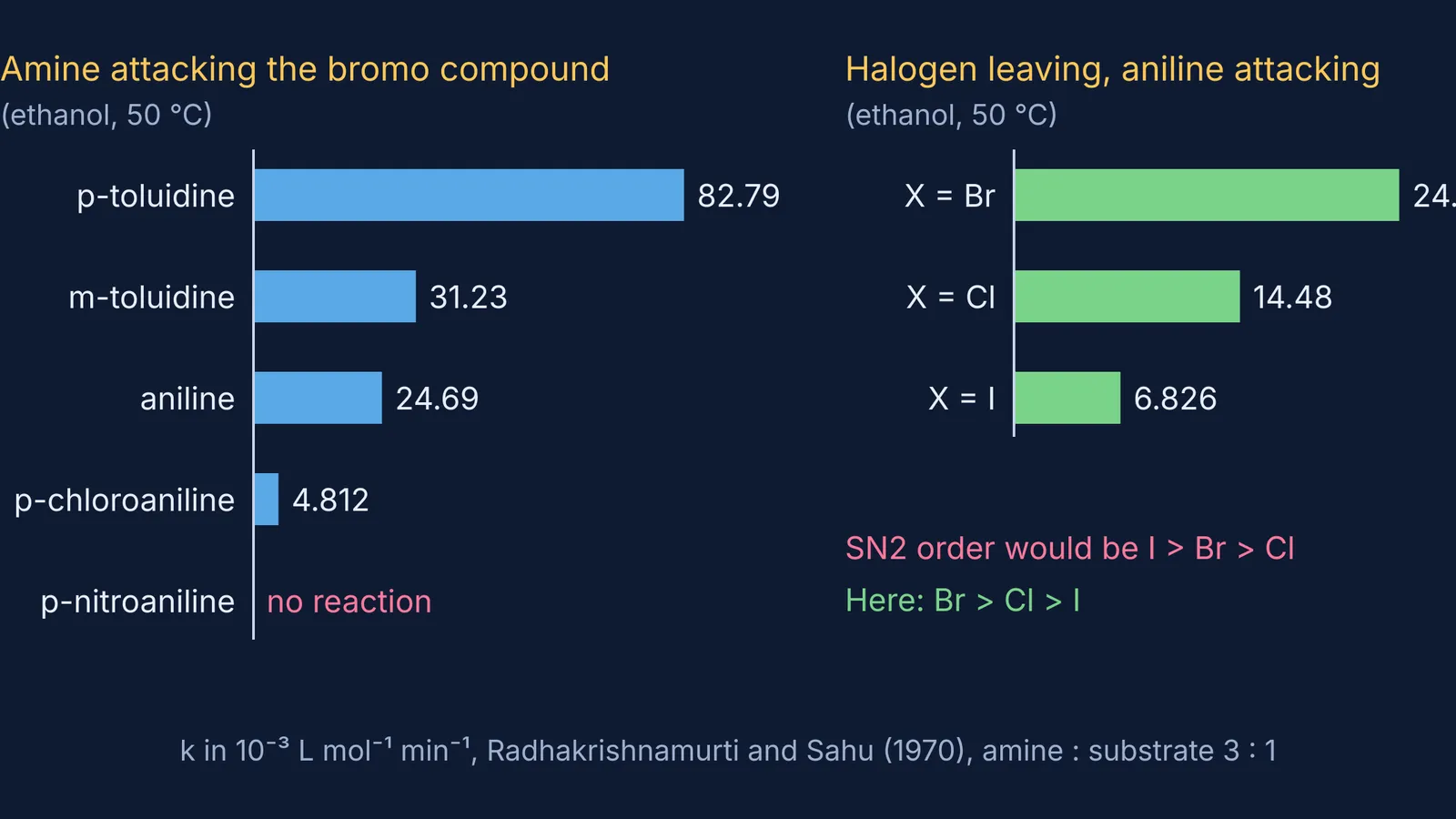
Table I, bromo compound, ethanol, amine : substrate 3 : 1, k in 10⁻³ L mol⁻¹ min⁻¹:
p-Toluidine: 82.79
m-Toluidine: 31.23
Aniline: 24.69
p-Chloroaniline: 4.812
m-Nitroaniline: 0.2592, in ethanol–DMSO only (aniline there: 32.13)
p-Nitroaniline and o-nitroaniline: no reaction
That is the basicity order of these anilines. Approximate pKa values of the conjugate acids, from standard tables (not the paper): p-toluidine 5.1, m-toluidine 4.7, aniline 4.6, p-chloroaniline 4.0, m-nitroaniline 2.5, p-nitroaniline 1.0.
The nitrogen lone pair does the attacking, so anything that makes it more available speeds the reaction:
–CH₃ pushes electron density into the ring, and most strongly from the para position. p-Toluidine is 3.35 times as fast as aniline.
–Cl withdraws by its inductive effect more than it donates by resonance. p-Chloroaniline is 0.195 times as fast.
–NO₂ at ortho or para pulls the lone pair into the ring by resonance. The amine is then too poor a nucleophile to react under these conditions.
The authors read the silence of p-nitroaniline as a sign that forming the new C–N bond matters most. Why the lone pair of aniline is less available than that of an alkylamine is explained in why benzylamine is more basic than aniline.
Why is bromide the fastest leaving group here, not iodide?
Table III keeps the amine fixed (aniline, 3 : 1, ethanol) and changes the halogen:
2,4-Dinitro-1-bromobenzene: 24.69
2,4-Dinitro-1-chlorobenzene: 14.48
2,4-Dinitro-1-iodobenzene: 6.826
The order is Br > Cl > I, and it holds in all four solvents. Our ratios from the ethanol column: Br/Cl = 1.71 and I/Cl = 0.47.
In SN1 and SN2 at a saturated carbon, the order is I > Br > Cl, because the C–X bond breaks in the slow step and C–I is the weakest bond. The paper itself makes this contrast. The SNAr order is different.
The standard addition–elimination picture explains why (this is the modern textbook account, not a quote from the paper):
Addition (slow). The amine adds to the carbon that carries the halogen. The ring loses its aromaticity and becomes a negatively charged σ-complex (Meisenheimer complex). The extra charge spreads onto the oxygens of the 2- and 4-nitro groups.
Elimination (fast). The halide leaves, aromaticity comes back, and the N–H proton is lost.
The C–X bond is not broken in the slow step, so the C–X bond strength does not decide the rate. The halogen acts mainly through its effect on the addition step. That is why the three rates sit within a factor of about 3.6 of each other, and why iodine, the easiest to break off in SN2, comes last here.
As of 1970, the authors judged a slow breakdown of the intermediate unlikely and favoured rate-determining bond formation. To explain Br beating Cl they added a 1957 idea of J. F. Bunnett about halogen polarisability. That extra idea belongs to its period; for exams, use the picture above.
Caution: Br > Cl > I is what this paper found for these amines and solvents. Fluorine was not studied, so do not stretch it to every SNAr reaction.
Why does the solvent change the rate?
For every amine and halogen the order was ethanol–DMSO > ethanol–DMF > ethanol > ethanol–acetonitrile. For aniline with the bromo compound the extremes are 32.13 and 14.72, a factor of 2.2. The authors' 1970 explanation: the transition state is a stronger hydrogen-bond donor than the amine, and DMSO is a stronger hydrogen-bond acceptor than ethanol, so DMSO stabilises it more.
Worked example: how long does half the bromo compound take to react?
Question. 2,4-Dinitro-1-bromobenzene (a₀ = 0.025 M) reacts with aniline (b₀ = 0.075 M) in ethanol at 50 °C, with k = 24.69 × 10⁻³ L mol⁻¹ min⁻¹. Take rate = k[ArBr][aniline] and assume one aniline is used per substitution. Find the time for 50% of the bromo compound to react.
This is our calculation, not the paper's; it ignores any amine that takes up the HBr.
Integrated rate law for unequal concentrations. k t = [1/(b₀ − a₀)] ln[a₀(b₀ − x)/(b₀(a₀ − x))].
Amount reacted. x = 0.5 × 0.025 = 0.0125 M.
Log term. a₀(b₀ − x) = 0.025 × 0.0625 = 0.0015625. b₀(a₀ − x) = 0.075 × 0.0125 = 0.0009375. Ratio = 1.667, ln 1.667 = 0.511.
Prefactor. k(b₀ − a₀) = 0.02469 × 0.050 = 0.0012345 min⁻¹.
Time. t = 0.511 ÷ 0.0012345 = 414 min, about 6.9 hours.
With p-toluidine (k = 82.79 × 10⁻³) the same steps give 123 min. If you treat aniline as constant at 0.075 M (pseudo-first-order), you get 0.693 ÷ (0.02469 × 0.075) = 374 min, about 10% short, because the amine does run down.
For more integrated rate law problems, the Fermi Problem Library has a step-by-step solver that explains the reasoning.
Where does this appear in the JEE and NEET syllabus?
Exam line: Class 12 Haloalkanes and Haloarenes (nucleophilic substitution in nitro-activated haloarenes), Class 12 Amines (effect of –CH₃, –Cl and –NO₂ on the basicity of aniline) and Class 12 Chemical Kinetics (second-order rate law). If you are revising these chapters for JEE Main and Advanced, Fermi Test Prep offers practice with an AI tutor.
Quick checklist
2,4-Dinitrohalobenzene + ArNH₂ → 2,4-dinitrodiphenylamine + HX, second order overall.
k did not change between 1 : 1 and 1 : 3, so extra amine did not catalyse.
Rate follows amine basicity: p-toluidine 82.79 > m-toluidine 31.23 > aniline 24.69 > p-chloroaniline 4.812; p-nitroaniline none.
Leaving group: Br > Cl > I here; SN1/SN2 is I > Br > Cl.
Slow step in SNAr is addition, giving a Meisenheimer complex.