On this page
Hydrogen peroxide can reduce chlorine dioxide to chlorite, but only if something is there to take up the acid the reaction makes. In 1956 S. M. Mehta and D. J. Mehta at the Institute of Science, Bombay, showed this with a set of yield measurements. Their short paper, "Use of sodium perborate in the preparation of sodium chlorite", is a clean redox and stoichiometry lesson.
What did Mehta and Mehta measure in 1956?
Sodium chlorite, NaClO₂, was sold in a bleaching product called "Textone". The paper says it was usually made by passing chlorine dioxide into hydroxides or peroxides of alkali and alkaline earth metals. An earlier note by G. R. Levi (1936, cited in the paper) had found that perborates and percarbonates give chlorite but persulphates do not. The Mehtas wanted numbers.
They passed ClO₂ into sodium perborate (NaBO₃·4H₂O) solution at 29–30 °C and titrated the chlorite formed, then repeated this with hydrogen peroxide, boric acid, borax, NaOH, Na₂CO₃ or NaHCO₃ added. The yields are given as a percentage of a theoretical amount; on every row we checked, that theory is 2 mol of NaClO₂ per mol of peroxide.
This post is about the chemistry. How the same laboratory used redox to analyse copper oxides is covered in Mehta and Bharucha's 1952 copper analysis.
What did the controls show?
From the paper's tables and text:
ClO₂ with H₂O₂ alone: no chlorite.
ClO₂ with H₂O₂ and boric acid: no chlorite.
ClO₂ with NaOH alone: "very small" amounts of chlorite.
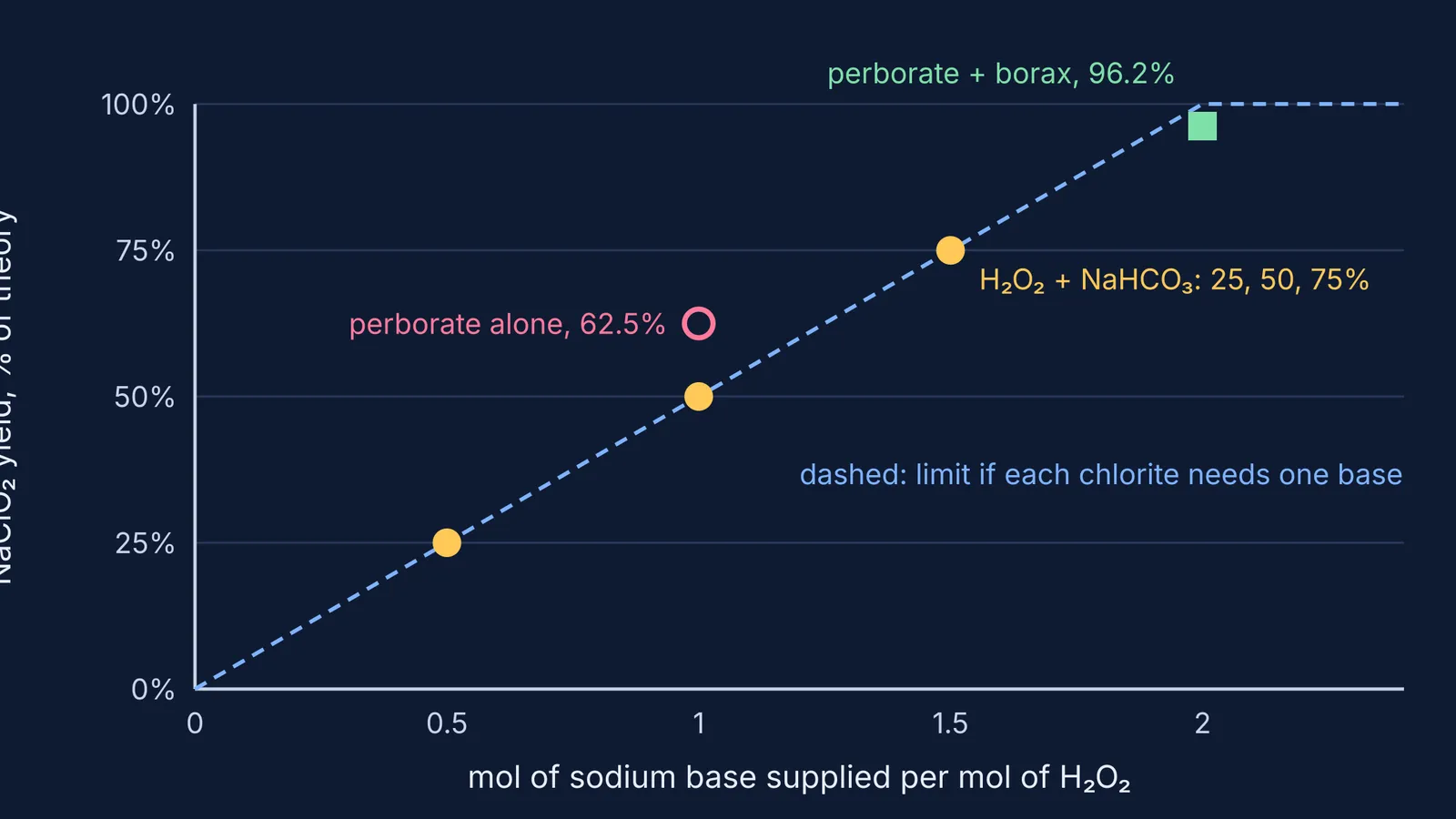
ClO₂ with perborate alone: a steady 62.5% of theory at low loadings.
Perborate plus borax or NaOH: 96.2%.
Perborate plus extra H₂O₂ or boric acid: the same mass of chlorite as perborate alone.
Reductant alone does nothing, base alone very little, and together they give a nearly complete yield. The authors concluded that "the available oxygen as well as the alkalinity of the solution" together decide the yield. Perborate, they noted, acts like H₂O₂ plus alkali in a solid, stable form.
In water, written as the simple formula, perborate releases hydrogen peroxide and borate:
NaBO₃·4H₂O → Na⁺ + B(OH)₄⁻ + H₂O₂ + H₂O
Why does H₂O₂ reduce ClO₂ only when alkali is present?
The paper gives no equation. Ours, consistent with its 2 : 1 theory basis, is:
2ClO₂ + H₂O₂ + 2OH⁻ → 2ClO₂⁻ + O₂ + 2H₂O
Chlorine goes from +4 in ClO₂ to +3 in ClO₂⁻. Each ClO₂ gains one electron, so two ClO₂ gain two. The peroxide oxygen goes from −1 to 0 in O₂ and the H₂O₂ loses two electrons. H₂O₂ is the reducing agent, as in its other reducing reactions in basic solution, covered in how H₂O₂ acts as both an oxidising and a reducing agent.
Now write the same change without the hydroxide:
2ClO₂ + H₂O₂ → 2ClO₂⁻ + 2H⁺ + O₂
Every chlorite ion made comes with one H⁺. The next three points are modern reasoning, not the paper's:
The acid has to go somewhere. If nothing removes the H⁺, the solution turns acidic. Chlorite then becomes chlorous acid, HClO₂, which is a weak and unstable acid.
Peroxide is a much stronger reductant in base. H₂O₂ is a very weak acid (pKa about 11.6), so alkali turns it into HO₂⁻. Approximate standard potentials: ClO₂/ClO₂⁻ is +0.95 V. O₂/H₂O₂ is +0.70 V in acid, but O₂/HO₂⁻ is about −0.08 V in base. The driving force grows from roughly 0.26 V to about 1.03 V.
In acid, peroxide and ClO₂ can coexist. Industry makes ClO₂ from chlorate and H₂O₂ in strong acid, as explained in how chlorine dioxide bleaches paper.
What about NaOH alone? Textbooks give 2ClO₂ + 2OH⁻ → ClO₂⁻ + ClO₃⁻ + H₂O, so ClO₂ acts as a mixed anhydride. That route turns at most half the chlorine into chlorite, and the other half into chlorate. With peroxide present, all of the chlorine can end up as chlorite.
Why does the yield follow the amount of base?
The bicarbonate runs (Table VI) show this most clearly: H₂O₂ with NaHCO₃ in mole ratios 1 : 0.5, 1 : 1 and 1 : 1.5. gave 25.0%, 50.0% and 75.0% of theory, row after row.
Each HCO₃⁻ removes one H⁺ (HCO₃⁻ + H⁺ → CO₂ + H₂O). By the equation, one H⁺ appears for every chlorite ion. So, on our reading, the moles of chlorite cannot exceed the moles of bicarbonate. Theory allows 2 mol of chlorite per mol of H₂O₂, so 0.5 mol of base gives 0.5 ÷ 2 = 25%, 1 mol gives 50% and 1.5 mol gives 75%. The base is the limiting reagent.
Two results do not fit this simple count:
Perborate alone supplies one Na⁺ and one borate per H₂O₂. A simple base count predicts 50%. The measured yield was 62.5%. The paper does not explain the difference, and we will not guess.
Sodium carbonate gave less than its base content predicts (about 64% at 1 : 1). The authors suggest H₂O₂ decomposes in the more strongly alkaline solution.
The yield also fell at high loadings of perborate: 61.0% at 0.05 mol, 55.2% at 0.1 mol and 45.7% at 0.2 mol in 100 mL. The authors put this down to chlorite decomposing at high concentration.
How do you calculate the chlorite yield? A worked example
Question. 0.010 mol H₂O₂ and 0.015 mol NaHCO₃ in water are treated with excess ClO₂. Using 2ClO₂ + H₂O₂ + 2OH⁻ → 2ClO₂⁻ + O₂ + 2H₂O, find the maximum mass of NaClO₂ and the percentage yield based on peroxide. (Na = 22.99, Cl = 35.45, O = 16.00.)
Molar mass. NaClO₂ = 22.99 + 35.45 + 2 × 16.00 = 90.44 g/mol.
Theory from peroxide. 1 mol H₂O₂ gives 2 mol ClO₂⁻. So 0.010 mol gives 0.020 mol, which is 0.020 × 90.44 = 1.809 g.
Limit from base. One base is used per chlorite. 0.015 mol NaHCO₃ allows only 0.015 mol ClO₂⁻.
Limiting reagent. 0.015 is less than 0.020, so the bicarbonate limits. Maximum NaClO₂ = 0.015 × 90.44 = 1.357 g.
Yield. 1.357 ÷ 1.809 × 100 = 75.0%.
The Mehtas measured 1.357 g and 74.98% for this mixture. For more limiting-reagent and redox problems, the Fermi Problem Library has a step-by-step solver that explains the reasoning.
Where does this appear in the JEE and NEET syllabus?
Exam line: Class 11 Redox Reactions (oxidation numbers of Cl in ClO₂ and ClO₂⁻, H₂O₂ as a reductant, balancing in basic medium), with Class 11 stoichiometry for limiting reagent and percentage yield. If you are revising these chapters for JEE Main and Advanced, Fermi Test Prep offers practice with an AI tutor.
If you read the paper, note that Table II's percentage is per total peroxide, including added H₂O₂, so it falls while the grams of chlorite stay constant.
Quick checklist
Cl is +4 in ClO₂, +3 in ClO₂⁻ and +5 in ClO₃⁻.
In this reaction H₂O₂ is the reductant and is oxidised to O₂.
No base, no chlorite: ClO₂ with H₂O₂ alone gave none.
One chlorite needs one base; with NaHCO₃ the yield was 25, 50 and 75% at 0.5, 1 and 1.5 mol.
Perborate alone gave 62.5%, which the paper leaves unexplained.
Chlorine dioxide is a toxic gas that can decompose explosively. This chemistry is for reading, not for trying.