

On this page
Most reagents you meet in redox chemistry pick a side. KMnO₄ oxidises, SnCl₂ reduces. Hydrogen peroxide does both, and exam questions test whether you can tell which job it is doing in a given reaction. The reason lies in one number: the oxidation state of oxygen in H₂O₂ is −1. Below you will find the four half-equations to learn, the standard examples with balanced equations, a rule for spotting the role, and a fully worked balancing of KMnO₄ with H₂O₂.
Why can H₂O₂ act as both an oxidising and a reducing agent?
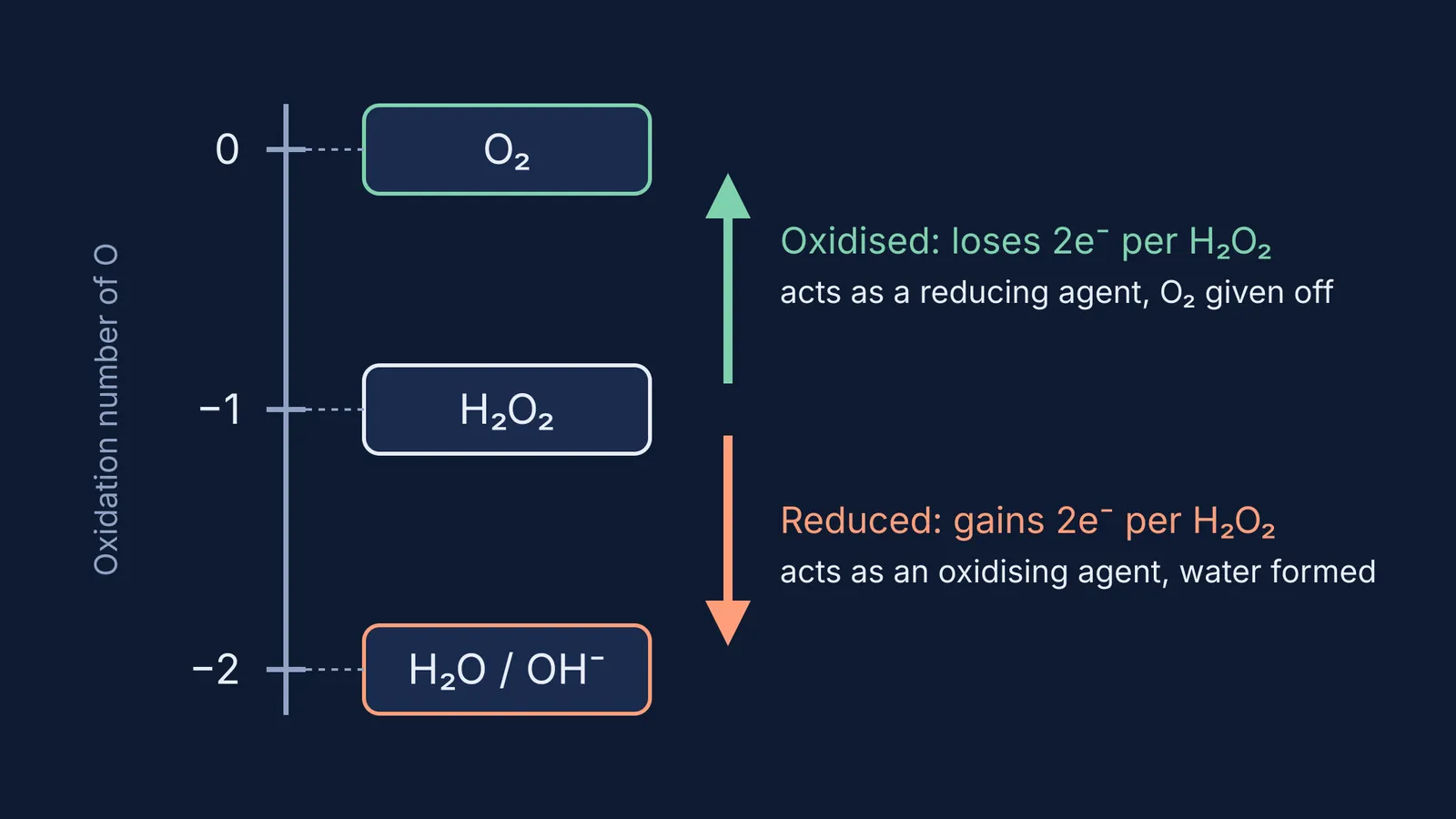
In H₂O₂, each hydrogen is +1, so the two oxygens share −2 between them: each is −1. Oxygen's common oxidation states run from −2 (in water and oxides) to 0 (in O₂). The −1 state sits in the middle, so oxygen in H₂O₂ can move in either direction:
Down to −2, forming H₂O or OH⁻. Oxygen gains electrons, so H₂O₂ is reduced and acts as an oxidising agent.
Up to 0, forming O₂. Oxygen loses electrons, so H₂O₂ is oxidised and acts as a reducing agent.
The −1 state also comes from the O–O single bond. Our post on why H₂O₂ has an open book structure shows that peroxide link, and it is this weak bond that breaks in most of the reactions below. A species with an element in an intermediate oxidation state, such as SO₂ or HNO₂, can usually act both ways; H₂O₂ is the most common example in the syllabus.
What are the half-equations for H₂O₂ in acidic and basic medium?
Learn these four. Each one moves 2 electrons per H₂O₂, because two oxygen atoms each change by 1.
As an oxidising agent:
Acidic medium: H₂O₂ + 2H⁺ + 2e⁻ → 2H₂O
Basic medium: H₂O₂ + 2e⁻ → 2OH⁻
As a reducing agent:
Acidic medium: H₂O₂ → O₂ + 2H⁺ + 2e⁻
Basic medium: H₂O₂ + 2OH⁻ → O₂ + 2H₂O + 2e⁻
Check the last one: on the left, H = 2 + 2 = 4, O = 2 + 2 = 4 and charge = −2. On the right, H = 4, O = 2 + 2 = 4 and charge = −2 (from the two electrons). Every equation in this post balances the same way, in atoms and in charge.
Which reactions show H₂O₂ as an oxidising agent?
Here H₂O₂ takes electrons from the other reactant and ends up as water or hydroxide.
Ferrous to ferric in acid: 2Fe²⁺ + H₂O₂ + 2H⁺ → 2Fe³⁺ + 2H₂O
Iodide to iodine in acid: 2I⁻ + H₂O₂ + 2H⁺ → I₂ + 2H₂O. The brown iodine (blue with starch) makes this a common test for H₂O₂.
Lead sulphide to lead sulphate: PbS + 4H₂O₂ → PbSO₄ + 4H₂O. Sulphur goes from −2 to +6, an 8-electron change, so it needs four H₂O₂. This is how old oil paintings are restored: white lead pigment that has turned black as PbS is converted to white PbSO₄.
Chromium(III) to chromate in base: 2Cr³⁺ + 3H₂O₂ + 10OH⁻ → 2CrO₄²⁻ + 8H₂O. Chromium goes from +3 to +6, losing 3 electrons each, 6 in total, matched by three H₂O₂ gaining 2 each.
Which reactions show H₂O₂ as a reducing agent?
Here H₂O₂ gives up electrons and oxygen gas is released.
Permanganate in acid: 2MnO₄⁻ + 5H₂O₂ + 6H⁺ → 2Mn²⁺ + 5O₂ + 8H₂O. The purple colour disappears.
Permanganate in base: 2MnO₄⁻ + 3H₂O₂ → 2MnO₂ + 3O₂ + 2H₂O + 2OH⁻. Mn goes only to +4 here, so 3 electrons per Mn.
Silver oxide: Ag₂O + H₂O₂ → 2Ag + H₂O + O₂
Iodine in base: I₂ + H₂O₂ + 2OH⁻ → 2I⁻ + 2H₂O + O₂. Compare this with the iodide reaction above: the same pair goes in opposite directions depending on the medium.
Chlorine and hypochlorite (antichlor action): Cl₂ + H₂O₂ → 2HCl + O₂, and OCl⁻ + H₂O₂ → Cl⁻ + H₂O + O₂. This is used to remove excess chlorine after bleaching.
H₂O₂ also does both jobs at once. In decomposition, 2H₂O₂ → 2H₂O + O₂, one oxygen pair goes down to −2 and the other goes up to 0. That is disproportionation, and it is why H₂O₂ slowly loses strength on standing.
How do you tell which role H₂O₂ plays in a reaction?
Look at two things: the partner and the product.
The product. If O₂ is given off, H₂O₂ was oxidised, so it acted as a reducing agent. If only H₂O or OH⁻ forms from it, it was reduced, so it acted as an oxidising agent.
The partner. Against a strong oxidant such as MnO₄⁻, Cr₂O₇²⁻, Cl₂ or Ag₂O, H₂O₂ is pushed to give up electrons. Against an easily oxidised species such as Fe²⁺, I⁻ (in acid), S²⁻ or Cr³⁺ (in base), it takes electrons.
Confirm with oxidation numbers. Find the element in the partner that changes. If it goes up, H₂O₂ is the oxidant; if it goes down, H₂O₂ is the reductant.
The n-factor of 2 is what links molarity, normality and volume strength in titration questions. If those conversions trip you up, read our guide on how to calculate the volume strength of hydrogen peroxide.
How do you balance KMnO₄ with H₂O₂ in acidic medium?
Worked example: balance MnO₄⁻ + H₂O₂ → Mn²⁺ + O₂ in acidic solution.
Assign oxidation numbers. Mn goes from +7 to +2: it gains 5 electrons. Oxygen in H₂O₂ goes from −1 to 0 in O₂: each H₂O₂ loses 2 electrons. So MnO₄⁻ is the oxidant and H₂O₂ the reductant.
Equalise electrons. The LCM of 5 and 2 is 10. Take 2MnO₄⁻ (gaining 10 electrons) and 5H₂O₂ (losing 10 electrons).
Write the skeleton: 2MnO₄⁻ + 5H₂O₂ → 2Mn²⁺ + 5O₂
Balance oxygen with water. Left: 8 + 10 = 18 O. Right: 10 O in O₂. Add 8H₂O on the right.
Balance hydrogen with H⁺. Left: 10 H. Right: 16 H. Add 6H⁺ on the left.
Final equation: 2MnO₄⁻ + 5H₂O₂ + 6H⁺ → 2Mn²⁺ + 5O₂ + 8H₂O
Check charge. Left: −2 + 6 = +4. Right: 2 × (+2) = +4. Balanced.
In molecular form, with sulphuric acid: 2KMnO₄ + 3H₂SO₄ + 5H₂O₂ → K₂SO₄ + 2MnSO₄ + 8H₂O + 5O₂. Notice that all the O₂ comes from H₂O₂, not from permanganate, which is why the coefficient of O₂ equals that of H₂O₂.
If you balanced it differently and are not sure where you went wrong, the Fermi Problem Library has a step-by-step solver that explains the reasoning, so you can compare each step with yours.
Checklist before your exam
Oxygen in H₂O₂ is −1, between −2 and 0, so it can go either way.
Oxidant: H₂O₂ + 2H⁺ + 2e⁻ → 2H₂O (acid); H₂O₂ + 2e⁻ → 2OH⁻ (base).
Reductant: H₂O₂ → O₂ + 2H⁺ + 2e⁻ (acid); H₂O₂ + 2OH⁻ → O₂ + 2H₂O + 2e⁻ (base).
O₂ given off means H₂O₂ acted as a reducing agent.
Oxidises Fe²⁺, I⁻, PbS and Cr³⁺ (base); reduces MnO₄⁻, Ag₂O, Cl₂ and OCl⁻.
n-factor is 2, except 1 in disproportionation.
KMnO₄ in acid: 2MnO₄⁻ + 5H₂O₂ + 6H⁺ → 2Mn²⁺ + 5O₂ + 8H₂O.


