On this page
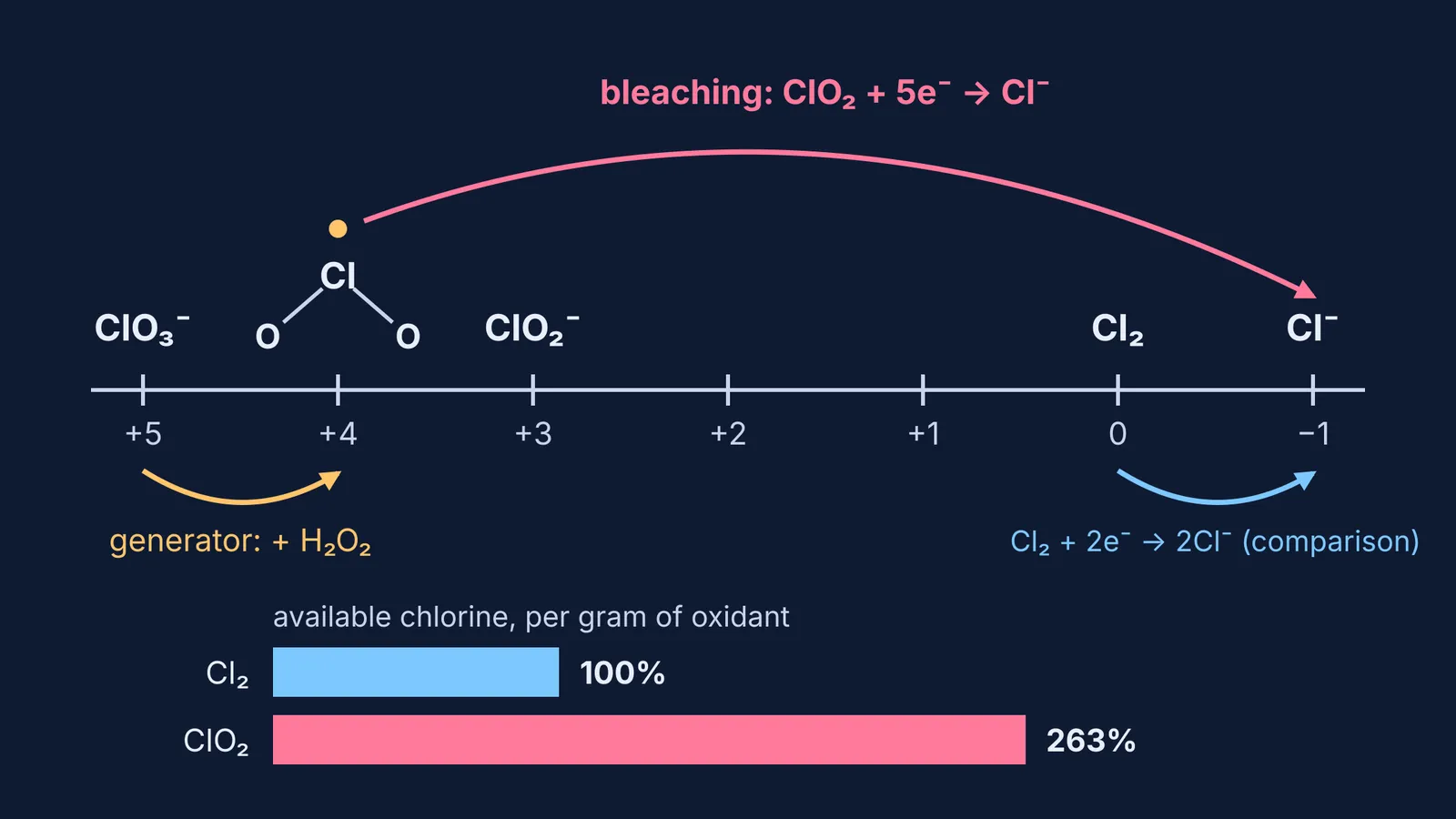
Paper mills used to whiten wood pulp with chlorine gas. Most have since switched to chlorine dioxide, ClO₂, the odd-electron oxide NCERT asks you to draw. Mill reports then say something that looks impossible: a kilogram of ClO₂ counts as 2.63 kg of chlorine, or "263% available chlorine". The number is not a misprint. It comes straight out of oxidation states and n-factors, the same counting you use in redox titrations.
Why did paper mills stop bleaching with chlorine gas?
Pulp still holds some lignin after cooking, and lignin is what makes unbleached pulp brown. Bleaching oxidises it into pieces that wash out. Chlorine gas does this, but it also adds chlorine atoms to lignin's aromatic rings. The chlorinated organic by-products included traces of dioxins, a family of persistent, toxic compounds (the same class discussed in why burning plastic waste is harmful).
The fix was elemental chlorine free (ECF) bleaching. The Wikipedia article on ECF defines it as a technique that uses chlorine dioxide to bleach wood pulp, and the chlorine dioxide article says about 95% of bleached kraft pulp is now made with ClO₂ in ECF sequences. ClO₂ oxidises lignin mainly by removing electrons, with much less chlorination of the rings.
Two clarifications that examiners and readers both get wrong:
ECF is not chlorine-free. ClO₂ contains chlorine, and chlorinated by-products still form. They are much lower, not zero.
TCF is a different process. "Totally chlorine free" pulp uses no chlorine compounds at all, bleaching with oxygen, ozone or hydrogen peroxide instead.
How chlorine bleaches a coloured dye, and why that differs from SO₂ bleaching, is covered in why chlorine bleaching is permanent but SO₂ bleaching is not.
Why is chlorine dioxide made at the mill?
ClO₂ has 7 + 6 + 6 = 19 valence electrons, so one is unpaired. That makes it a paramagnetic radical, and its bent shape and 117.4° angle are worked out in structures of SO₂, SO₃, ClO₂ and Cl₂O₇. It is also unstable. According to the chlorine dioxide article, the gas may decompose explosively at partial pressures above 10 kPa. So it is never shipped. Mills make it on site as a dilute solution in water, by reducing sodium chlorate.
One common route uses hydrogen peroxide in acid:
2ClO₃⁻ + H₂O₂ + 2H⁺ → 2ClO₂ + O₂ + 2H₂O
Check it: 2 Cl on each side; 8 O on each side (6 + 2, then 4 + 2 + 2); 4 H on each side; charge 0 on both sides. In terms of electrons, each Cl goes from +5 to +4 (gains one electron), and each H₂O₂ oxygen goes from −1 to 0, so one H₂O₂ gives up the two electrons that two chlorates need. Other generators use methanol or hydrochloric acid as the reductant instead; the chlorine dioxide article notes that the methanol and peroxide routes avoid making chlorine gas as a by-product.
How many electrons does ClO₂ take when it bleaches?
In bleaching, most of the ClO₂ ends up as chloride, Cl at −1. From +4 to −1 is five electrons:
ClO₂ + 4H⁺ + 5e⁻ → Cl⁻ + 2H₂O
Check: 2 O and 4 H on each side; charge on the left is +4 − 5 = −1, matching Cl⁻. In practice the path is messy and some ClO₂ ends up as chlorate instead, which wastes oxidising power. But five electrons is the full value, and it is the one the industry convention uses.
Compare chlorine gas: Cl₂ + 2e⁻ → 2Cl⁻. One mole of Cl₂ (70.9 g) takes two electrons.
Worked example: why does ClO₂ count as 263% chlorine?
"Available chlorine" expresses any oxidant as the mass of Cl₂ that would do the same oxidising. It compares electrons accepted, not chlorine atoms. The iodometric titrations guide uses the same idea for bleaching powder. Molar masses: ClO₂ 67.45, Cl₂ 70.90, NaClO₃ 106.44 g mol⁻¹.
(a) Available chlorine of ClO₂
One mole of ClO₂ (67.45 g) accepts 5 mol of electrons.
Cl₂ accepts 2 mol of electrons per mole, so 5 mol of electrons is the work of 5/2 = 2.5 mol of Cl₂.
Mass of that Cl₂: 2.5 × 70.90 = 177.3 g.
So 67.45 g of ClO₂ oxidises like 177.3 g of Cl₂. The ratio is 177.3/67.45 = 2.63.
One kilogram of ClO₂ therefore counts as 2.63 kg of chlorine, or 263% available chlorine. A ClO₂ molecule holds one chlorine atom, not 2.63; the number is about oxidising equivalents.
(b) Chlorate needed
Suppose a bleaching stage uses 10 kg of ClO₂ per tonne of pulp (a teaching number; real charges vary). Each NaClO₃ gives one ClO₂, so the minimum chlorate is 10 × 106.44/67.45 = 15.8 kg. Real generators need a little more because the yield is not 100%.
(c) The n-factor that changes with pH
ClO₂ is often measured by iodometry. At neutral pH, iodide reduces ClO₂ only to chlorite, one electron. The ATSDR toxicological profile on chlorine dioxide describes exactly this in neutrally buffered KI:
2ClO₂ + 2I⁻ → 2ClO₂⁻ + I₂
Acidify to about pH 2 and the chlorite takes four more electrons:
ClO₂⁻ + 4I⁻ + 4H⁺ → Cl⁻ + 2I₂ + 2H₂O
So the same sample uses 1 mol of thiosulphate per mol of ClO₂ at pH 7, and 5 mol in total once it is acidified. Water labs use this split to tell ClO₂ from chlorite already in the water, as in the sequential titration of Standard Methods 4500-ClO₂ C.
Try it, assuming no free chlorine or chlorate is present (a simplified case). A 250 mL sample needs 1.50 mL of 0.0100 M thiosulphate at pH 7, then a further 7.50 mL after acidifying to pH 2.
pH 7 step. Thiosulphate = 1.50 × 10⁻⁵ mol, so ClO₂ = 1.50 × 10⁻⁵ mol. Mass = 1.50 × 10⁻⁵ × 67.45 = 1.01 mg, so 4.05 mg L⁻¹.
What the ClO₂ contributes at pH 2. Its chlorite takes 4 more electrons: 4 × 1.50 × 10⁻⁵ = 6.00 × 10⁻⁵ mol, which is 6.00 mL of titrant.
The extra. 7.50 − 6.00 = 1.50 mL, or 1.50 × 10⁻⁵ mol of electrons, from chlorite that was already there.
Original chlorite. 1.50 × 10⁻⁵/4 = 3.75 × 10⁻⁶ mol × 67.45 g mol⁻¹ = 0.253 mg, so 1.01 mg L⁻¹.
If the n-factor bookkeeping still slips, the Fermi Problem Library has a step-by-step solver that explains the reasoning at each line.
Quick checklist
ECF bleaching uses ClO₂ in place of Cl₂ and cuts chlorinated by-products sharply; it is not chlorine-free. TCF uses no chlorine compounds.
ClO₂ is too unstable to ship, so it is made on site: 2ClO₃⁻ + H₂O₂ + 2H⁺ → 2ClO₂ + O₂ + 2H₂O (Cl +5 → +4).
Bleaching: ClO₂ + 4H⁺ + 5e⁻ → Cl⁻ + 2H₂O, five electrons.
Available chlorine = 2.5 × 70.90/67.45 = 2.63, so 263%. It compares electrons, not atoms.
Iodometry: n = 1 at pH 7 (to chlorite), n = 5 in total at pH 2 (to chloride).