

On this page
Four oxides, one routine: count the electron regions on the central atom and you get the hybridisation, the shape and a bond angle within a few degrees. The measured values below come from the NIST Computational Chemistry Comparison and Benchmark Database.
What are the structures of SO₂ and SO₃?
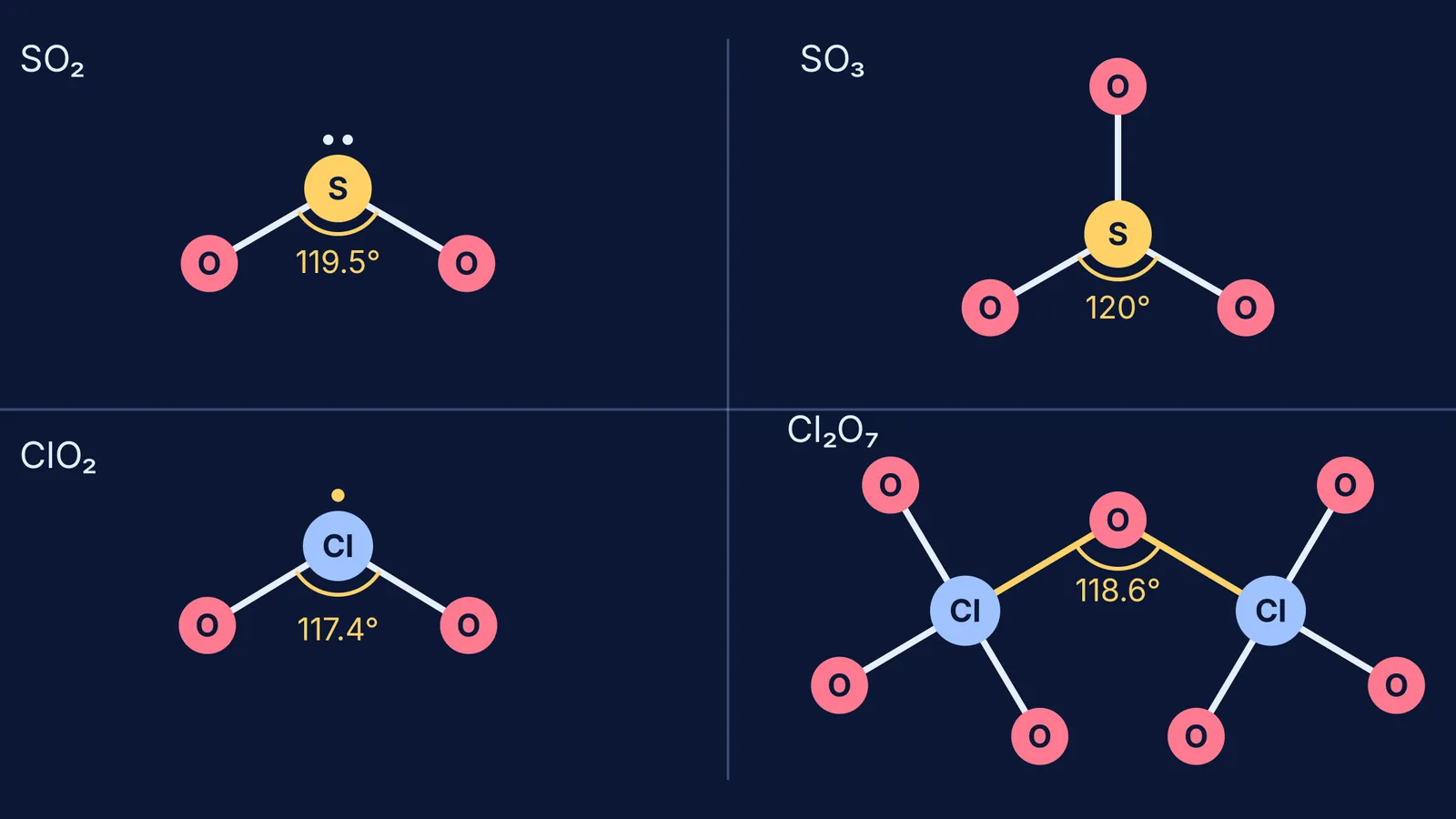
Sulphur has six valence electrons. In SO₂ it forms two σ bonds to oxygen and keeps one lone pair. That makes three electron regions, so sulphur is sp² and the molecule is bent.
The measured O–S–O angle in SO₂ is 119.5° and the S–O bond length is 1.432 Å, according to NIST's experimental geometry for SO₂. The lone pair squeezes the angle just below 120°. Both S–O bonds are the same length, which is why you draw two resonance structures.
In SO₃ all six sulphur electrons go into bonding: three σ bonds, no lone pair, sp², trigonal planar. The O–S–O angle is 120° and each S–O bond is 1.418 Å, per NIST's data for SO₃. The molecule is symmetric (point group D₃h) and has no dipole moment, as the sulphur trioxide entry notes.
One trap: that is gaseous SO₃. Pure SO₃ freezes at 16.8 °C into γ-SO₃, a cyclic trimer, a six-membered ring of alternating sulphur and oxygen atoms (sulphur trioxide). In the trimer each sulphur has four σ bonds, so it is sp³ and tetrahedral. If a question says solid or trimer, the answer changes.
How do you draw ClO₂ and Cl₂O₇?
ClO₂ has 7 + 6 + 6 = 19 valence electrons. That is an odd number, so one electron is unpaired and the molecule is paramagnetic, as the chlorine dioxide entry states. Around chlorine, count two σ bonds, one lone pair and the odd electron. Four regions gives the usual school answer: sp³ and bent.
The measured O–Cl–O angle in ClO₂ is 117.4°, with Cl–O bonds of 1.470 Å (NIST data for ClO₂). That is far wider than the 109.5° an sp³ count suggests: a single electron repels less than a lone pair, and the Cl–O bonds have partial double-bond character.
Cl₂O₇ is two ClO₃ groups joined through one bridging oxygen, with chlorine at +7 (dichlorine heptoxide). Each chlorine has four σ bonds and no lone pair, so it is sp³ and tetrahedral. The bridging oxygen has two bonds and two lone pairs, yet its Cl–O–Cl angle is 118.6°. The bridging Cl–O bonds are 1.709 Å and the terminal ones 1.405 Å, the single-versus-double-bond difference your drawing should show.
Are the pπ–dπ bonds in SO₂ and SO₃ real?
In the textbook model, sulphur has one unhybridised 3p orbital left after sp² hybridisation. It overlaps side-on with an oxygen 2p orbital to make one pπ–pπ bond. Any further π bond has to use an empty sulphur 3d orbital, which gives a pπ–dπ bond.
So in the textbook count, SO₂ has one pπ–pπ and one pπ–dπ bond, and gaseous SO₃ has one pπ–pπ and two pπ–dπ bonds. This worked question on gaseous SO₃ uses exactly this reasoning. In Cl₂O₇ each chlorine is sp³ with no p orbital to spare, so all six Cl=O π bonds count as pπ–dπ. Some guides count differently (this explainer lists two pπ–dπ bonds for SO₂), so use the convention in the book your exam follows.
The model is a simplification. The high energy and poor overlap of sulphur's 3d orbitals mean they play almost no part in bonding, as the overview of hypervalent molecules summarises. SO₂ can be described with s and p orbitals alone, giving each S–O bond an order of 1.5 (sulphur dioxide). In the exam, give the pπ–dπ answer the question expects; for understanding, think resonance.
How do you work out any oxide's shape?
Count valence electrons. An odd total, as in ClO₂, means an unpaired electron and paramagnetism.
Pick the central atom and count σ bonds plus lone pairs. Count a single odd electron as a region.
Turn regions into hybridisation: 3 is sp², 4 is sp³.
Name the shape from the atoms only, ignoring lone pairs.
Adjust the angle: lone pairs squeeze it, a lone electron squeezes it less, multiple bonds take up more room.
Worked example: which has the larger bond angle, SO₂ or ClO₂? NIST gives 119.5° for SO₂ and 117.4° for ClO₂, so SO₂, but only just. An sp³ count alone would have guessed about 109° for ClO₂, which is far off.
The same counting works for the oxides of nitrogen and the oxoacids of phosphorus and sulphur, where every S=O raises the same pπ–dπ question. For chlorine with lone pairs and many bonds, try interhalogen shapes like ClF₃.
When a step goes wrong, recheck the electron count, then try a few in the Fermi Problem Library, where the step-by-step solver explains the reasoning rather than printing an answer. If hybridisation or resonance feels shaky, the Fermi Concept Library has a lesson for each concept in chemistry.


