On this page
Chlorine water whitens a coloured flower for good. Sulphur dioxide whitens it too, but the colour does not stay away for long. The difference is direction: chlorine oxidises, sulphur dioxide reduces, and the oxygen in air can only undo one of those.
What makes a dye coloured in the first place?
"A chromophore is the part of a molecule responsible for its color," according to Wikipedia's entry on chromophores. In many dyes the chromophore is a chain of alternating single and double bonds, called a conjugated system. The same entry explains that the longer the conjugated system, the longer the wavelength of light it can absorb.
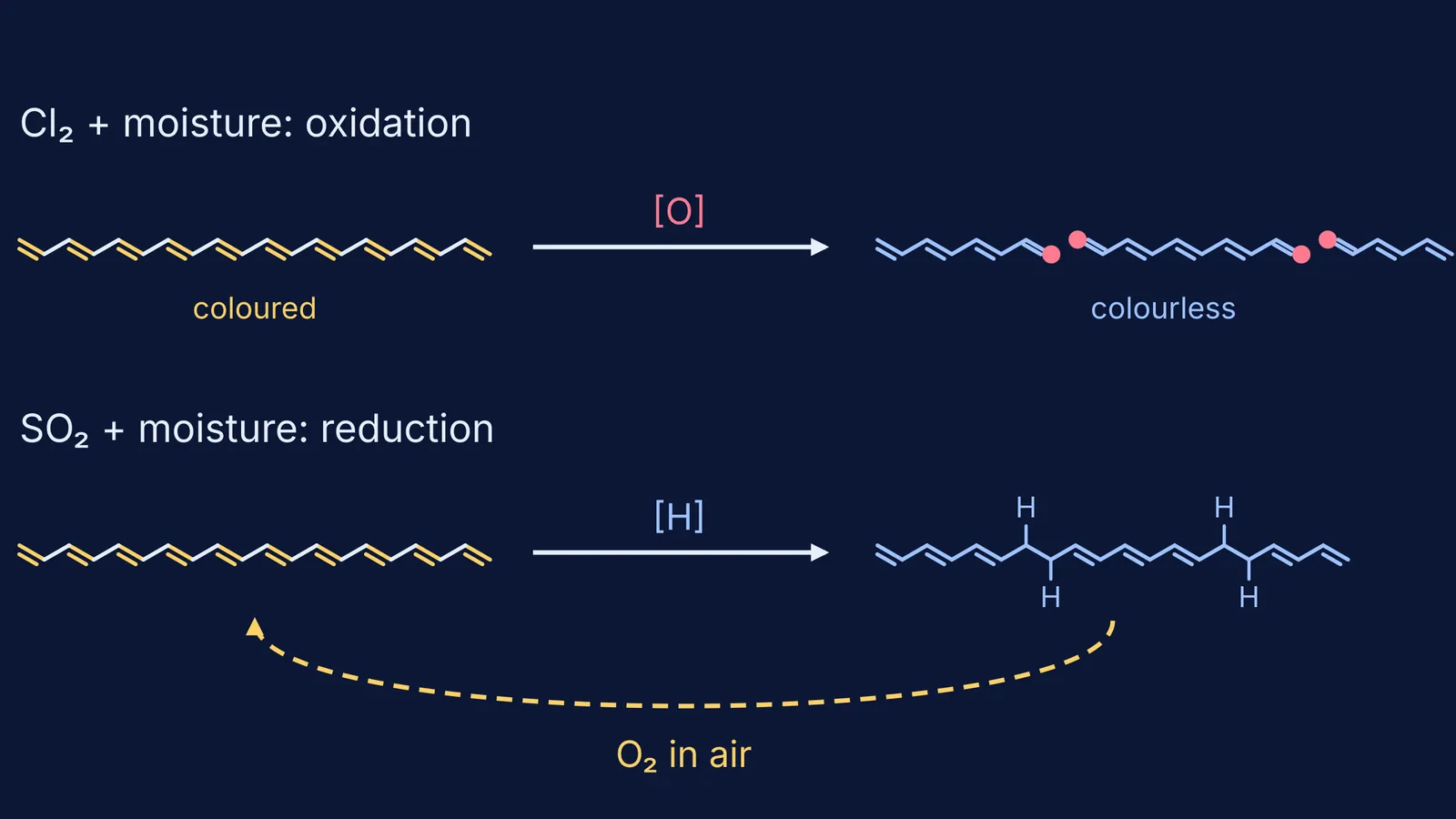
So a bleach does not have to destroy the whole dye molecule. It only has to break that chain or cut it short. Wikipedia's article on bleach names the two ways to do it: oxidising bleaches break the chemical bonds that make up the chromophore, while reducing bleaches convert double bonds in the chromophore into single bonds. Either way, what is left no longer absorbs visible light.
How does chlorine bleach, and why is it permanent?
Chlorine bleaches in the presence of moisture. With water it forms hypochlorous acid, Cl₂ + H₂O ⇌ HOCl + HCl, and the entry on hypochlorous acid describes HOCl as an oxidising agent and a stronger oxidant than chlorine itself. School answers write the same idea with nascent oxygen:
Cl₂ + H₂O → 2HCl + [O]
Coloured substance + [O] → colourless substance
Bonds in the chromophore break and oxygen ends up in the pieces. To restore the colour, something would have to reduce those pieces and rejoin them. The reactive part of air is oxygen, itself an oxidiser, so it cannot do that, and the colour stays gone.
The bleach article records that Claude Berthollet recognised in 1785 that chlorine could be used to bleach fabrics; read his story in Claude Louis Berthollet and chlorine bleach.
How does SO₂ bleach, and what is nascent hydrogen?
Wikipedia's sulfur dioxide entry describes SO₂ as a good reductant that can decolorise substances in the presence of water. The school-answer version is:
SO₂ + 2H₂O → H₂SO₄ + 2[H]
Coloured substance + [H] → colourless substance
The same entry gives sulphur an oxidation state of +4 in SO₂. In H₂SO₄ it is +6 (two hydrogens at +1 and four oxygens at −2 leave +6 for sulphur). Sulphur goes from +4 to +6, so SO₂ is oxidised and the dye is reduced. If oxidation numbers still trip you up, our guide to balancing redox reactions with oxidation numbers and half-reactions walks through them.
Treat [H] as bookkeeping, not as a free atom floating around. The Wikipedia article on nascent hydrogen calls it an outdated concept that has been discredited in organic chemistry. Write [H] and [O] in your answer because they make the electron accounting easy to follow, but know they are shorthand.
The sulfur dioxide entry calls SO₂ a useful reducing bleach for papers and delicate materials such as clothes, and the bleach article notes it is used to bleach wool.
Why does colour come back after SO₂ bleaching?
The sulfur dioxide entry puts it plainly: the bleaching effect normally does not last very long, because oxygen in the atmosphere reoxidises the reduced dyes and restores the colour.
Reduction left the dye's skeleton in one piece; it only turned a few double bonds into single bonds. Reoxidation by air reverses that, the double bonds re-form, the chain is conjugated again, and the colour returns. An oxidiser can reverse a reduction, and air supplies one free. More oxidiser cannot reverse an oxidation.
How do you write this as a full-marks answer?
A typical give-reasons question: "Bleaching by chlorine is permanent but that by sulphur dioxide is temporary. Explain." Here is a model answer in three steps.
Chlorine bleaches by oxidation in the presence of moisture: Cl₂ + H₂O → 2HCl + [O]; coloured matter + [O] → colourless matter.
Sulphur dioxide bleaches by reduction in the presence of moisture: SO₂ + 2H₂O → H₂SO₄ + 2[H]; coloured matter + [H] → colourless matter.
The reduced, colourless product is slowly reoxidised by atmospheric oxygen and regains its colour, while air cannot reverse the oxidation done by chlorine. Hence chlorine bleaching is permanent and SO₂ bleaching is temporary.
Before you move on, check your answer:
Did you write "in the presence of moisture" for both gases?
Did you name the process (oxidation or reduction), not just the gas?
Did you say what air does? Step 3 is the part the question is really asking about.
Is the SO₂ equation balanced? Count it: one S, four O and four H on each side.
For more on structuring answers like this, see our guide to give-reasons questions in CBSE Class 12 chemistry.
If the idea of oxidation and reduction as opposite directions still feels shaky, the Fermi Concept Library gives every chemistry concept its own lesson and its place in the map. To practise more questions like this one, the Fermi Problem Library has worked problems with a step-by-step solver that explains the reasoning rather than printing an answer.