On this page
A class test leaves you with 30 answer scripts and a column of totals. The totals tell you who struggled, not which question or topic let the class down. An AI chatbot can do that breakdown quickly, if you give it the right table, keep names out, and check its arithmetic.
How do you anonymise class marks before pasting them into AI?
India's Digital Personal Data Protection Act, 2023 treats anyone below 18 as a child and requires verifiable consent from a guardian before a child's data is processed, according to PRS Legislative Research's summary of the law. UNESCO's 2023 guidance on generative AI in education asks governments to mandate the protection of data privacy, as UN News reported at its launch. This job needs nothing personal at all.
Copy your marks sheet into a new file and replace each name with a code (S01, S02). Keep the key in your own file; never paste it.
Delete roll numbers, admission numbers, section, school name and remarks.
Keep one row per student, one column per question, plus rows for each question's maximum marks and topic.
Follow your school's policy on AI tools; if there is none, ask first.
What should you ask AI to calculate?
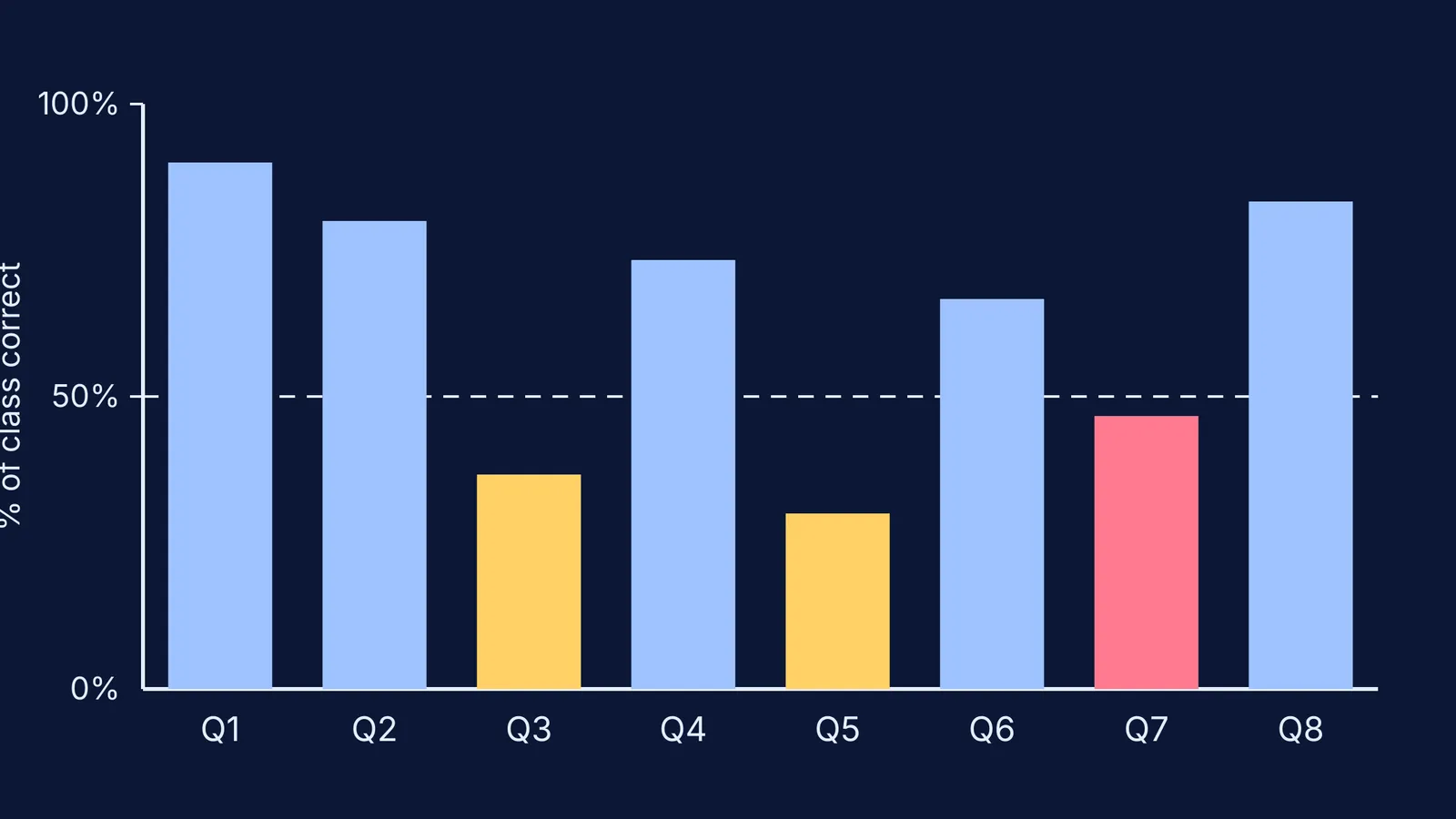
Two numbers from classic item analysis do most of the work. Item difficulty is the percentage of students who answer a question correctly, or for multi-mark questions the average score divided by the maximum, in the University of Washington's item-analysis guide. That guide calls a question easy at 85% or above, moderate at 51-84% and hard at 50% or below.
Item discrimination is a question's ability to separate students who know the material from those who don't, the same guide says. It measures this with a correlation between each question and the total score, and says a question with a negative value should be examined, for example for a mis-keyed answer. A simpler classroom stand-in: rank students by total, split the class into halves, and subtract the bottom half's proportion correct from the top half's.
A prompt you can copy:
"Here is a marks table for 30 students, coded S01 to S30, on an 8-question test. Row 2 gives maximum marks and row 3 the topic. For each question, give the percentage correct, the proportion correct in the top 15 and bottom 15 by total, and the difference. Show the counts you used. Then list any topic averaging 50% or below."
What does the AI's output look like for a class test?
This is an invented Class 9 test on motion, 30 students, eight one-mark questions.
Q1, distance versus displacement: 27 of 30 correct, 90%. Easy; move on.
Q3, area under a velocity-time graph: 11 of 30, 37%. Top half 9 of 15, bottom half 2 of 15, difference 0.47. Hard but fair, so reteach it.
Q5, distance travelled from a velocity-time graph: 9 of 30, 30%. Top half 6, bottom half 3, difference 0.20. Same topic as Q3, so the topic is weak, not one question.
Q7, converting km/h to m/s: 14 of 30, 47%. Top half 6, bottom half 8, difference -0.13. Negative: check the answer key and the wording before blaming the class.
How do you check the AI's sums?
Don't take the table on trust. In a February 2026 preprint, AI-rithmetic by Alex Bie and colleagues found that frontier models' accuracy at adding whole numbers drops as the numbers get longer, with most errors coming from misaligned digits or missed carries. We explain why this happens in why AI makes calculation mistakes in long problems.
Recount two questions by hand, including the one the AI flags as worst.
Check that each question's top-half and bottom-half counts add up to its total correct.
Check that the class average the AI reports matches your register.
Better still, ask for spreadsheet formulas and run them yourself.
How do you turn the results into a reteaching plan?
Sort each flagged question into one of four actions:
Hard, positive discrimination, shared topic (Q3 and Q5): reteach the topic to the whole class, then ask one fresh question on it next lesson.
Hard with negative or near-zero discrimination (Q7): check the question first. Fix the key, rewrite it, or leave it out of the totals.
Moderate, but the same few students low across one topic: a small-group session while others practise.
Easy: move on, and keep one or two for later revision.
Then ask the AI to draft a short reteach with three check questions, and check the physics yourself.
For students who cannot picture what the area under the line means, the Fermi Simulation Lab has interactive simulations for ideas that are easier to see than to read. Fermi's AI tutor works out what a student already knows and builds a plan for the session, which suits the student who missed both graph questions.
When you write the next test, plan its spread of topics with how to build a question paper from a blueprint using AI, and set clear marking for long answers with using AI to draft marking rubrics.