

On this page
Board examiners do not mark a long science answer as a whole. They give marks for named steps. For physics, chemistry or biology, an AI chatbot can draft a rubric for a five-mark question in a minute. That draft only helps once it matches how the board awards marks and you have tried it on real answer sheets.
What should an AI-drafted marking rubric look like?
Start from the board's scheme, not the chatbot's idea of a good answer. CBSE publishes a sample paper and marking scheme for each subject; the Class XII Physics marking scheme for 2026-27 is for a 70-mark theory paper and splits every long answer into small marked steps.
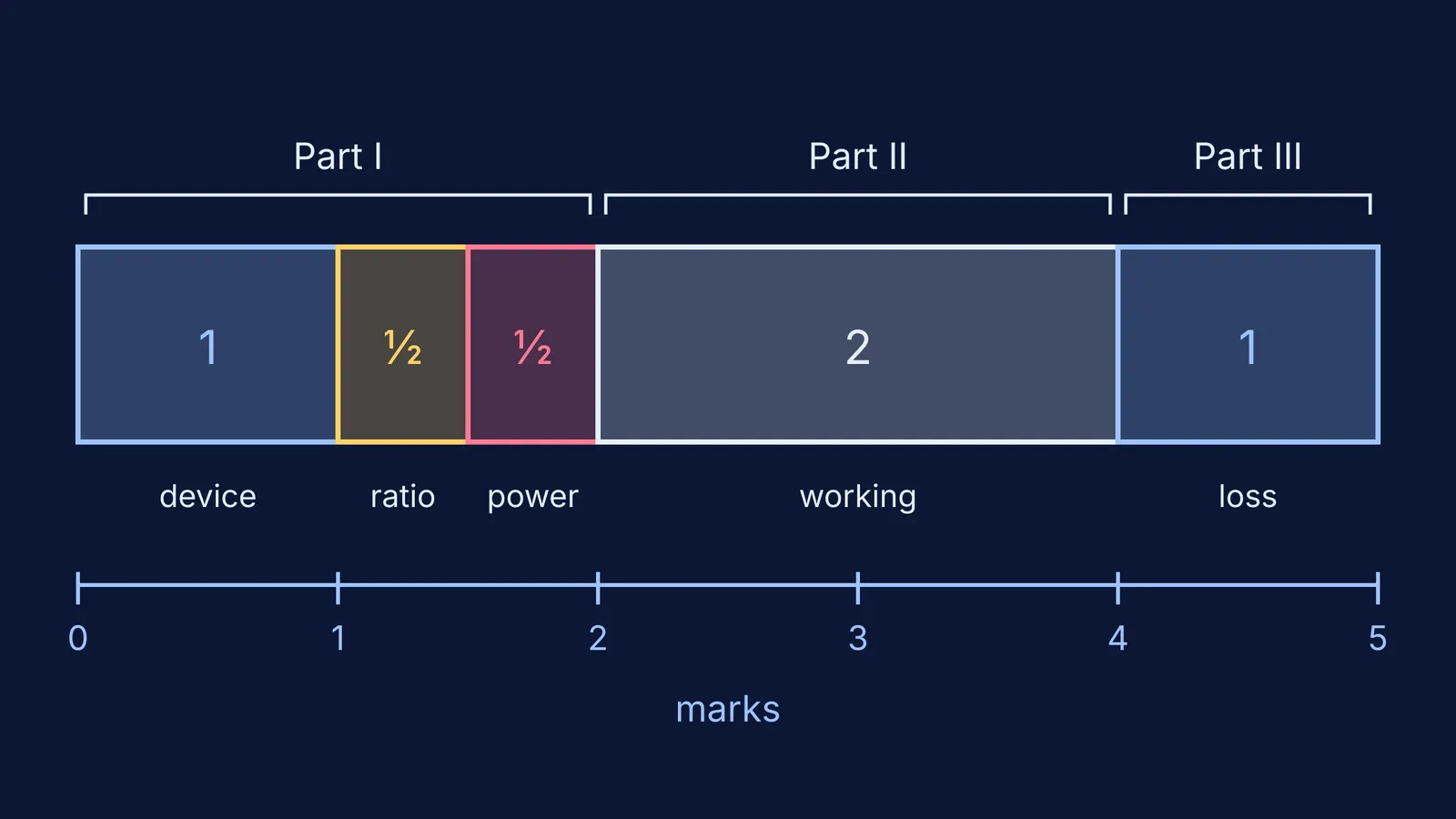
Take its Question 33(A), on the step-up transformer, worth 5 marks. Part I gives 1 mark for naming the device with a diagram, half a mark for the turns ratio and half a mark for showing that input power equals output power. Part II gives 2 marks for the working mechanism. Part III gives 1 mark for any one of four losses: copper, eddy current, hysteresis or flux leakage.
Each criterion in your rubric should have four things:
one thing an examiner can see on the page
its mark value, matching the board's split
the other answers that also earn it ("any one of")
what does not earn it, such as a formula with no symbols explained
How do you prompt AI to draft the rubric?
Paste the question and the official marking scheme, then ask for criteria in that format. A prompt that works:
"Here is a 5-mark CBSE Class 12 physics question and the board's marking scheme."
"Turn the scheme into a rubric with one row per mark or half mark. For each row, give what the examiner must see, other acceptable answers, and a near-miss answer that should not get the mark."
"Do not add criteria that are not in the scheme. Flag any step where the scheme is unclear."
Check the draft line by line: the marks must add up to the total, and every criterion must trace back to the scheme. Our guide to using CBSE marking schemes to write answers that earn the marks shows the same logic from the student's side.
How do you test an AI rubric on real answer scripts?
Mark a small, mixed pile yourself first: some strong answers, some middling and some weak. Then ask the AI to mark the same scripts with your rubric, criterion by criterion, and to quote the line of the answer that earned each mark. Compare row by row, not just the totals.
Research on AI grading in science tells you where to look. In a study of a handwritten thermodynamics exam taken by 252 students, Gerd Kortemeyer and colleagues found that a fine-grained rubric for a whole problem often led to errors, while grading in parts was more reliable but missed nuances. Hand-drawn diagrams were graded less reliably than mathematical working, and failing scripts still needed a human grader.
A 2026 study of a handwritten general chemistry exam by Jan Cvengros and Gerd Kortemeyer found high agreement between AI and human graders on text answers and chemical equations, and lower reliability on numerical and graphical tasks. Wu and colleagues, studying AI scoring of written science answers, found that the models often took shortcuts instead of the deeper reasoning expected of human graders; they report that high-quality analytic rubrics reflecting how humans grade can narrow that gap.
So check diagram marks yourself and look hardest at the weakest scripts.
Which rubric criteria usually need fixing?
List every row where you and the AI disagreed. They usually fall into four patterns:
Vague wording. "Explains working clearly" invites guesswork. Rewrite it as what must appear: "states that alternating current in the primary produces changing flux that links the secondary".
Missing alternatives. If a student named eddy current loss and the AI wanted copper loss, add all four losses to the row.
Diagrams. List the labels that earn the mark, and mark diagrams yourself.
Carried errors. Decide whether a correct method using an earlier wrong number earns the method mark, and write it down.
Change one criterion at a time and re-run the same scripts. When you and the AI agree on every row for the strong and middling scripts, the rubric is ready to share with students.
What do you do with what the rubric shows?
A good rubric shows which step the whole class keeps losing. If many students drop the working-mechanism marks, that is a teaching problem, not a marking one. Students can practise that kind of step in the Fermi Problem Library, where a step-by-step solver explains the reasoning rather than printing an answer. Fermi's AI tutor notices where a student is stuck and decides whether to explain, ask or show.
More for teachers: what studies show about teachers using AI for feedback and what to check before using an AI lesson plan.


