

On this page
A question paper blueprint is a grid that fixes, before any question is written, how many marks go to each chapter, each question type and each thinking level. AI tools are good at filling a grid like that and bad at noticing when they have broken it. So the useful split is simple: you design the blueprint, AI drafts, and you audit.
What should a question paper blueprint include?
A working blueprint has three dimensions and one total.
Chapters or units, each with a mark share that matches how much teaching time it got.
Question types, such as MCQ, case-based and short or long answer.
Thinking levels. Many teachers use the revised Bloom's taxonomy, which names six levels from remember, understand and apply up to analyse, evaluate and create (Krathwohl, 2002, Theory Into Practice).
If you teach a CBSE class, borrow the Board's own split. For the 2024-25 session, CBSE set year-end and Board theory papers for Classes IX to XII at 50% competency-focused questions, 20% MCQs and 30% short or long answer questions (CBSE Circular Acad-30/2024). Check the current curriculum and the CBSE sample question papers and marking schemes each year, because the design can change. Our guide to competency-based questions in CBSE shows what those items look like.
A worked example: a 40-mark Class 10 physics test
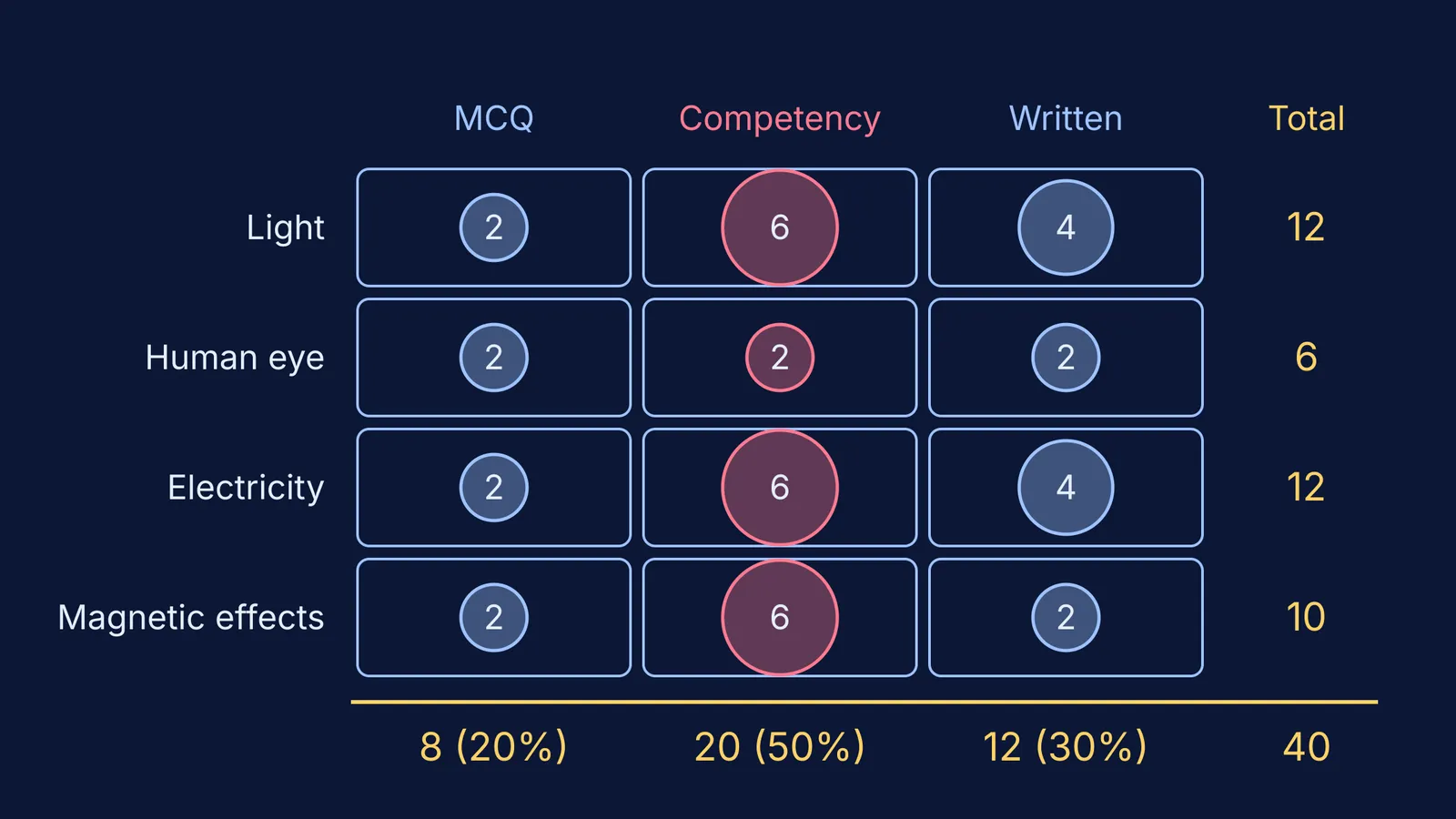
Here is a blueprint for a unit test on four chapters, using the same 50-20-30 split as the CBSE circular above.
Light: 2 marks MCQ, 6 competency, 4 written (12 marks)
Human eye: 2 MCQ, 2 competency, 2 written (6 marks)
Electricity: 2 MCQ, 6 competency, 4 written (12 marks)
Magnetic effects of current: 2 MCQ, 6 competency, 2 written (10 marks)
Column totals: 8 marks MCQ (20%), 20 competency (50%), 12 written (30%). Do this arithmetic yourself before opening any AI tool; our explainer on why AI makes maths mistakes shows why you should not trust a total it gives you.
How do you get AI to draft questions against a blueprint?
Ask for one cell at a time, not the whole paper. A prompt that works:
"You are helping a Class 10 physics teacher. Write 3 competency-based questions on Electricity worth 2 marks each."
"Each must describe a real situation, such as a household circuit or a phone charger, and need the student to apply Ohm's law or the power formula, not recall a definition."
"For each, give the answer, a step-by-step marking scheme, and the one misconception a wrong answer would show."
"Use only the NCERT Class 10 syllabus. Do not use concepts from Class 11."
Small requests are easier to check, and you can ask for two or three options per slot and keep one. Our post on how teachers can use AI for lesson planning covers the same draft-then-edit habit for lessons.
How do you check an AI-generated question paper for errors?
Assume every draft has problems. In a 2025 study in Advances in Physiology Education, independent experts reviewed 65 ChatGPT-generated practice questions for medical students studying renal physiology; 49% had item-writing flaws and 22% had factual or conceptual errors (Camarata et al., 2025). It rated 59 of the 65 (91%) a reasonable starting point for revision, and the authors concluded such questions are workable only when a subject expert with item-writing training supervises them. Medical school is not Class 10, but the lesson carries: the draft saves time, and the checking is your job.
Run this audit on the full draft:
Solve every question yourself, on paper, without looking at the AI's answer. Mark any answer that differs.
Check the numbers: units, significant figures, and whether the given values give a realistic result.
Hunt for repeats: two questions testing the same idea with different numbers, or one that gives away another's answer.
Check the MCQ options: exactly one correct answer, and wrong options that match real mistakes.
Re-total the blueprint: add the marks by chapter, by type and by level, and compare each with your grid.
Balance the difficulty: read the paper as a weak, an average and a strong student. Each should find something they can do and something that stretches them.
Time it: write full solutions and see whether the paper fits the period.
What should students do with the paper afterwards?
A blueprint makes marks useful: you can see that a class lost most marks on competency questions in Electricity, not just a low total. For students who get the method wrong, the Fermi Problem Library has worked problems with a step-by-step solver that explains the reasoning rather than printing an answer. And Fermi's AI tutor can work out what a student already knows and build a plan for the session, so revision starts from the chapter where they actually lost marks.
Start with your next unit test: draw the grid, fill one cell with AI, and audit it with the checklist above.


