

On this page
In many towns, rubbish heaps are set alight at street corners, and plastic is often in them. A cool, smoky fire turns plastic into soot and new chemicals instead of harmless gases, and some of those chemicals stay in your body for years.
What happens when plastic burns?
Most plastics are polymers: very long chains built mostly from carbon and hydrogen, and PVC also carries chlorine on its chain. If combustion were complete, the carbon and hydrogen would leave as carbon dioxide and water. That needs plenty of oxygen and a high, steady temperature. A heap of rubbish has neither, so you get carbon monoxide, soot and broken pieces of molecules instead. If the difference between complete and incomplete combustion is hazy, our explainer on fuels, combustion and flame zones covers it.
The Illinois Environmental Protection Agency puts it plainly: because burn barrels receive little oxygen, they create low-temperature fires that generate toxic pollutants. These include particulates, sulfur dioxide, carbon monoxide and metals such as lead, cadmium and chromium. The same page says burn barrels produce more than twice as much dioxin per pound of rubbish as municipal incinerators.
Why does a low temperature make the smoke more toxic?
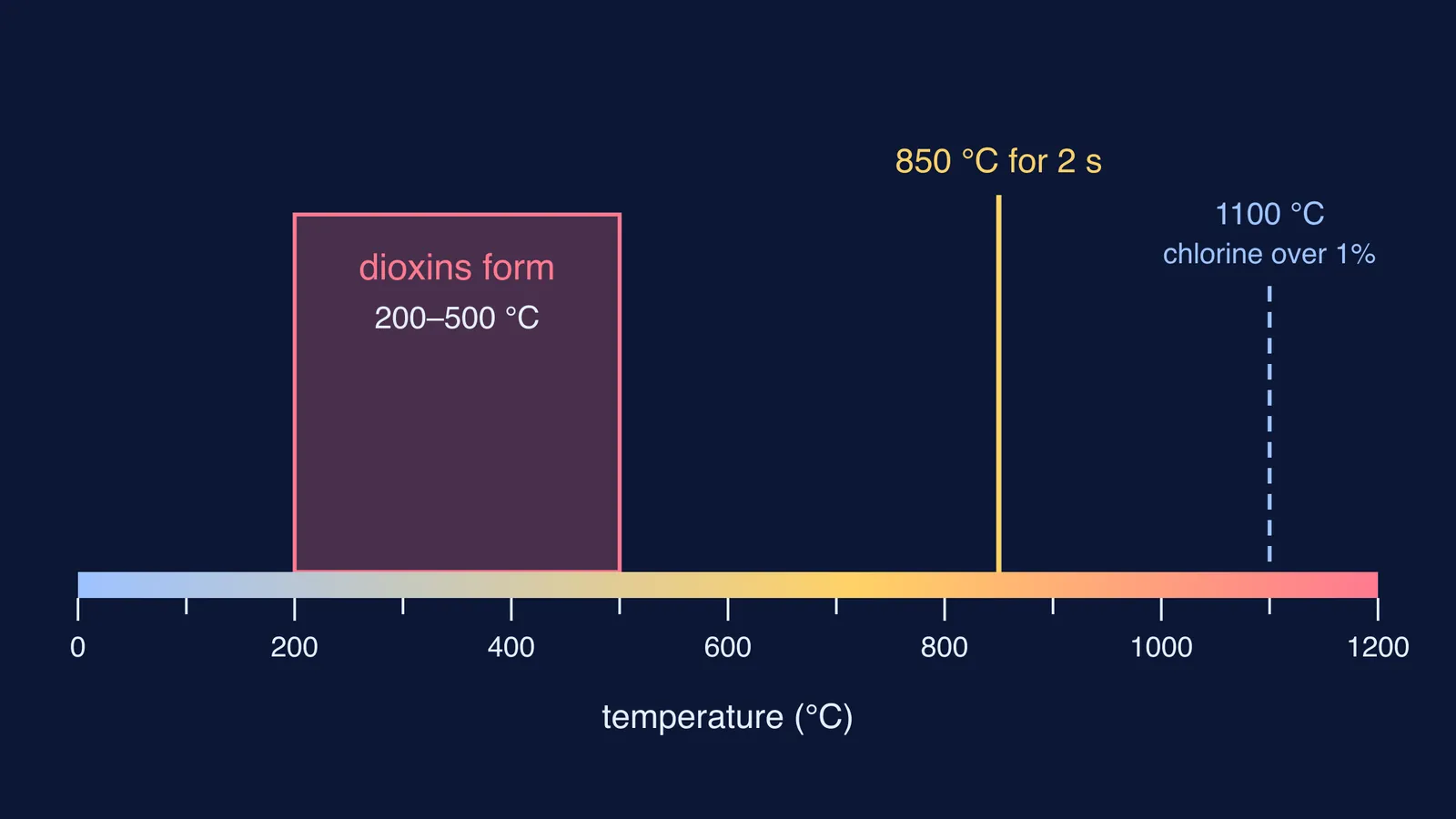
Dioxins are a family of chlorine-containing chemicals that form in a particular temperature band. A study of burning simulated PVC-coated cable describes a dioxin formation window of 200 to 500 °C that open burning inevitably passes through (Zhang and colleagues, Chemosphere, 2021). The chlorine comes from the plastic itself: the authors studied how PVC acts as a source of dioxins, and found that adding metallic copper, as in a cable's wire, raised the dioxin yield at 300 °C by a factor of 1,390 compared with PVC alone.
Industrial incinerators are built to burn much hotter. UK guidance on the EU Waste Incineration Directive requires incinerator gas to reach 850 °C for 2 seconds, rising to 1,100 °C for hazardous waste with more than 1% halogenated organic substances, expressed as chlorine. Incinerators must also control what leaves the chimney, under emission limits.
How temperature and oxygen together decide what a fire makes is easier to see than to read. The Fermi Simulation Lab has interactive simulations for ideas like this.
Why is burning plastic waste harmful to health?
Two things in the smoke matter most.
Dioxins. WHO says dioxins can cause reproductive and developmental problems, damage the immune system, interfere with hormones and cause cancer. Their half-life in the body is estimated at 7 to 11 years. More than 90% of human exposure comes through food, mainly meat, dairy products, fish and shellfish. Illinois EPA explains that dioxin settles on plants eaten by livestock and reaches people through meat and dairy.
Fine soot (PM2.5). WHO says fine particulate matter in outdoor air causes cardiovascular and respiratory disease, and cancers-air-quality-and-health). Its fact sheet on smoke from household fuels describes small particles that penetrate deep into the lungs and enter the bloodstream. Our guide to what PM2.5 and AQI numbers mean explains how to read the readings.
Illinois EPA notes that short-term exposure can aggravate asthma, while long-term exposure can raise the risk of cancer, heart disease and breathing problems. If you or someone at home has breathing trouble after smoke exposure, see a doctor.
How common is open burning of waste?
A 2014 study led by Christine Wiedinmyer at the US National Center for Atmospheric Research (Environmental Science and Technology, doi:10.1021/es502250z) estimated that about 41% of the world's waste is burned in the open. As reported by Phys.org, that burning produces as much as 29% of human-caused PM2.5 emissions and 10% of mercury emissions, and India is among the countries with the largest emissions. The researchers cautioned that actual emissions could be larger or smaller than their estimates by a factor of two.
In India, the Solid Waste Management Rules, 2016 set zero tolerance for burning waste on streets, in open public spaces, in drains or in water bodies.
What should you do with plastic waste instead?
A short plan for your home:
Keep dry waste, including plastic, separate from wet kitchen waste so it can be collected and recycled.
Rinse food containers before they go into dry waste. Our guide to why plastic takes hundreds of years to break down explains why burying it is no answer either.
Never add plastic to a bonfire, a chulha or a winter warming fire.
If you see a garbage fire, move indoors, close windows on that side and keep children and older relatives away from the smoke.
If rubbish burning near you continues, raise it with your resident welfare association or municipal ward office.
If polymers or combustion are shaky topics for you, the Fermi Concept Library has a lesson on every concept in chemistry and biology, each with its place in the map.


