

On this page
Every year, millions of tons of synthetic packaging enter landfills and waterways, where they linger across generations. A global analysis in Science Advances found that of the 6,300 million metric tons of plastic waste produced through 2015, only 9% was recycled and 12% incinerated, leaving 79% to accumulate in landfills or the natural environment. While an apple core vanishes in weeks and paper rots in a month, polyolefin packaging endures for centuries due to chemical engineering and evolutionary biology.
Why cannot bacteria and fungi digest plastic?
Natural decomposition depends on biological enzymes secreted by bacteria and fungi. Decomposers recycle biopolymers like cellulose and proteins because their polar glycosidic or peptide bonds allow microbial hydrolases to cleave chains into nutrients. Even newly evolved bacteria like *Ideonella sakaiensis* documented in Science only cleave hydrolysable ester bonds in polyethylene terephthalate (PET)—they cannot cleave non-polar polyolefins.
Common polyolefins like polyethylene, polypropylene, and polystyrene present an entirely foreign obstacle. As a review in Biotechnology Advances details, they consist of hydrocarbon chains made exclusively of non-polar carbon-carbon single bonds. Because these aliphatic backbones are fiercely hydrophobic, they repel water, preventing enzymes from docking.
Bacterial cell walls also impose a size barrier, unable to transport molecules larger than 600 to 1,000 Daltons. Commercial plastics exceed 20,000 to 100,000 Daltons, preventing cellular uptake without prior breakdown.
What makes the carbon-carbon backbone so stable?
The polymer chain's energetic stability shields it from spontaneous breakdown. As detailed in Biotechnology Advances, every link in the polyethylene backbone is a carbon-carbon sigma bond with a bond dissociation energy of 348 kJ/mol, while carbon-hydrogen bonds require 413 kJ/mol to break. Cleaving these non-polar bonds without an enzyme requires energetic input that ambient soil or water temperatures cannot provide.
Furthermore, high-density polyethylene chains align into tightly packed crystalline lamellae that block oxygen diffusion and shield internal chains. You can explore how monomers pack into solid phases in our guide to addition and condensation polymers.
When visualizing long-chain macromolecules or bond dissociation barriers, the Fermi Simulation Lab provides interactive simulations for ideas that are easier to see than to read.
How does sunlight start the breakdown process?
Because biological digestion fails, breakdown relies on abiotic weathering driven by solar ultraviolet radiation. In Proceedings of the National Academy of Sciences, researchers demonstrated that solar photodegradation, rather than microbial action alone, governs the initial breakdown of surface plastics.
Ultraviolet photons generate free radicals in the presence of oxygen. Through auto-oxidation and Norrish reactions, oxygen inserts into the backbone to form polar carbonyl groups. This photo-oxidation cleaves long chains into shorter, brittle oligomers and adds polar handles that allow microbial biofilms to attach.
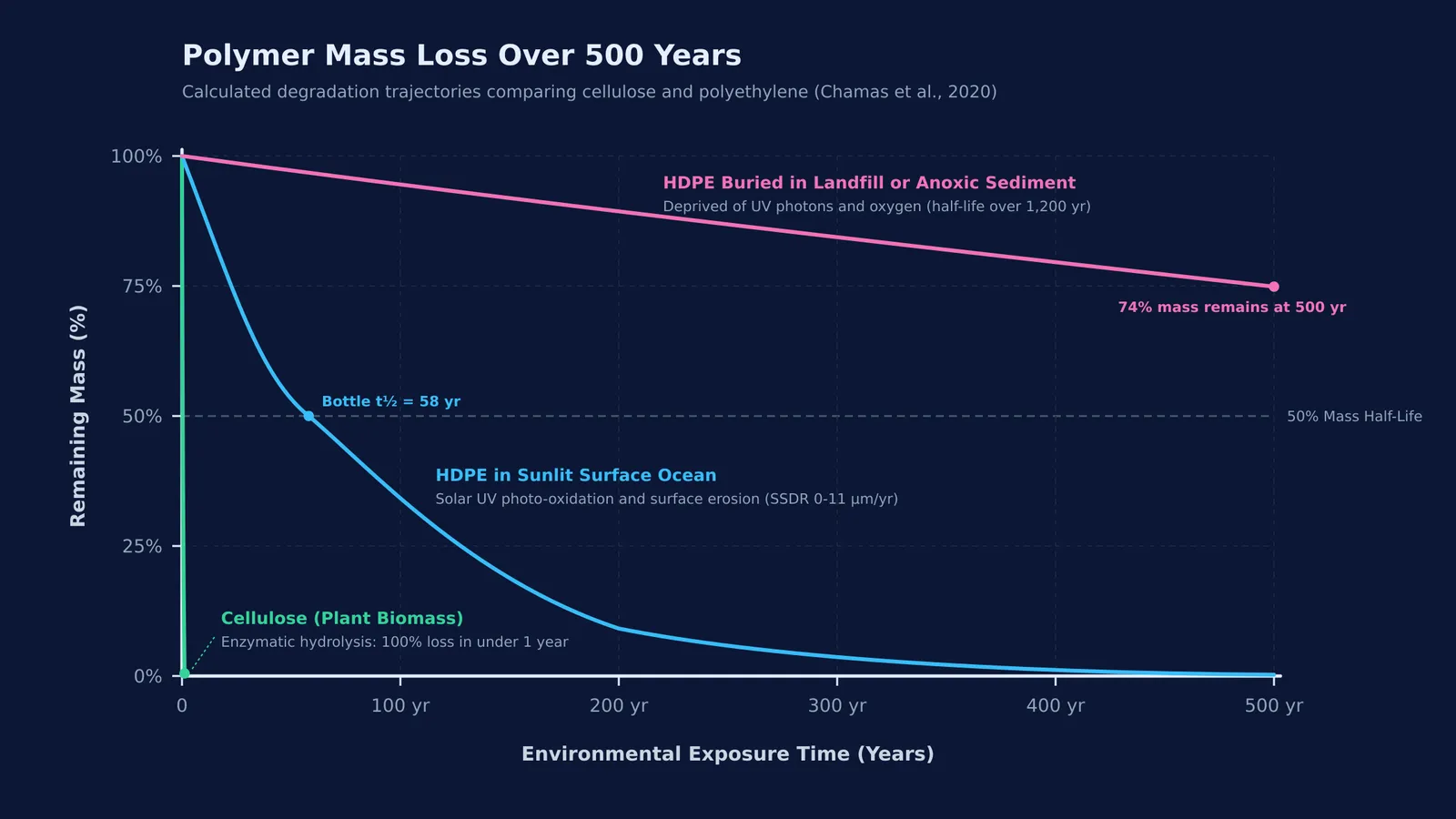
Once plastic fragments into oxidized microplastics, specialized microbes slowly begin bio-assimilation. However, if plastic is buried in a landfill or sinks into the dark ocean abyss, solar photons cannot reach it, halting oxidation and freezing degradation.
How long does plastic actually last in the environment?
Popular infographics quote figures like '450 years for a bottle', but scientific lifespan depends on geometry and exposure. In ACS Sustainable Chemistry & Engineering, researchers introduced the Specific Surface Degradation Rate (SSDR) to harmonize global field data.
They reported that high-density polyethylene in marine waters exhibits an SSDR between 0 and 11 μm per year. Using the mean marine SSDR, the authors calculated extrapolated half-lives ranging from 58 years for thin consumer bottles to approximately 1,200 years for thick-walled pipes. Even biodegradable alternatives like polylactic acid degrade at rates similar to conventional polyethylene in cold seawater, because their decomposers require industrial composters operating at 58°C.
How can students evaluate whether a polymer will biodegrade?
To evaluate whether a material biodegrades, apply four diagnostic criteria:
Backbone chemistry: Polar bonds (esters, glycosides) allow enzymatic cleavage; pure hydrocarbon backbones do not.
Surface affinity: Hydrophilic surfaces permit water-mediated enzyme docking; hydrophobic plastics repel water.
Morphology: Amorphous chains are accessible, whereas tightly packed crystalline sheets block enzyme and oxygen penetration.
Environmental triggers: Abiotic scission requires solar ultraviolet light, heat, and atmospheric oxygen.
Cellulose degrades in weeks because its polar glycosidic bonds absorb water and fit natural cellulase enzymes. Polyethylene persists for centuries because its non-polar carbon-carbon backbone repels water, packs into crystalline lamellae, and lacks compatible biological enzymes.
How can students connect polymer chemistry to school exams?
In the Indian curriculum, polymer persistence connects across syllabus levels. Class 8 Science introduces the 5R principle—Refuse, Reduce, Reuse, Recycle, Recover—for non-biodegradable waste. In Class 10 Science, the curriculum on our environment and ecosystem waste examines enzyme specificity and biomagnification, while the chapter on carbon compounds and covalent bonding covers catenation and covalent stability.
Understanding why enzymes cannot fit non-polar carbon backbones transforms textbook memorization into intuitive chemistry. To explore molecular structures across your syllabus, the Fermi Concept Library covers every concept in physics, chemistry, and biology with its own lesson and place in the map.


