On this page
Corroded brass can leave a powder that holds three kinds of copper at once: copper metal, cuprous oxide (Cu₂O) and cupric oxide (CuO). Every one of them contains copper, so simply measuring total copper tells you almost nothing. In 1952, S. M. Mehta and N. R. Bharucha at the Institute of Science, Bombay, published a way to measure all three. Their trick was to ask a redox question of each component: can it reduce Fe³⁺ to Fe²⁺, and how many electrons does it give? Three titrations on three portions of the same sample then give three unknowns.
Who were Mehta and Bharucha, and where is the paper?
The paper is "Quantitative determination of copper, cuprous oxide and cupric oxide in a mixture", received on 28 February 1952 and printed in the Proceedings of the Indian Academy of Sciences, Section A, vol. 37, pp. 29–32 (doi:10.1007/BF03052855). The byline reads S. M. Mehta, F.A.Sc., and N. R. Bharucha, of the Department of Chemistry, The Institute of Science, Bombay. A footnote says the method was developed during a study of the corrosion of brass by alkalis. We have not verified their biographies, so we leave them out.
Why is a Cu, Cu₂O and CuO mixture hard to analyse?
The paper opens by saying that dissolving Cu₂O selectively from copper and CuO is difficult. It then lists earlier methods and what went wrong with each:
Dilute sulphuric acid dissolves CuO, but Cu₂O reacts with it to give copper metal and copper sulphate. A correction is possible, but the acid also attacks fine copper powder.
Sodium cyanide extracts the oxides, but it also attacks finely divided copper.
Cold aqueous ammonia with hydrazine sulphate extracts Cu₂O, but the authors found that a small amount of CuO always dissolved too.
Alcoholic HCl has, in their words, "marked solvent action on CuO".
The sulphuric acid problem is the one you already know from Class 12. In acid, Cu(I) disproportionates: Cu₂O + 2H⁺ → Cu + Cu²⁺ + H₂O. Half the copper ends up as metal and gets counted as the wrong component. For the E° argument behind this, see why Cu⁺ is unstable in water.
How does the three-portion method work?
They divided each sample into three equal parts.
Portion 1 measures copper metal. Hot saturated KI dissolves the Cu₂O and leaves Cu and CuO behind. The residue goes into acidified FeCl₃. Copper metal reduces Fe³⁺: Cu + 2Fe³⁺ → Cu²⁺ + 2Fe²⁺. CuO also dissolves, CuO + 2H⁺ → Cu²⁺ + H₂O, but it reduces nothing. The Fe²⁺ is titrated with standard dichromate using diphenylamine sulphonate indicator and phosphoric acid.
Portion 2 measures copper plus Cu₂O. The whole portion goes straight into FeCl₃. Now Cu₂O reduces Fe³⁺ as well: Cu₂O + 2Fe³⁺ + 2H⁺ → 2Cu²⁺ + 2Fe²⁺ + H₂O. The dichromate titre is larger, and the difference from portion 1 gives Cu₂O.
Portion 3 measures total copper. The portion dissolves in concentrated HNO₃. Urea is added and the solution boiled to remove oxides of nitrogen, and the copper is then found iodometrically. CuO follows by difference.
The titration reaction in steps 1 and 2 is Cr₂O₇²⁻ + 6Fe²⁺ + 14H⁺ → 2Cr³⁺ + 6Fe³⁺ + 7H₂O. In step 3, 2Cu²⁺ + 4I⁻ → 2CuI + I₂, and the iodine is titrated with thiosulphate: I₂ + 2S₂O₃²⁻ → 2I⁻ + S₄O₆²⁻. One Cu²⁺ ends up matching one thiosulphate. The background is in iodometric vs iodimetric titrations.
The paper does not explain why hot KI dissolves Cu₂O but not Cu or CuO. It is usually put down to Cu(I) forming soluble iodide complexes, but that is our gloss, not their claim. The paper does show that KI leaves copper metal alone: they purified their copper powder by boiling it with saturated KI.
Why does CuO dissolving in FeCl₃ not spoil the result?
Here is a point worth noticing. The authors criticise an earlier method because acidified FeCl₃ "will dissolve CuO and is likely to cause an error". Yet their own portions 1 and 2 also put CuO into FeCl₃. Our reading is that the difference lies in what is measured. The earlier method measured copper in the solution, so dissolved CuO added copper. Mehta and Bharucha titrate Fe²⁺, and CuO makes no Fe²⁺, so it is invisible to the dichromate.
How many electrons does each component give?
This is the n-factor bookkeeping, and it is the whole method.
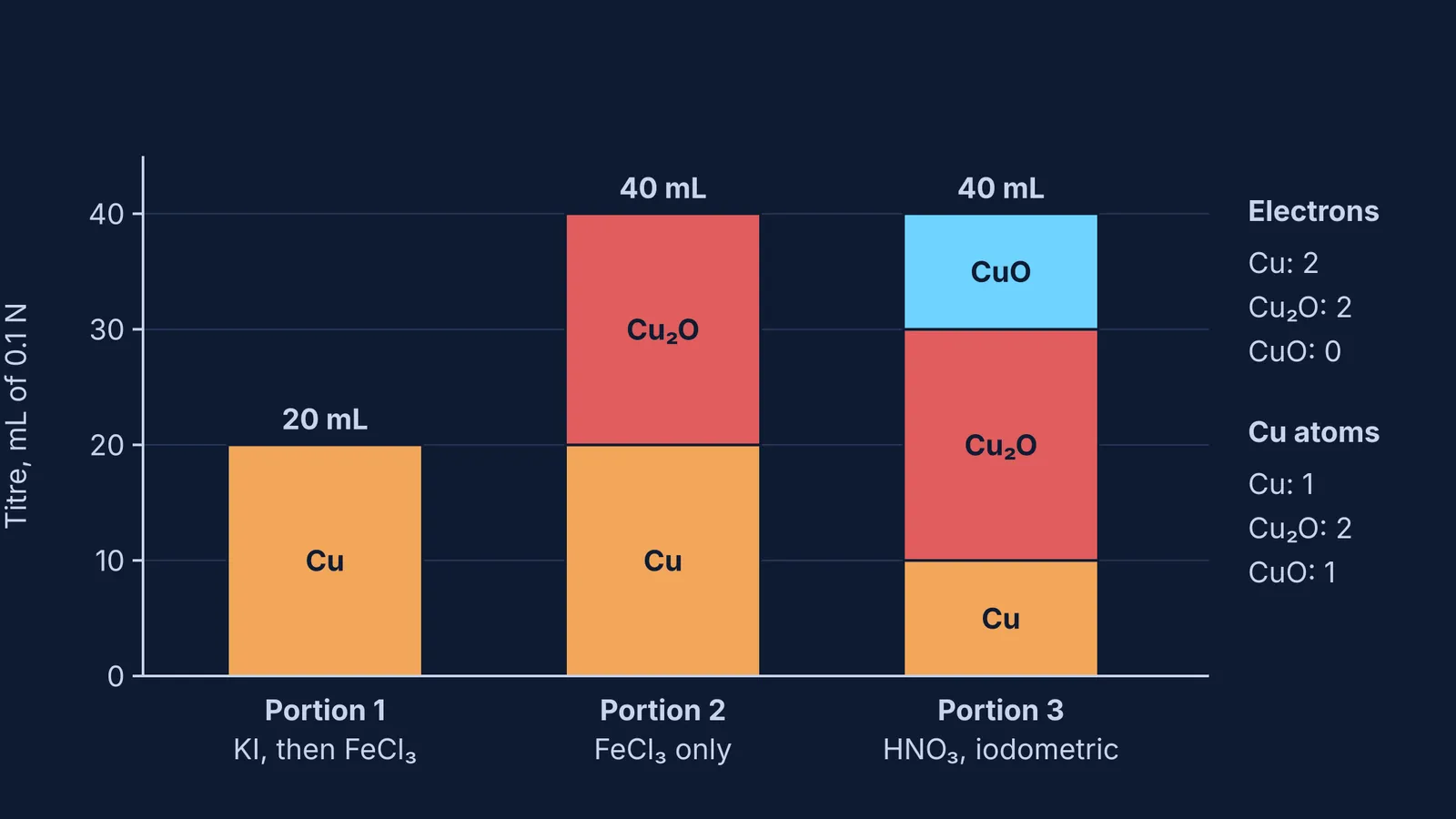
Cu → Cu²⁺: 2 electrons per Cu, so 2 Fe²⁺ per Cu.
Cu₂O → 2Cu²⁺: each Cu goes from +1 to +2, so 2 electrons per formula unit of Cu₂O.
CuO: already +2. Zero electrons.
Dichromate: each Cr goes from +6 to +3, so n = 6 per Cr₂O₇²⁻. Fe²⁺ has n = 1.
For a refresher on equivalents, see n-factor and the equivalent concept.
Worked example: three titrations, three unknowns
This is our own problem, built on their scheme. Each portion of a mixture contains 1.000 mmol each of Cu, Cu₂O and CuO, which weighs 63.55 + 143.09 + 79.55 = 286.2 mg. Dichromate and thiosulphate are both 0.1 N.
Portion 1 (KI, then FeCl₃). Only Cu reduces Fe³⁺: 1.000 mmol × 2 = 2.00 meq. Titre = 2.00 ÷ 0.1 = 20.0 mL of dichromate.
Portion 2 (FeCl₃ only). Cu gives 2.00 meq and Cu₂O gives 1.000 × 2 = 2.00 meq. Total 4.00 meq, titre = 40.0 mL.
Portion 3 (HNO₃, iodometric). Total Cu = 1 + 2 × 1 + 1 = 4.00 mmol. Titre = 40.0 mL of 0.1 N thiosulphate.
Now work backwards, as you would in the exam:
Cu = 20.0 × 0.1 ÷ 2 = 1.00 mmol.
Cu₂O = (40.0 − 20.0) × 0.1 ÷ 2 = 1.00 mmol.
CuO = 4.00 − 1.00 − 2 × 1.00 = 1.00 mmol. Notice the factor 2: each Cu₂O holds two copper atoms.
For scale, their first test mixture held 0.5571 g Cu and 0.7304 g Cu₂O. That is 17.53 meq of Fe²⁺ from copper and 10.21 meq from Cu₂O for the whole sample, before it was split into thirds (our calculation).
How accurate was the method?
They tested five synthetic mixtures. For mixture 1 they took 0.5571 g Cu, 0.7304 g Cu₂O and 0.3975 g CuO, and found 0.5569, 0.7305 and 0.3977 g. Across all fifteen numbers in their table, the largest difference between taken and found is 0.4 mg, and the largest relative error is about 0.13% (our calculation from their table).
Where does this come up in JEE and NEET?
Class 11 Redox: n-factors of Cu, Cu₂O and CuO, dichromate n = 6, and mixture problems solved with milliequivalents. The same logic appears in finding Fe²⁺ and Fe³⁺ with two titrations.
Class 12 d-block: Cu(I) versus Cu(II) stability, and iodometric estimation of copper.
If mixture numericals still feel slippery, Fermi Test Prep for JEE Main and Advanced has an AI tutor that can take you through the milliequivalent steps. For more redox problems worked one step at a time, try the Fermi Problem Library.
Quick checklist
Hot KI removes Cu₂O; acidified FeCl₃ then sees only Cu as a reductant.
Cu gives 2 e⁻, Cu₂O gives 2 e⁻ per formula unit, CuO gives none.
Portion 2 minus portion 1 gives Cu₂O.
Total copper by iodometry, after urea removes oxides of nitrogen.
CuO = total Cu − Cu − 2 × Cu₂O, in mmol.