On this page
Add a trace of iodine to bromine in acetic acid and an aromatic compound brominates faster. In 1969 G. Kothandaraman, J. Rajaram and J. C. Kuriacose, at the Department of Chemistry, Indian Institute of Technology, Madras, worked out why, using anisole and p-nitrophenol. Their paper, "Catalysed bromination of aromatic substrates", appeared in the Proceedings of the Indian Academy of Sciences (received 12 April 1969; communicated by M. Santappa). Kothandaraman's footnoted address is the Department of Chemistry, University of California, Davis. The result is a neat exam-style derivation: one step of stoichiometry and one of calculus.
How does anisole brominate without a catalyst?
Anisole has an –OCH₃ group that pushes electron density into the ring, so it reacts with bromine in acetic acid even without FeBr₃. NCERT gives p-bromoanisole as the main product, with some ortho isomer. The paper reports 1 : 1 stoichiometry:
C₆H₅OCH₃ + Br₂ → BrC₆H₄OCH₃ + HBr
Check: C 7 = 7, H 8 = 8, O 1 = 1, Br 2 = 2.
The paper quotes this rate law from earlier work it cites:
Rate = k₃[ArH][Br₂]² + k₂[ArH][Br₂]
The second term matters only at low concentrations. So in the main path the rate is second order in bromine. The paper's picture is that one Br₂ molecule attacks a complex already formed between the ring and another Br₂.
For p-nitrophenol, a much less reactive ring because –NO₂ withdraws electron density, the uncatalysed reaction was also first order in substrate and second order in bromine.
For the usual ring-activation story, see electrophilic substitution reactions of anisole. For why benzene itself needs a Lewis acid, see the role of FeCl₃ in the chlorination of benzene.
What does iodine do in bromination?
Iodine does not act alone. It reacts with bromine to form the interhalogen iodine bromide:
I₂ + Br₂ → 2IBr
Earlier work cited in the paper (Lambourne and Robertson, 1947) had shown that IBr is the real catalyst in "iodine-catalysed" bromination. In this paper they kept total bromine (X mol L⁻¹) above total iodine (Y mol L⁻¹), so IBr could only act as a catalyst, not as the bromine source. Then:
[IBr] = 2Y, because each I₂ takes one Br₂ and makes two IBr.
[Br₂] free = X − Y, the bromine left over.
Under these conditions the rate for anisole was first order in anisole, first order in IBr and first order in free Br₂:
Rate = k[ArH][IBr][Br₂]
In the paper's words, the order in bromine is "reduced by one unit" and the order in iodine bromide becomes one. One of the two Br₂ molecules in the slow step is replaced by IBr. The p-nitrophenol reaction followed the same kinetics, so the substituent changed the rate but not the mechanism.
How IBr helps is our gloss, not the paper's claim: I–Br is a polar bond, and IBr can draw on the Br–Br bond much as a second Br₂ or a Lewis acid does. The paper establishes the orders only. For the shapes and bonding of interhalogens, see interhalogen compounds: shapes of ClF₃, BrF₅ and IF₇.
How did they prove that IBr is the catalyst?
They held p-nitrophenol and iodine fixed and added more and more bromine. They plotted the initial rate against total bromine ÷ total iodine (X/Y).
Below X/Y = 1: the rate stayed near zero. Every Br₂ added was used up making IBr, so no free Br₂ was left.
At X/Y = 1.0: the plot showed a break.
Above X/Y = 1: the rate rose in a straight line.
Our reading of the line: once all the iodine is IBr, [IBr] = 2Y is fixed, and free Br₂ = X − Y grows in step with X. A rate proportional to [IBr][Br₂] then grows linearly. The paper also notes there is no evidence for IBr₃, so it was not considered.
Why does the rate peak at one part iodine to three of bromine?
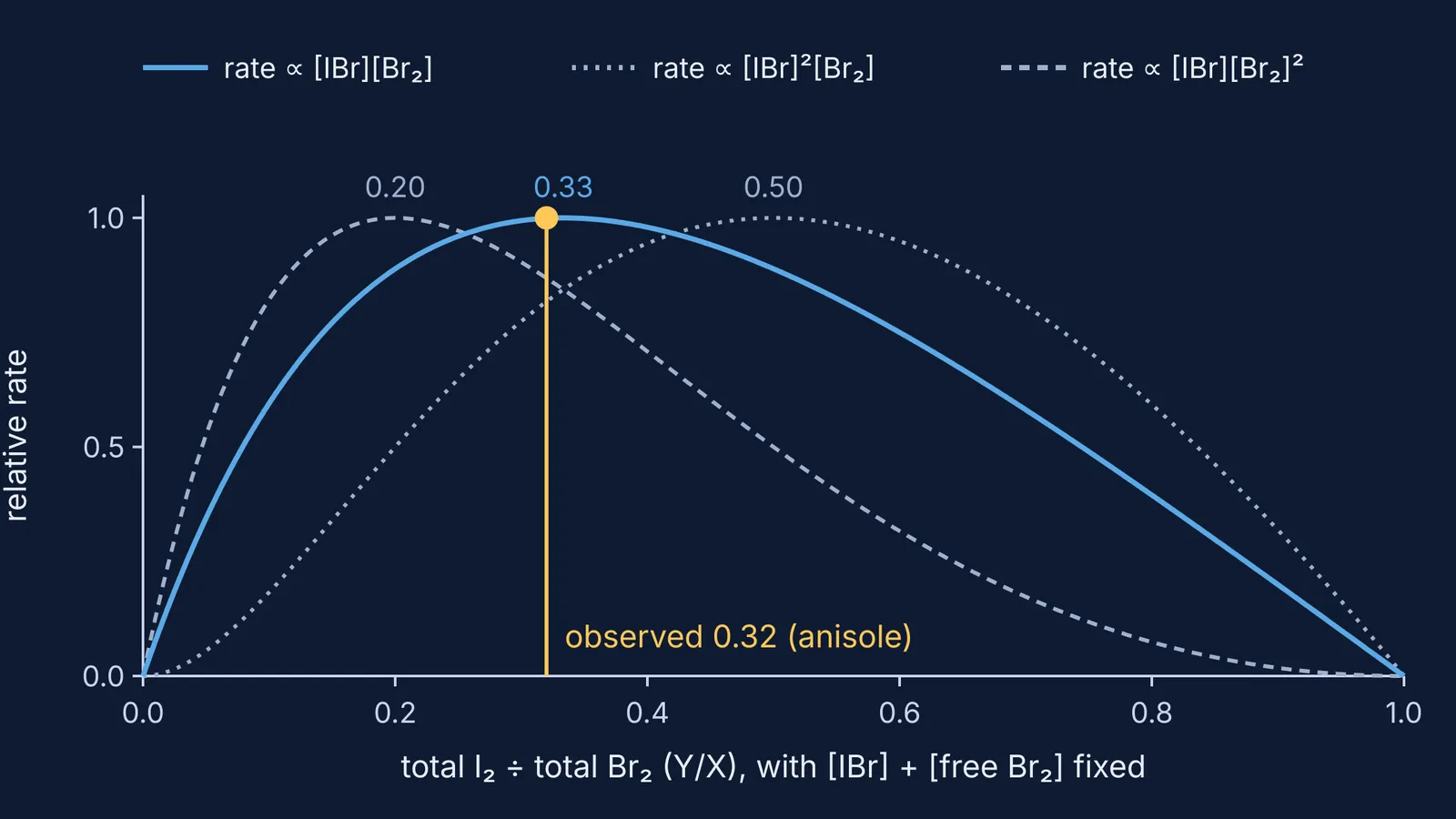
This is the catalytic maximum. Keep anisole fixed, and keep [IBr] + [free Br₂] = S constant while changing how much of S is iodine bromide.
Worked derivation (the general formula comes from an earlier paper the authors cite, Aust. J. Chem. 1969; the steps below are ours):
Write the sum. [IBr] + [Br₂] = 2Y + (X − Y) = X + Y = S.
Write the rate in one variable. [Br₂] = S − 2Y, so rate ∝ (2Y)(S − 2Y) = 2SY − 4Y².
Differentiate and set to zero. d(rate)/dY ∝ 2S − 8Y = 0, so Y = S/4.
Find X. X = S − Y = 3S/4.
Ratio. Y/X = (S/4) ÷ (3S/4) = 1/3 = 0.333. At this point [IBr] = [Br₂] = S/2.
A number check (our calculation): with S = 0.030 M, the maximum is at Y = 0.0075 M and X = 0.0225 M, giving [IBr] = [Br₂] = 0.015 M. The rate falls to 0.89 of the maximum at Y/X = 0.2 or 0.5, and to zero at Y/X = 1, where no free Br₂ remains.
For orders m in IBr and n in Br₂, the same steps give the paper's formula:
Y/X = m/(m + 2n)
m = n = 1: 0.333
m = 2, n = 1: 0.500
m = 1, n = 2: 0.200
The observed maximum for anisole was at 0.32, against 0.33 predicted. For p-nitrophenol it was also at 0.33. The position of the peak picks out m = n = 1 independently of the order measurements. A numerical scan of the rate law (our check) puts the maximum at 0.333 to three decimals.
If you want more practice turning a rate law into an optimisation like this, the Fermi Problem Library has a step-by-step solver that explains the reasoning.
Where does this appear in the JEE and NEET syllabus?
Exam line: Class 11 Hydrocarbons and Class 12 Haloarenes (halogenation needs a Lewis acid; –OCH₃ activates and –NO₂ deactivates the ring), Class 12 p-block (interhalogens such as IBr) and Class 12 Chemical Kinetics (order with respect to each reactant). If you are revising these chapters for JEE Main and Advanced, Fermi Test Prep offers practice with an AI tutor.
The paper prints its results as figures only, so the quotable numbers are 0.32, 0.33 and the break at 1.0. These are reported results, not a laboratory procedure.
Quick checklist
Uncatalysed bromination in acetic acid: rate ∝ [ArH][Br₂]², second order in bromine.
Iodine catalysis is really IBr catalysis: I₂ + Br₂ → 2IBr.
With excess bromine, rate ∝ [ArH][IBr][Br₂]: IBr replaces one Br₂.
[IBr] = 2Y and free [Br₂] = X − Y.
Rate near zero until X/Y = 1, then linear.
At fixed [IBr] + [Br₂], the maximum is at Y/X = m/(m + 2n) = 1/3; observed 0.32 for anisole.