On this page
In May 1930 a four-page paper reached the Journal of the Indian Chemical Society from the Sir T. N. Palit Laboratory in Calcutta. Susil Kumar Mitra described a new way to make serine, one of the amino acids in your Class 12 table, using Gabriel's phthalimide method and a malonic ester. His first attempt failed: the molecule fell apart into phthalic acid and ammonium salts. What fixed it was not a new reagent but a new order of steps.
Who was Susil Kumar Mitra and where did he work?
Everything we know comes from the paper itself: "A new synthesis of serine", Journal of the Indian Chemical Society, vol. 7, pp. 799–802 (scan on the Internet Archive), received 14 May 1930. The byline gives the Sir T. N. Palit Laboratory, University College of Science and Technology, Calcutta. The last paragraph thanks Sir P. C. Ray "for placing the resources of his research laboratory at my disposal". You can read about Ray in our post on Prafulla Chandra Ray and the Calcutta school.
We found nothing reliable about Mitra's life, so we say nothing more. He is not the physicist Sisir Kumar Mitra.
Serine was not new. Mitra cites earlier syntheses by Erlenmeyer jun. (1902), Fischer and Leuchs (1902) and Leuchs and Geiger (1906). His paper describes "another synthesis of serine by following Gabriel's method of synthesis of α-amino-acids".
What makes serine awkward to build?
Serine is α-amino-β-hydroxypropionic acid, HOCH₂–CH(NH₂)–COOH, formula C₃H₇NO₃. Three carbons carry three different functional groups: an amino group, a hydroxyl group and a carboxylic acid. You have to put nitrogen on the middle carbon and keep the CH₂OH intact.
Mitra's plan was to carry each group in a protected form and reveal them at the end:
Nitrogen as a phthalimide, which can be attached only once (the Gabriel idea).
The carboxylic acid as a malonic ester, with two –COOEt groups on one carbon. One of them is later lost as CO₂.
The hydroxyl as a methyl ether, –CH₂OCH₃.
How did Gabriel's method build an amino acid?
The paper describes the route in three stages. This is a historical account, not a procedure.
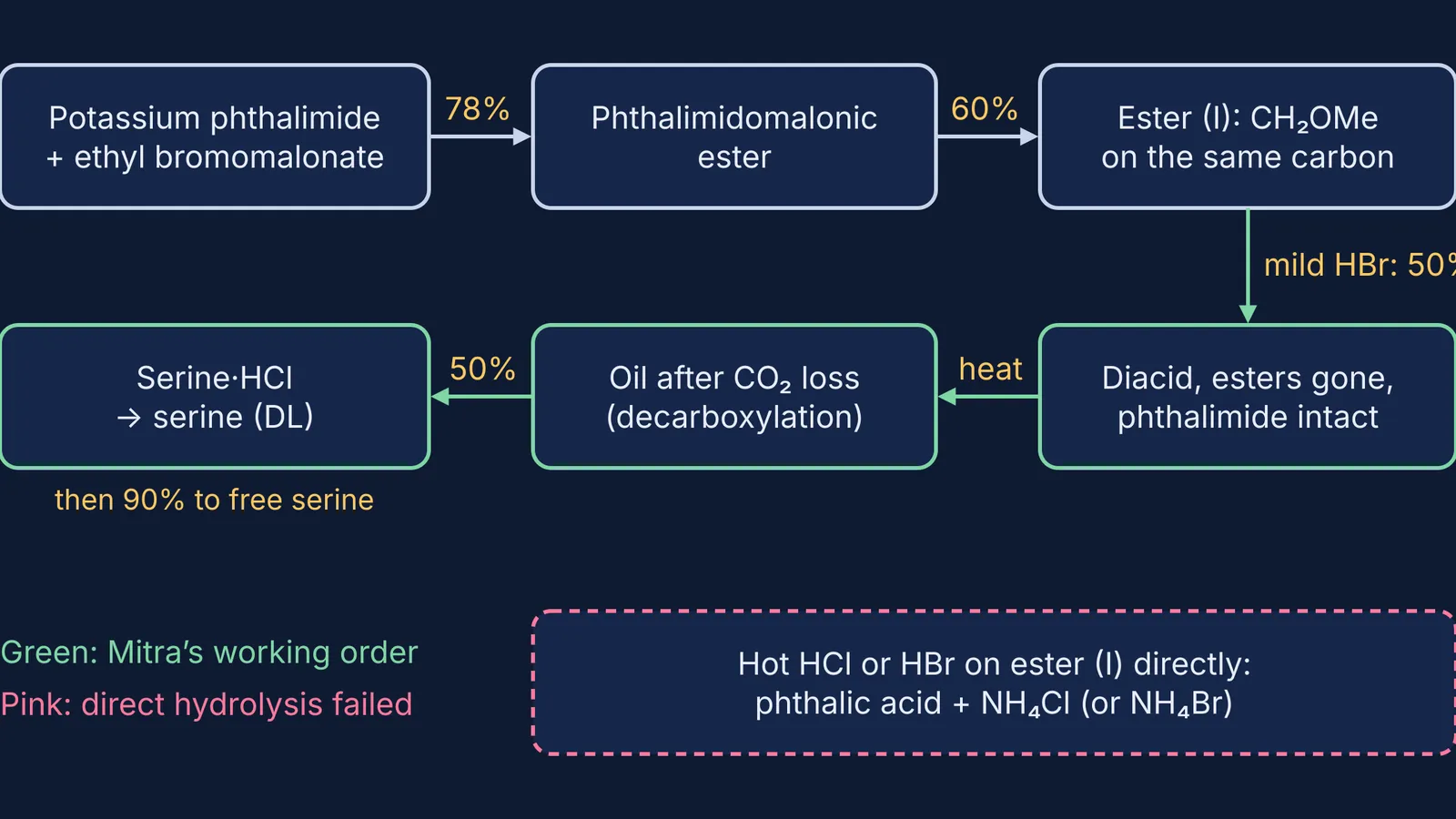
Potassium phthalimide and ethyl bromomalonate gave phthalimidomalonic ester (diethyl phthalimidomalonate), in 78% yield. The nitrogen is now on the central malonate carbon, which still carries one hydrogen.
The sodium salt of that ester reacted with chloromethyl ether. The CH₂OCH₃ group went onto the same carbon. This was methoxymethylphthalimidomalonic ester, compound (I), in 60% yield.
Everything except serine then had to come off: two ethyl groups, one CO₂, the phthalyl group and the methyl of the ether.
Our post on Siegmund Gabriel's phthalimide synthesis explains why a phthalimide nitrogen gives only a primary amine. The malonic ester synthesis explains why the acidic CH between two esters is so easy to substitute.
Why did the obvious acid hydrolysis wreck the molecule?
The direct approach was to heat ester (I) with strong hydrochloric or hydrobromic acid and remove everything at once. Mitra reports that this "resulted in profound decomposition of the molecule, and phthalic acid and ammonium chloride (or bromide) were formed in quantity even at 100°". Gentler boiling with 10 or 20% hydrochloric acid caused "no appreciable change". Too harsh destroyed the molecule; too mild did nothing.
Ammonium chloride means the nitrogen had left the carbon skeleton completely. Mitra's explanation was "the labile nature of the NH₂-group, attached to a reactive methylene group".
The working route changed the order:
Hydrobromic acid at a lower temperature (48 °C, not 100 °C) cleaved only the two ethyl esters. Ethyl bromide separated, and the product was the diacid with the phthalimide still in place (50%).
On heating, this diacid "evolves carbon dioxide" at 140–145 °C, the usual behaviour of a substituted malonic acid, and leaves an oil.
Only then did fuming hydrochloric acid remove the phthalyl group and the ether methyl. Phthalic acid was filtered off and serine hydrochloride crystallised (50%).
Moist silver oxide removed the HCl to give free serine (90%).
One modern way to read this (our gloss, not Mitra's) is as an ordering problem. The CO₂ was lost while the nitrogen was still locked inside the phthalimide, and the nitrogen was freed only at the very end.
Did the alkaline route work any better?
Aqueous sodium hydroxide gave "considerable quantities of phthalic acid". Alcoholic potassium hydroxide instead gave a white tripotassium salt, C₁₃H₁₀O₈NK₃. Mitra drew it as structure (II), with the phthalimide ring opened and both malonate carboxyls free. When he acidified it, "carbon dioxide was profusely evolved" at once and an oil separated. Boiling that oil with concentrated HCl gave serine hydrochloride in 55% yield.
By our arithmetic C₁₃H₁₀O₈NK₃ (425.52 g mol⁻¹) has 3.29% N and 27.57% K; he printed 3.29 and 27.53.
Worked example: checking Mitra's analyses with molar masses
Use C 12.011, H 1.008, N 14.007, O 15.999 and Cl 35.45. These are our calculations.
Step 1. Molar mass of serine, C₃H₇NO₃. 3 × 12.011 + 7 × 1.008 + 14.007 + 3 × 15.999 = 36.033 + 7.056 + 14.007 + 47.997 = 105.09 g mol⁻¹.
Step 2. Percentages. C = 36.033 ÷ 105.09 × 100 = 34.29%. H = 7.056 ÷ 105.09 × 100 = 6.71%. N = 14.007 ÷ 105.09 × 100 = 13.33%. Mitra found C 34.5, H 6.8 and N 13.26. He printed the calculated values as 34.28, 6.6 and 13.3. Our hydrogen comes out at 6.71, so his printed 6.6 is a little low.
Step 3. The hydrochloride. Serine·HCl is C₃H₈ClNO₃, molar mass 141.55 g mol⁻¹. That gives C 25.46%, H 5.70% and N 9.90%. His two preparations gave C 24.7, H 5.9, N 9.71 (acid route) and C 25.9, H 5.7, N 10.1 (alkaline route).
Step 4. The substituted ester (I), C₁₇H₁₉NO₇. Molar mass 349.34 g mol⁻¹, with C 58.45% and N 4.01%. Both match his printed values.
Step 5. Overall yield. Multiply the step yields from phthalimidomalonic ester: 0.60 × 0.50 × 0.50 × 0.90 = 0.135, or about 13.5%. Including the first 78% step, it is 0.78 × 0.135 = 0.105, about 10.5%.
One more point is our reasoning, not the paper's. No step in this route chooses between the two mirror-image forms, so Mitra's serine would have been racemic (DL). The serine in proteins is the L form. The paper does not discuss this.
The Fermi Concept Library covers Gabriel synthesis, decarboxylation and amino acid structure. The Fermi Problem Library has a step-by-step solver for percentage-composition and yield problems that explains the reasoning.
Where does this fit in JEE and NEET chemistry?
Class 12 Amines: Gabriel phthalimide synthesis and why it stops at a primary amine.
Class 12 Carboxylic acids: malonic acids lose CO₂ on heating.
Class 12 Biomolecules: serine, an amino acid with a polar CH₂OH side chain.
Class 11 Basic concepts: percentage composition and multi-step yields.
Checklist
Serine is HOCH₂CH(NH₂)COOH, C₃H₇NO₃, 105.09 g mol⁻¹.
Mitra (Calcutta, 1930) carried N as phthalimide, COOH as malonic ester and OH as a methyl ether.
Strong hot acid on the full ester gave phthalic acid and ammonium salts, not serine.
The working order was: cleave the esters, lose CO₂, then remove the phthalyl group.
Step yields multiply: 60% × 50% × 50% × 90% is about 13.5%.
No step chooses a mirror image, so his product would have been racemic.