

On this page
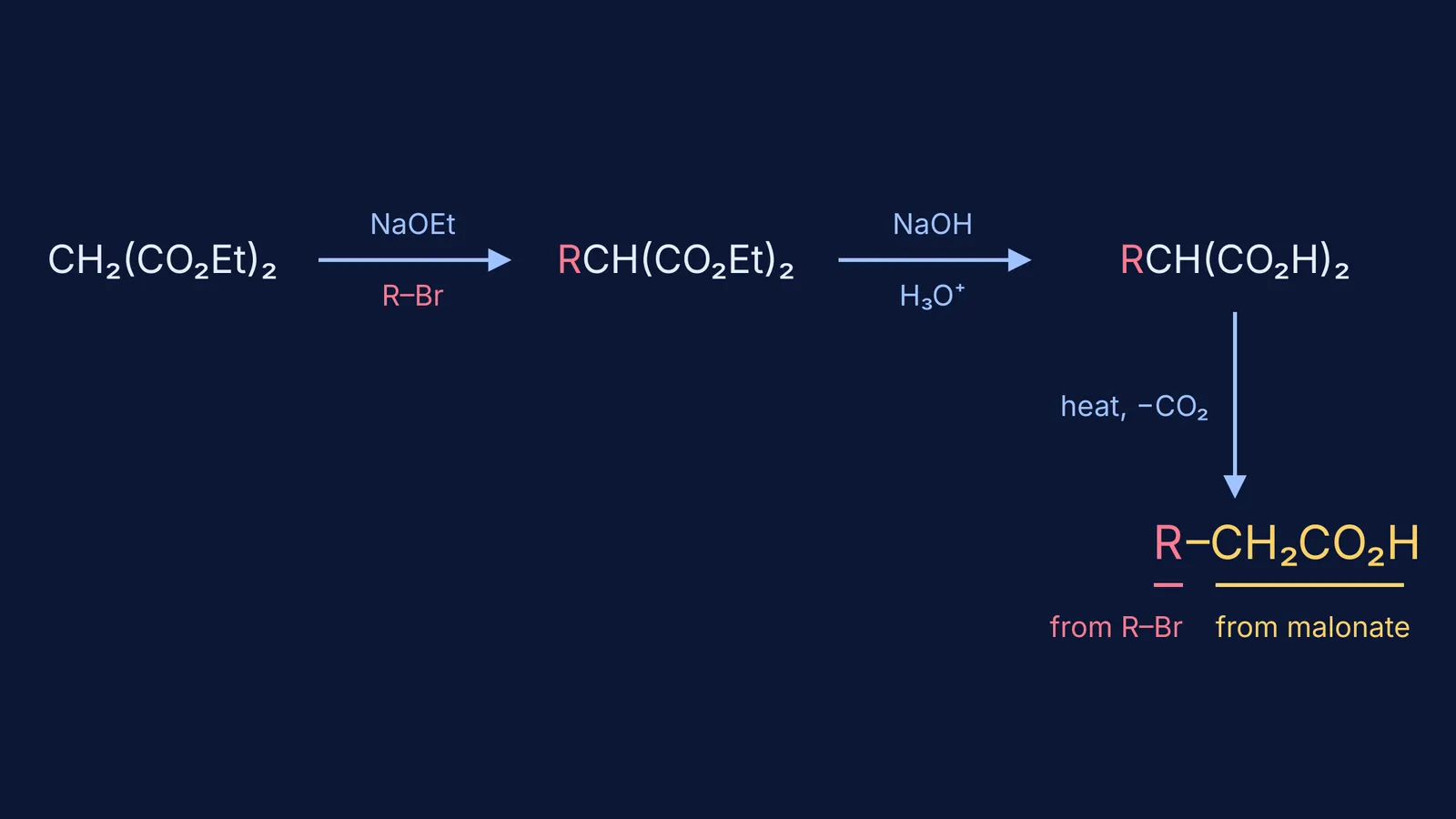
When a question asks you to build a carboxylic acid with a new chain on the α-carbon, think malonic ester synthesis. It takes three moves: make the enolate of diethyl malonate, alkylate it, then hydrolyse and heat so that one carboxyl group leaves as CO₂. Spot the CH₂COOH piece in the target and you can plan the route backwards.
What is the malonic ester synthesis?
Diethyl malonate is diethyl propanedioate, C₇H₁₂O₄: a CH₂ group sitting between two ethyl ester groups (PubChem).
That CH₂ is the whole point. Its hydrogens sit between two carbonyl groups, and diethyl malonate has a pKa of 12.6, acidic enough for sodium ethoxide to remove one (LibreTexts, Alkylation of Enolate Ions/22%3A_Carbonyl_Alpha-Substitution_Reactions/22.07%3A_Alkylation_of_Enolate_Ions)). If the idea of an acidic C–H still feels odd, our explainer on why the alpha hydrogen of aldehydes and ketones is acidic covers the resonance behind it.
The net result: the alkyl group from the halide ends up on the α-carbon of acetic acid. It is the acid-making twin of the acetoacetic ester synthesis of methyl ketones, which runs the same steps on ethyl acetoacetate.
How does the malonic ester synthesis work, step by step?
The sequence below follows the LibreTexts account of the reaction/22%3A_Carbonyl_Alpha-Substitution_Reactions/22.07%3A_Alkylation_of_Enolate_Ions).
Enolate formation. Sodium ethoxide in ethanol removes one α-hydrogen. Ethoxide is chosen to match the ethyl esters, because other alkoxide bases risk transesterification.
Alkylation. The enolate attacks R–X by SN2, giving RCH(CO₂Et)₂.
Optional second alkylation. One α-hydrogen is left, so a second round of base and R′–X gives RR′C(CO₂Et)₂.
Hydrolysis. Aqueous NaOH, then acid, turns both esters into COOH groups: a substituted malonic acid.
Decarboxylation. Heating removes one COOH as CO₂, leaving RCH₂COOH (or RR′CHCOOH).
Why does the substituted malonic acid lose CO₂ on heating?
In a malonic acid, each COOH has another carbonyl group close by. LibreTexts describes the loss of CO₂ as concerted: the acidic hydrogen of one carboxyl group transfers to the nearby carbonyl, CO₂ leaves, and the enol of a carboxylic acid forms, which then tautomerises to the acid (LibreTexts/22%3A_Carbonyl_Alpha-Substitution_Reactions/22.07%3A_Alkylation_of_Enolate_Ions)). Our post on why beta-keto acids decarboxylate easily on heating walks through the same idea for the ketone version.
How do you plan a malonic ester synthesis for a target acid?
Work backwards with three questions:
Find the COOH and the carbon next to it (the α-carbon). Those two carbons come from malonate.
List every group on the α-carbon other than hydrogen. Each one is an alkyl halide.
Check each halide can take part in SN2 (methyl, primary or secondary, not tertiary), or is a dihalide that can close a ring. If not, pick another route.
Worked example 1: hexanoic acid, CH₃CH₂CH₂CH₂CH₂COOH. Strip off CH₂COOH and a butyl group is left, so the halide is 1-bromobutane: NaOEt and CH₃CH₂CH₂CH₂Br give CH₃CH₂CH₂CH₂CH(CO₂Et)₂, then NaOH, H₃O⁺ and heat give hexanoic acid. LibreTexts uses the same example (LibreTexts/22%3A_Carbonyl_Alpha-Substitution_Reactions/22.07%3A_Alkylation_of_Enolate_Ions)).
Worked example 2: 2-methylbutanoic acid, CH₃CH₂CH(CH₃)COOH. The α-carbon carries a methyl and an ethyl group, so you alkylate twice: NaOEt and CH₃I, then NaOEt and CH₃CH₂Br, before hydrolysis and heating. The α-carbon is now a stereocentre, and because nothing controls which face reacts, the acid forms as a racemic mixture.
Worked example 3: cyclopentanecarboxylic acid. The α-carbon sits in a five-membered ring, and the other four ring carbons come from 1,4-dibromobutane. Two equivalents of NaOEt let the enolate alkylate once, then close the ring with the second bromide. LibreTexts shows this ring closure and notes that rings of three, four, five and six members can be made by changing the dihaloalkane.
Which alkyl halides work, and where do students lose marks?
Because the alkylation is SN2, LibreTexts says primary or secondary halides (chloride, bromide, iodide or tosylate) are preferred, while tertiary halides cannot be used and typically give E2 elimination products instead (LibreTexts/22%3A_Carbonyl_Alpha-Substitution_Reactions/22.07%3A_Alkylation_of_Enolate_Ions)).
Check your answer against these common slips:
Counting three carbons from malonate in the product. Only two survive; one leaves as CO₂, and the ethyl groups leave as ethanol.
Using NaOMe with a diethyl ester, which invites transesterification.
Proposing tert-butyl bromide to put a tert-butyl group on the α-carbon. It eliminates instead.
Heating before hydrolysis. The diacid loses CO₂, not the diester.
If your carbon counts keep coming out wrong, the Fermi Problem Library has worked problems with a step-by-step solver that explains the reasoning rather than printing an answer. If enolates themselves feel shaky, the Fermi Concept Library gives each chemistry concept its own lesson and shows where it sits in the map.
Try three targets of your own tonight: one straight-chain acid, one with two α-groups and one ring.


