

On this page
Since April 2020, BS-VI diesel and petrol in India may carry no more than 10 ppm of sulphur. Our post on why BS-VI fuel has low sulphur explains why that sulphur has to go. This post follows it out of the fuel. Refineries strip sulphur from oil fractions with hydrogen, so it leaves as hydrogen sulphide gas. H₂S is far too toxic to release and wasteful to burn to SO₂, so it is turned into solid yellow sulphur by the Claus process. It is a Class 11 redox reaction run at plant scale.
What is the Claus process?
The US Environmental Protection Agency's AP-42 chapter on sulphur recovery calls the Claus process the most common way to turn H₂S into elemental sulphur. It works in two stages.
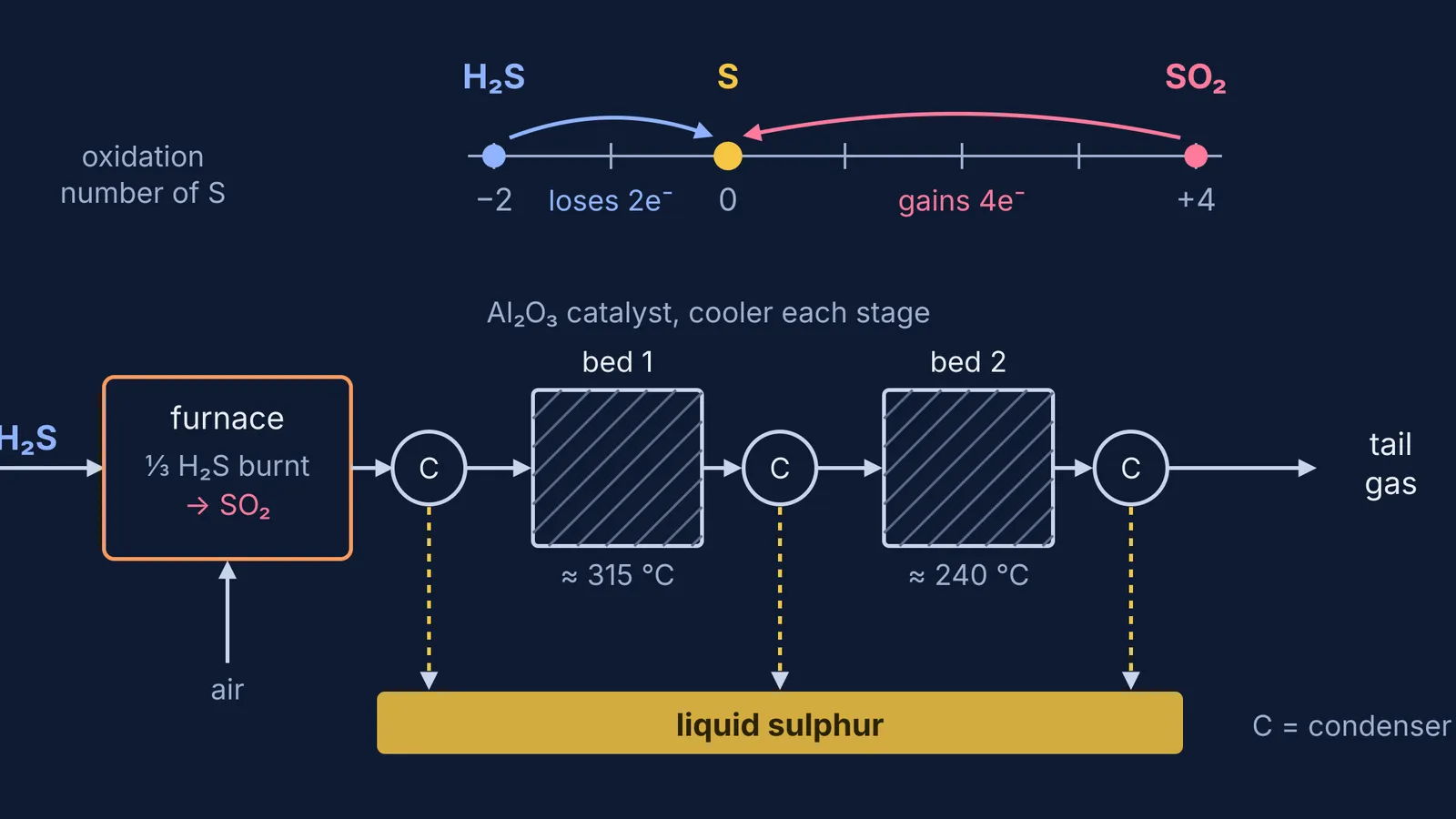
Thermal stage. About one-third of the H₂S is burnt with air in a furnace: 2H₂S + 3O₂ → 2SO₂ + 2H₂O. AP-42 gives furnace temperatures of about 980 to 1540 °C. Some sulphur already forms here, and AP-42 says about 65 to 70% of the sulphur is recovered in the condenser right after the furnace.
Catalytic stage. The remaining two-thirds of the H₂S reacts with the SO₂ just made: 2H₂S + SO₂ ⇌ 3S + 2H₂O. This runs over activated alumina (or titanium dioxide) at about 200 to 315 °C, in two or more beds in series.
Add them so the SO₂ cancels and you get AP-42's overall equation: 2H₂S + O₂ → 2S + 2H₂O. Check it: 4 H, 2 S and 2 O on each side.
Sulphur vapour is a mix of S₂, S₆ and S₈. In exam answers, write plain S throughout, or 3/8 S₈, but never mix the two.
Why is this a comproportionation reaction?
Write the oxidation number of sulphur in each species:
H₂S: sulphur is −2.
SO₂: sulphur is +4.
S: sulphur is 0.
Sulphur in two different oxidation states meets in the middle. That is comproportionation, the reverse of disproportionation. The post on disproportionation and comproportionation reactions covers the general idea with manganese and iodine examples. Here it is with sulphur.
Note two things. First, SO₂ is the oxidising agent here. You usually meet SO₂ as a reducing agent, decolourising acidified KMnO₄ or dichromate. Against H₂S, which is a stronger reductant, SO₂ is reduced from +4 to 0. Second, the n-factors explain the 2 : 1 ratio:
H₂S → S: each sulphur loses 2 electrons, so n = 2.
SO₂ → S: each sulphur gains 4 electrons, so n = 4.
Equivalents must match, so 2 mol of H₂S (2 × 2 = 4 equivalents) react with 1 mol of SO₂ (1 × 4 = 4 equivalents). That is why exactly one-third of the H₂S has to be burnt. Burn too little and H₂S is left over. Burn too much and SO₂ is left over. Either way, sulphur escapes in the tail gas. For more on the method, see n-factor and the equivalent concept.
How does Le Chatelier's principle explain the plant design?
AP-42 writes the catalytic reaction with "+ heat" on the product side: it is exothermic. So, by Le Chatelier's principle, a lower temperature shifts the equilibrium towards sulphur. AP-42 notes that higher recoveries are achieved at lower temperatures. That is why each catalytic bed runs cooler than the one before. Wikipedia's Claus process article gives typical bed temperatures of about 315 to 330 °C, 240 °C and 200 °C.
The second trick is product removal. Between beds, the gas is cooled in a condenser, and liquid sulphur drains out. Removing a product pulls the equilibrium forward again, so the next bed can convert more of what is left. AP-42 says each catalytic stage can recover about two-thirds of the sulphur still in the gas.
There is a limit: below the sulphur dew point, liquid sulphur condenses on the catalyst and blocks it, as AP-42 notes. So the gas is reheated slightly before each bed.
Do not apply the same argument to the furnace. At 1000 °C and above, sulphur vapour is mostly S₂, the reaction is not the same equilibrium as in the cool beds, and the furnace is there mainly to make SO₂ and release heat. The "cooler is better" rule is for the catalytic stage only.
Worked example: how much sulphur and air for 1 tonne of H₂S?
A refinery unit treats 1.00 tonne of H₂S. Use H = 1.008, S = 32.06 and O = 16.00 g/mol.
Moles of H₂S. Molar mass = 2(1.008) + 32.06 = 34.08 g/mol. Moles = 1.00 × 10⁶ g ÷ 34.08 = 29,300 mol = 29.3 kmol.
Maximum sulphur. From 2H₂S + O₂ → 2S + 2H₂O, 1 mol of H₂S gives 1 mol of S. So 29.3 kmol of S × 32.06 kg/kmol = 941 kg, or 0.941 tonne.
Oxygen needed. 1 mol of O₂ per 2 mol of H₂S, so 29.3 ÷ 2 = 14.7 kmol of O₂ × 32.00 = 470 kg of O₂.
Check through the two stages. One-third of 29.3 is 9.78 kmol of H₂S burnt, which needs 1.5 × 9.78 = 14.7 kmol of O₂ (same answer) and gives 9.78 kmol of SO₂. It meets the other 19.6 kmol of H₂S in the 1 : 2 ratio.
Air needed. Air is about 23.1% oxygen by mass, so 470 ÷ 0.231 ≈ 2,030 kg, or about 2.0 tonnes of air.
Now the tail gas. AP-42 gives about 95 to 96% recovery for a plant with three catalytic beds and no tail-gas treatment.
Sulphur lost at 96% recovery. 4% of 941 kg = 37.6 kg of sulphur per tonne of H₂S.
As SO₂ after incineration. Plants burn the leftover sulphur compounds in the tail gas to SO₂ before release. Each 32.06 kg of S becomes 64.07 kg of SO₂, so 37.6 × 64.07 ÷ 32.06 ≈ 75 kg of SO₂.
With tail-gas treatment. AP-42 lists systems that reach about 99.9% recovery. Then the loss is 0.1% of 941 kg ≈ 0.94 kg of S, or about 1.9 kg of SO₂.
The last few per cent of recovery decide how much SO₂ the refinery itself emits. If you want to practise more stoichiometry chains like this, the Fermi Problem Library has worked problems with a step-by-step solver that explains the reasoning rather than printing an answer.
Where does Claus sulphur go?
AP-42 says about 90 to 95% of recovered sulphur is produced by the Claus process. This is why mining has faded: our story on how the Frasch process extracts sulphur notes that most sulphur now comes from cleaning oil and gas. Much of it ends up as sulphuric acid.
H₂S is lethal at low concentrations and gives no reliable warning, because it dulls your sense of smell. This is plant chemistry, not a home or school experiment.
Quick checklist
Overall: 2H₂S + O₂ → 2S + 2H₂O. Stages: burn one-third of the H₂S to SO₂, then 2H₂S + SO₂ ⇌ 3S + 2H₂O over alumina.
Sulphur goes from −2 and +4 to 0: comproportionation, with SO₂ as the oxidant.
n-factors 2 (H₂S) and 4 (SO₂) give the 2 : 1 ratio and the one-third rule.
Catalytic step is exothermic: cooler beds, sulphur condensed between beds, but stay above the dew point.
1 tonne of H₂S gives at most 0.941 tonne of S and needs about 2 tonnes of air.


