On this page
In 1867, sulphur was found in a salt dome in Calcasieu Parish, Louisiana, the Frasch process article records. The hard part was reaching it. According to Herman Frasch's biography, the sulphur lay below a layer of quicksand, and every attempt to reach it with ordinary mine shafts ended in disaster. Frasch's idea: melt the sulphur where it lies and bring it up as a liquid.
Who was Herman Frasch?
Herman Frasch (1851 to 1914) was born in Württemberg, now part of Germany, and sailed to New York as a young man, his biography records. Before sulphur mining, he worked in petroleum and found a way to remove sulphur from crude oil using copper oxide. In 1894 his team drilled through the quicksand, and that December they pumped the first molten sulphur to the surface. He received the Perkin Medal in 1912.
The Frasch process began economic production at Sulphur Mines, Louisiana, in 1903, and it can be used for deposits 50 to 800 metres deep.
How does the Frasch process extract sulphur?
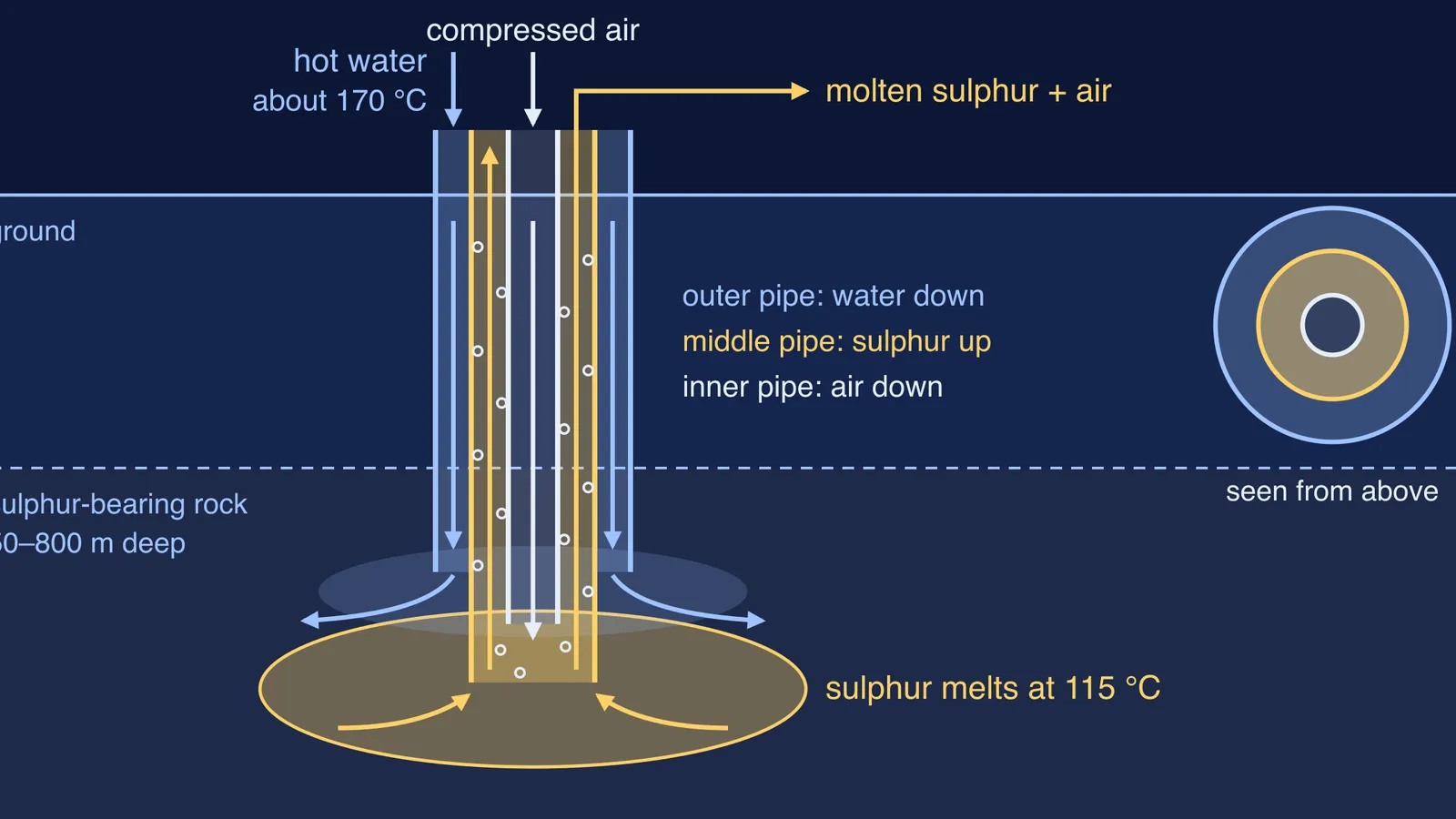
A hole is drilled down to the sulphur bed, and three pipes, one inside another, are lowered into it. OpenStax Chemistry 2e describes the steps:
Superheated water at about 170 °C and 10 atm pressure is forced down the outermost pipe into the deposit.
The hot water melts the sulphur around the bottom of the well.
Compressed air is sent down the innermost pipe into the liquid sulphur.
The air forces liquid sulphur, mixed with air, up the middle pipe to the surface.
The mixture goes into large settling vats, where the sulphur turns solid as it cools.
OpenStax states that sulphur made this way is 99.5% to 99.9% pure and needs no further purification for most uses.
Why does sulphur's low melting point make it work?
Sulphur melts at 115.21 °C, according to the Royal Society of Chemistry periodic table. That is only about 15 degrees above the temperature at which water boils in an open pot.
Open-pot water could never melt sulphur. Under pressure, though, water stays liquid above 100 °C. This superheated water is the same physics that lets a pressure cooker cook food above 100 °C. At the 170 °C quoted by OpenStax, the water is about 55 degrees hotter than sulphur's melting point, leaving a margin for heat lost on the way down.
The same RSC page gives sulphur's boiling point as 444.61 °C, far above anything the water reaches. So the sulphur melts but does not boil away. For what happens to its crystals on the way to melting, see our explainer on rhombic and monoclinic sulphur.
Why is compressed air needed to lift the sulphur?
Sulphur is about twice as dense as water: the RSC gives 2.07 g/cm³ for the solid. A tall column of it presses down hard on the bottom of the pipe. A rough calculation, ignoring friction, shows why Frasch added the air.
Take a well 300 m deep, inside the 50 to 800 m range for Frasch deposits.
Round the RSC's solid density to 2,000 kg/m³. Molten sulphur is somewhat lighter, so this slightly overstates the pressure.
Pressure needed to hold up a 300 m column: p = ρgh = 2,000 × 9.8 × 300, which is about 5.9 million Pa, or about 58 atm.
The same column of water would need only about 29 atm.
Froth the sulphur with air until the mixture is about half as dense, and the pressure needed falls to about 29 atm.
So the air does not blow the sulphur up like breath through a straw. It makes the column lighter, so the pressure of the hot water in the deposit can push it out at the top.
How to write the Frasch process in an exam
Check your answer against this list:
Draw three concentric pipes and label them from the outside in: hot water, molten sulphur, compressed air.
Say why the water stays liquid above 100 °C: it is superheated under pressure.
Give sulphur's melting point and say it is low enough for hot water to melt it.
Say what the air does: it froths the sulphur and lowers its density so it rises.
End with purity: the sulphur comes up pure enough for most uses without further treatment.
If the pipe layout still won't stick, the Fermi Simulation Lab has interactive simulations for ideas that are easier to see than to read, and the Fermi Concept Library gives each chemistry concept its own lesson.
Is the Frasch process still used today?
Rarely. The last Frasch sulphur mine in the United States closed in 2000, but the method is still used for deposits in Mexico, Ukraine and Poland. Today most sulphur is recovered while cleaning natural gas and oil, the RSC notes.
Much of that sulphur ends up as sulphuric acid. To follow it there, read our guide to the contact process for sulphuric acid.