

On this page
What happens when you arrange eight sulphur atoms into a crown-shaped ring, and then stack those rings together? Depending on the temperature, you get one of two distinct crystalline forms: rhombic or monoclinic sulphur. This structural difference is a frequent topic in high school chemistry and requires understanding how thermal energy alters crystal packing.
What is the difference between rhombic and monoclinic sulphur?
Both rhombic (α-sulphur) and monoclinic (β-sulphur) are crystalline allotropes made entirely of S8 molecules. Inside each molecule, the eight atoms form a puckered ring, often described as a "crown" shape. Sulphur atoms have six valence electrons, so each atom covalently bonds with two neighbours to complete its octet. This leaves two lone pairs on every sulphur atom. These electron pairs repel each other, forcing the ring out of a flat plane into its characteristic zigzag shape.
The difference lies entirely in how these identical rings pack together. In rhombic sulphur, the rings are tightly packed into an orthorhombic lattice, creating greenish-yellow, octahedral crystals. In monoclinic sulphur, the rings are arranged in a monoclinic lattice, yielding needle-shaped, yellow crystals that are less dense (Wikipedia).
Shape: Rhombic crystals are octahedral; monoclinic crystals are needle-like.
Density: Rhombic is the denser of the two forms due to its tighter packing.
Solubility: Rhombic sulphur is highly soluble in carbon disulphide (CS2).
If you are revising how molecules share electrons to form these kinds of rings, reviewing electron dot structures of covalent molecules is a good starting point.
What is the transition temperature of sulphur?
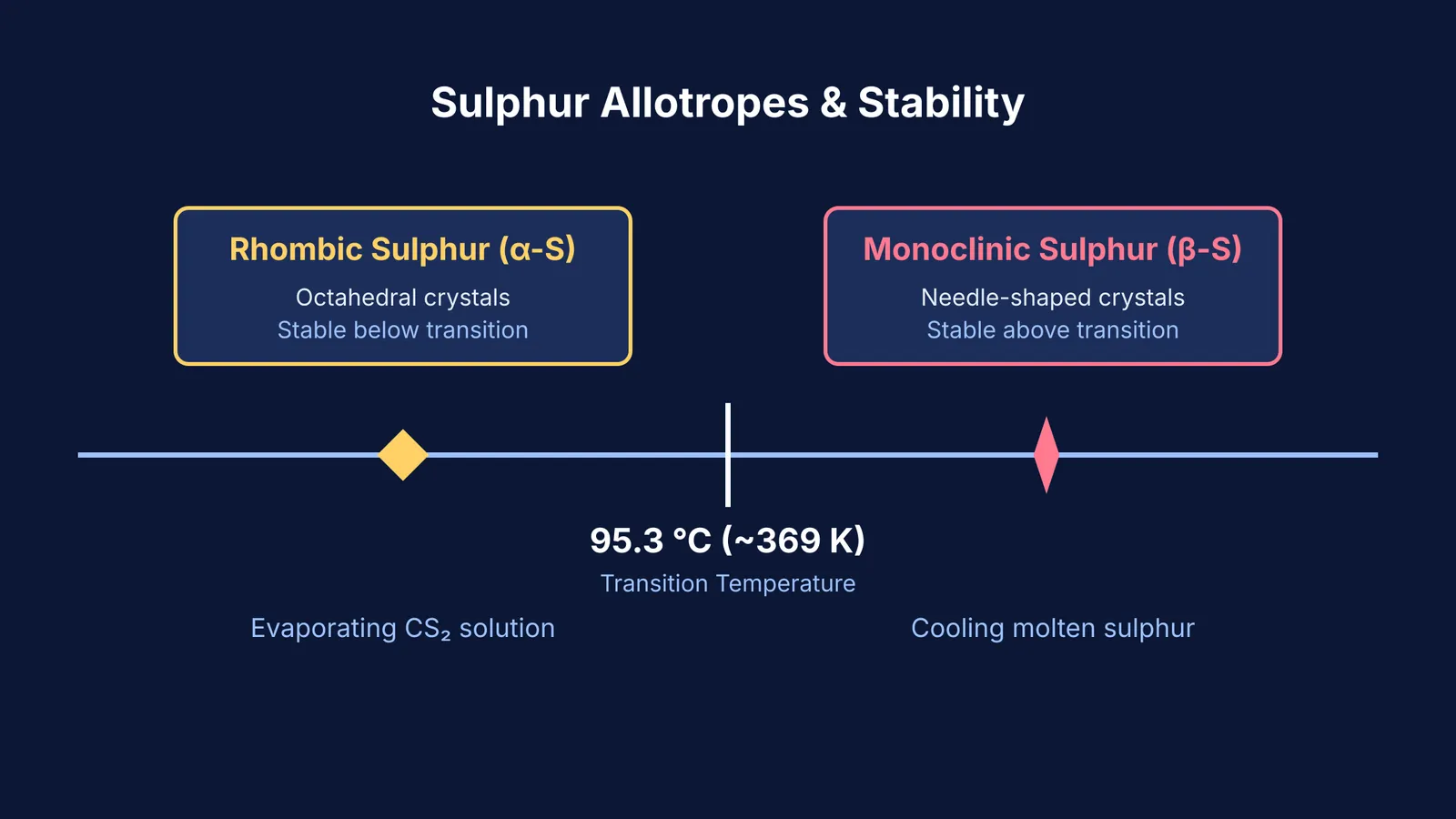
The stability of these two allotropes depends strictly on heat. The transition temperature between rhombic and monoclinic sulphur is 95.3 °C (about 369 K) (Wikipedia).
Below this temperature, rhombic sulphur is the stable form. If you leave a crystal of monoclinic sulphur at room temperature, it will slowly rearrange its lattice and revert to the rhombic form.
Above 95.3 °C, monoclinic sulphur becomes the stable form. As thermal energy is added to the tightly packed orthorhombic lattice, the vibrational energy of the S8 molecules increases. Eventually, the strict, dense packing becomes unstable, and the molecules shift into a slightly more open monoclinic lattice that allows for greater movement. At exactly the transition temperature, both allotropes can coexist in equilibrium. Understanding how substances behave as they cross these boundaries connects closely to the enthalpies of atomisation, sublimation and phase change.
When you encounter questions about phase shifts and realise you have forgotten which form is stable at which temperature, the Fermi Concept Library can help you rebuild the picture. Instead of memorising disjointed facts, Fermi's AI tutor works through the thermodynamics with you, mapping out why the less dense lattice dominates at higher temperatures.
How is rhombic sulphur prepared?
Rhombic sulphur (α-sulphur) is the most common form found in nature. It is the predominant form in "roll sulphur" and is highly soluble in carbon disulphide. Because it is the stable form at room temperature, it can be obtained by crystallising sulphur from a solution of carbon disulphide at ordinary temperatures (Wikipedia).
How is monoclinic sulphur prepared?
Monoclinic sulphur requires higher temperatures to form. It is prepared by crystallising molten sulphur at 100 °C and then cooling it rapidly. This rapid cooling slows down its reversion to the stable rhombic form. Another monoclinic form, known as nacreous or γ-sulphur, can be prepared by slowly cooling molten sulphur that has been heated above 150 °C (Wikipedia).
For students preparing for competitive exams, these practical details often turn up in statement-based questions. If you find yourself confusing the preparation methods, try working through a few matching problems in the Fermi Problem Library. The step-by-step solver explains the reasoning behind each reaction condition rather than just printing the final answer, so the connection between temperature and structure sticks.
How do you identify sulphur allotropes in exams?
In a multiple-choice question, examiners use specific clues to test your recognition of these two forms. Use this quick checklist to spot which allotrope is being described:
Is it described as "octahedral"? It is rhombic (α-sulphur).
Is it described as "needle-shaped"? It is monoclinic (β-sulphur).
Was it prepared using carbon disulphide (CS2)? It is rhombic.
Was it prepared by rapidly cooling molten sulphur? It is monoclinic.
Is the temperature specified as below 95.3 °C? Rhombic is the stable phase.
Is it asked whether they contain S8 rings? Both do.
Understanding that heat drives the shift from a tight lattice to a looser one makes the facts easier to hold onto than memorisation alone.


