On this page
Your textbook says the peroxide ion, O₂²⁻, is diamagnetic: molecular orbital theory gives it bond order 1 and no unpaired electrons. That is a prediction. In 1942 a physicist at Annamalai University checked it with a magnet and a balance. Miss K. Savithri and S. Ramachandra Rao measured hydrogen peroxide, sodium peroxide and barium peroxide, and all three were pushed out of the field. The clever part was how she got a clean number from impure samples, and you can redo her algebra with two simultaneous equations.
Who was K. Savithri and what did she publish?
What we know comes from the paper itself. It is "Magnetic susceptibility of some peroxides" by Miss K. Savithri and S. Ramachandra Rao, Department of Physics, Annamalai University, received on 5 May 1942 and printed in the Proceedings of the Indian Academy of Sciences, Section A, vol. 16, pp. 221–230 (doi:10.1007/BF03174793). The full text is open on the Academy's site.
The same issue carries a second paper by Savithri alone, a magnetic study of the reaction AsBr₃ + Br₂ ⇌ AsBr₅, and the journal's listings show her as co-author with Ramachandra Rao on studies of strontium and of magnesium, silver and lithium. We could not find her full name or what she did later, so we say nothing more about her life.
Of these three peroxides the paper says: "These peroxides do not seem to have been investigated before."
How do you measure magnetism with a balance?
Weigh a sample between the poles of an electromagnet, field off and then on. A paramagnetic sample (one with unpaired electrons) is pulled into the field and seems heavier. A diamagnetic sample (all electrons paired) is pushed out and seems lighter.
Savithri used two versions of this idea:
Gouy method for the H₂O₂ solutions, with water as the standard.
Curie method for the solid sodium and barium peroxides.
Her sodium peroxide held a trace of a ferromagnetic impurity, which would fake a pull. So she measured each sample at field currents of 2, 3, 4 and 5 amperes, and extrapolated to infinite field strength, where the impurity's share drops out. A more sensitive optical design from 1929 is the Bhatnagar–Mathur magnetic interference balance.
All the values in the paper are in units of 10⁻⁶ (cgs). Every one of them is negative. Negative χ means diamagnetic.
Why were her peroxide samples impure, and how did she fix it?
Peroxides are hard to get pure. She found the purity by titration with standard potassium permanganate, the same permanganate redox titration you meet in school:
5H₂O₂ + 2MnO₄⁻ + 6H⁺ → 2Mn²⁺ + 5O₂ + 8H₂O
Her analytical-grade Na₂O₂ was 94.0% peroxide, and she took the rest to be Na₂O. Her BaO₂ was 86.4% peroxide and 13.6% BaO, which she confirmed by weighing the barium as barium sulphate. The Perhydrol labelled 30% H₂O₂ turned out to be about 28%.
She did not try to purify the solids. Instead, heating a sample in vacuo drives off oxygen (2BaO₂ → 2BaO + O₂), so she made mixtures with less peroxide, down to about 65%.
Worked example: the susceptibility of pure Na₂O₂ from two impure samples
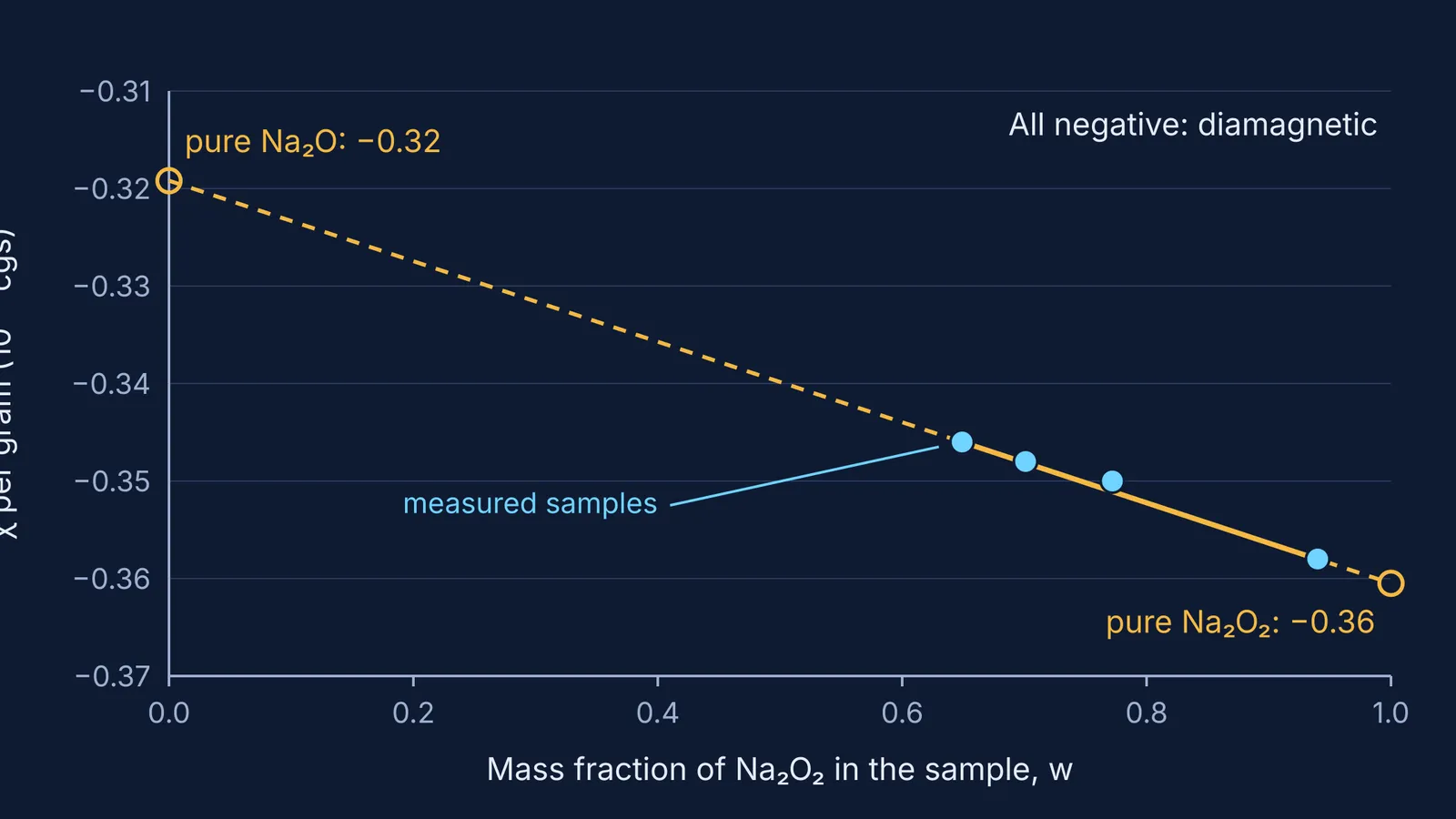
Let each gram be a fraction w of Na₂O₂ and (1 − w) of Na₂O, with susceptibilities adding by mass:
χ(mixture) = w·χ(Na₂O₂) + (1 − w)·χ(Na₂O)
Step 1. Take two samples from her Table II. At w = 0.649, χ = −0.346. At w = 0.940, χ = −0.358.
Step 2. Write two equations. Call the unknowns a (Na₂O₂) and b (Na₂O).
0.649a + 0.351b = −0.346
0.940a + 0.060b = −0.358
Step 3. Solve. Eliminating b gives a = −0.3605 and then b = −0.3192. The paper rounds these to −0.36 and −0.32.
Step 4. Test the answer on the other two samples. At w = 0.701 the rule predicts −0.348; she measured −0.348. At w = 0.772 it predicts −0.351; she measured −0.350. The mixture rule holds.
Step 5. Convert to molar susceptibility. Multiply by the molar mass. Na₂O₂ is 77.98 g/mol, so −0.36 × 77.98 = −28.1. Na₂O is 61.98 g/mol, so −0.32 × 61.98 = −19.8. Both match the paper.
For barium she measured pure BaO directly (−0.19) and solved one equation per sample. Six samples from 70.6% to 86.4% all gave about −0.24 for BaO₂, or −40.6 per mole.
Same trick for H₂O₂. A 28.1% solution had χ = −0.693, and water is −0.720. So χ(H₂O₂) = (−0.693 − 0.719 × −0.720) ÷ 0.281 = −0.624. Her mean above 10% was −0.619, which is −21.0 ± 0.4 per mole. An earlier value by Farquharson, quoted from a 1930 paper, was −16.73; she argued that her many measurements were more reliable.
What does MO theory say about O₂, O₂⁻ and O₂²⁻?
Count valence electrons and fill the O₂-type order (σ2s, σ*2s, σ2pz, π2p, π*2p):
O₂ (12 electrons): π*2p², one electron in each π* orbital. Bond order (8 − 4)/2 = 2. Two unpaired electrons, μ = √(2 × 4) = 2.83 BM. Paramagnetic.
O₂⁻, superoxide (13): π*2p³. Bond order (8 − 5)/2 = 1.5. One unpaired electron, μ = 1.73 BM. Paramagnetic.
O₂²⁻, peroxide (14): π*2p⁴, all paired. Bond order 1. μ = 0. Diamagnetic.
For the full filling method see our guide to molecular orbital theory and the magnetism of O₂ and its ions.
How big would one unpaired electron be? Our rough estimate from the Curie law, χ(molar) ≈ 0.125 μ²/T, gives about +1260 × 10⁻⁶ at 298 K for μ = 1.73. That is about 45 times the size of Na₂O₂'s −28.1, and of the opposite sign. So Savithri's small negative numbers rule out even one unpaired electron per O₂ unit. Superoxides such as KO₂ come out paramagnetic, as our post on why potassium forms a superoxide but lithium an oxide explains.
What did she conclude about the structure of peroxides?
She compared the peroxide with its monoxide. The second oxygen adds −28.1 − (−19.8) = −8.3 for sodium and −40.6 − (−29.1) = −11.5 for barium. These are modest amounts, so she saw no sign that bonding to the metal had changed. Her conclusion: "the valency of the metal is the same in the peroxide and monoxide". In other words the extra oxygen is singly bonded to the metal's oxygen in an O–O link, not double-bonded to the metal. Today we say the same thing in ionic terms: Na₂O₂ is 2Na⁺ and one O₂²⁻ ion, with Na at +1 in both oxides.
Her H₂O₂ discussion is more dated. She weighed two "tautomeric" forms against each other, one of them H₂O→O. Modern work settles on the skewed H–O–O–H molecule, and she herself noted that Venkateswaran's 1933 Raman data, with a strong line at 875 cm⁻¹, favoured H–O–O–H. Treat that part of the paper as history, not as current chemistry.
If you want more practice with mixture problems and bond-order questions, the Fermi Problem Library has a step-by-step solver that explains the reasoning, and the Concept Library links MO theory to magnetism.
Checklist before your exam
Peroxide O₂²⁻: bond order 1, no unpaired electrons, diamagnetic.
Superoxide O₂⁻: bond order 1.5, one unpaired electron, paramagnetic, μ = 1.73 BM.
O₂: bond order 2, two unpaired electrons, μ = 2.83 BM.
Negative χ means diamagnetic; positive means paramagnetic.
For an impure sample, write χ(mix) = w·χ₁ + (1 − w)·χ₂ and solve two equations.
Peroxide purity is found by permanganate titration.