On this page
Silver acetate, CH₃COOAg, is only sparingly soluble in water. Acetic acid shares its acetate ion. So if you shake the salt with acetic acid instead of water, the common-ion effect says less of it should dissolve. In 1919 two chemists at Aberdeen measured exactly that, all the way from pure water to nearly pure acid. The solubility did fall. But the common-ion arithmetic explains only about a twentieth of the fall at 1 N, and less than a twentieth of it near glacial acid.
What did Knox and Will measure in 1919?
The paper is J. Knox and H. R. Will, "The solubility of silver acetate in acetic acid and of silver propionate in propionic acid", J. Chem. Soc. Trans. 115 (1919) 853–854. We read it in the scanned 1919 volume and checked every number below against the page images. It is signed from the Chemical Department, University of Aberdeen, and was received on 16 June 1919. We have not checked anything else about the authors' lives or careers.
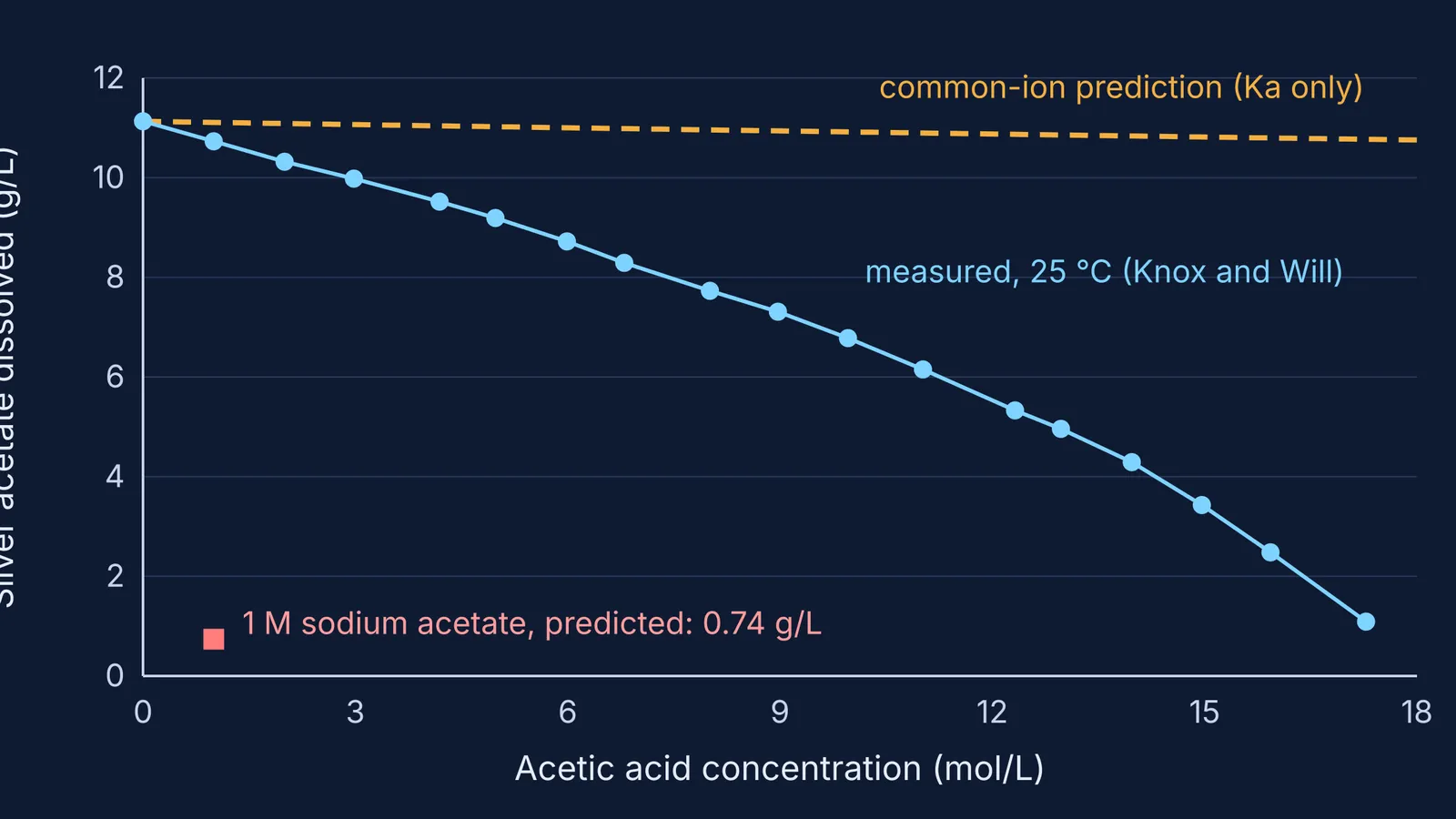
They were not testing the common-ion effect. They wanted to know whether silver acetate forms an acid salt with acetic acid, as sodium acetate does. They shook excess salt with water or acid at 25 °C until the solubility stopped changing, found the silver as silver chloride and titrated the acid with carbonate-free NaOH. Some of their rows (acid in gram-equivalents per litre, which for acetic acid equals mol/L):
0.00 N (water): 11.13 g/L
1.00 N: 10.73 g/L
4.98 N: 9.19 g/L
9.96 N: 6.78 g/L
14.96 N: 3.43 g/L
17.28 N: 1.09 g/L
Their water value sits between the older figures they quote: 11.18 (Goldschmidt), 11.07 (Jaques) and 11.21 (interpolated from Raupenstrauch). Pure acetic acid is about 17.5 mol/L, so their last point is close to glacial acid.
Their only conclusion was about phases: "the solubility curve is continuous, indicating that no new phase is formed". In other words, no acid salt. Silver propionate in propionic acid gave the same kind of smooth curve, from 9.04 g/L in water down to 2.17 g/L at 13.03 N. They offered no theory for why the solubility fell. The analysis below is ours.
Should acetic acid push silver acetate out of solution?
Two equilibria share the acetate ion:
CH₃COOAg(s) ⇌ Ag⁺(aq) + CH₃COO⁻(aq)
CH₃COOH(aq) ⇌ H⁺(aq) + CH₃COO⁻(aq)
Both balance in atoms and charge. More acetate from the acid should drive the first equilibrium back. The question is how much acetate the acid actually supplies. A 1 M acetic acid solution on its own (Ka about 1.75 × 10⁻⁵) has [H⁺] = [CH₃COO⁻] ≈ √(1.75 × 10⁻⁵) = 4.2 × 10⁻³ M. In a saturated silver acetate solution it is smaller still, because the salt's own acetate suppresses the acid's ionisation. This is the same idea as a buffer, where sodium acetate holds back acetic acid.
Worked example: how much does 1 M acetic acid lower the solubility?
Use the 1919 numbers: 11.13 g/L in water, and Ka = 1.75 × 10⁻⁵.
Molar mass. C₂H₃O₂Ag = 2(12.011) + 3(1.008) + 2(15.999) + 107.868 = 166.91 g/mol.
Solubility in water. s₀ = 11.13 ÷ 166.91 = 0.0667 mol/L. The naive solubility product is s₀² = 4.45 × 10⁻³. We call it naive because at 0.067 M the ions are far from ideal, so this is not a true thermodynamic Ksp.
Write the unknowns. Let s = [Ag⁺] and h = [H⁺]. Charge balance gives [CH₃COO⁻] = s + h. Take [CH₃COOH] ≈ 1 M, since so little of it ionises.
Write both equilibria. s(s + h) = 4.45 × 10⁻³ and h(s + h) = 1.75 × 10⁻⁵ × 1.
Add them. (s + h)² = 4.45 × 10⁻³ + 1.75 × 10⁻⁵ = 4.464 × 10⁻³, so s + h = 0.06681 M.
Solve. s = 4.45 × 10⁻³ ÷ 0.06681 = 0.06655 M, and h = 0.06681 − 0.06655 = 2.6 × 10⁻⁴ M.
Convert back. 0.06655 × 166.91 = 11.11 g/L. Predicted fall: 0.2%.
Knox and Will found 10.73 g/L, a fall of 3.6%. The common-ion effect accounts for about one-twentieth of it. Notice step 6: the acid adds only 2.6 × 10⁻⁴ M acetate, sixteen times less than it gives on its own, and only 0.4% of the 0.067 M acetate already present.
Now compare a strong common ion. In 1 M sodium acetate the acetate really is 1 M, so s(s + 1) = 4.45 × 10⁻³ gives s = 0.0044 M, or 0.74 g/L. That is a 15-fold fall. For the salt-only version and its limits, see Arthur Noyes's 1890 common-ion tests on thallium chloride.
Why did the solubility fall so much more than predicted?
Run the same calculation along the whole series. Predicted against measured:
4.98 N: 11.02 against 9.19 g/L (−1.0% against −17%)
9.96 N: 10.92 against 6.78 g/L (−1.9% against −39%)
17.28 N: 10.77 against 1.09 g/L (−3.2% against −90%)
The common-ion prediction stays almost flat. The real curve drops faster and faster. Our reading is that the liquid itself is changing. At 9.96 N, about 600 g of every litre is acetic acid; at 17.28 N, about 1040 g is, which leaves very little water. Water is what keeps the salt's ions apart in solution; acetic acid is a much poorer solvent for ions, so as it replaces water the salt dissolves less, common ion or not.
The calculation also stops being valid here. Ka = 1.75 × 10⁻⁵ is a constant for dilute solution in water. In a liquid that is mostly acetic acid it does not apply, and concentration is no longer a good stand-in for activity. So treat the 1 N comparison as the clean test, and the high-acid points as a sign that a different effect has taken over.
Where does this come up in JEE and NEET?
Class 11 Equilibrium: Ksp, the common-ion effect, and the suppression of a weak acid by its conjugate base. Common-ion problems use a salt such as CH₃COONa for the common ion, not the weak acid itself. Now you know why. Our guide to solubility product, Ksp and precipitation has the standard problems.
pH of mixtures: the same suppression appears when a strong acid holds back a weak one; see the pH of a weak and strong acid mixture.
If you want to check each line of a two-equilibrium problem like this one, the Fermi Problem Library has a step-by-step solver that explains the reasoning. For timed exam practice, Fermi Test Prep covers JEE Main and Advanced preparation with an AI tutor.
Quick checklist
Knox and Will, Aberdeen 1919: silver acetate at 25 °C fell from 11.13 g/L in water to 10.73 g/L in 1 N acetic acid and 1.09 g/L at 17.28 N.
Their conclusion: the curve is smooth, so no acid salt forms.
Common-ion arithmetic predicts only a 0.2% fall at 1 N, because the acid adds just 2.6 × 10⁻⁴ M acetate.
1 M sodium acetate would cut the solubility 15-fold. A weak acid is a poor source of common ion.
The large fall in strong acid is a change of solvent, not a common-ion effect. That reading is ours.