On this page
NCERT tells you that boric acid loses water on heating, H₃BO₃ → HBO₂ → B₂O₃. In 1917 James Eckersley Myers at Manchester ran the ladder the other way. He let glassy boron trioxide take up water and weighed it. The first step, to metaboric acid, was done in about a day. The second, to orthoboric acid, was still unfinished after six. He then tried to follow the slow step with a freezing-point measurement, and the freezing point refused to move. What that does and does not prove is a neat test of colligative properties.
What did J. E. Myers publish in 1917?
The paper is J. E. Myers, "Boric anhydride and its hydrates", J. Chem. Soc. Trans. 111 (1917) 172–179. We read it in the scanned 1917 volume and checked every number below against the page images. It is signed from The University, Manchester, and was received on 22 February 1917. We have not checked anything else about his life or career.
It had "always been assumed" that boron trioxide and metaboric acid react with water so fast that no rate or molar mass could be measured in solution. He noticed that ground B₂O₃ glass does not dissolve at once. After a minute or two "a reaction takes place quite suddenly" and the solid swells. In moist air the same change runs slowly enough to weigh.
How fast does boron trioxide take up water?
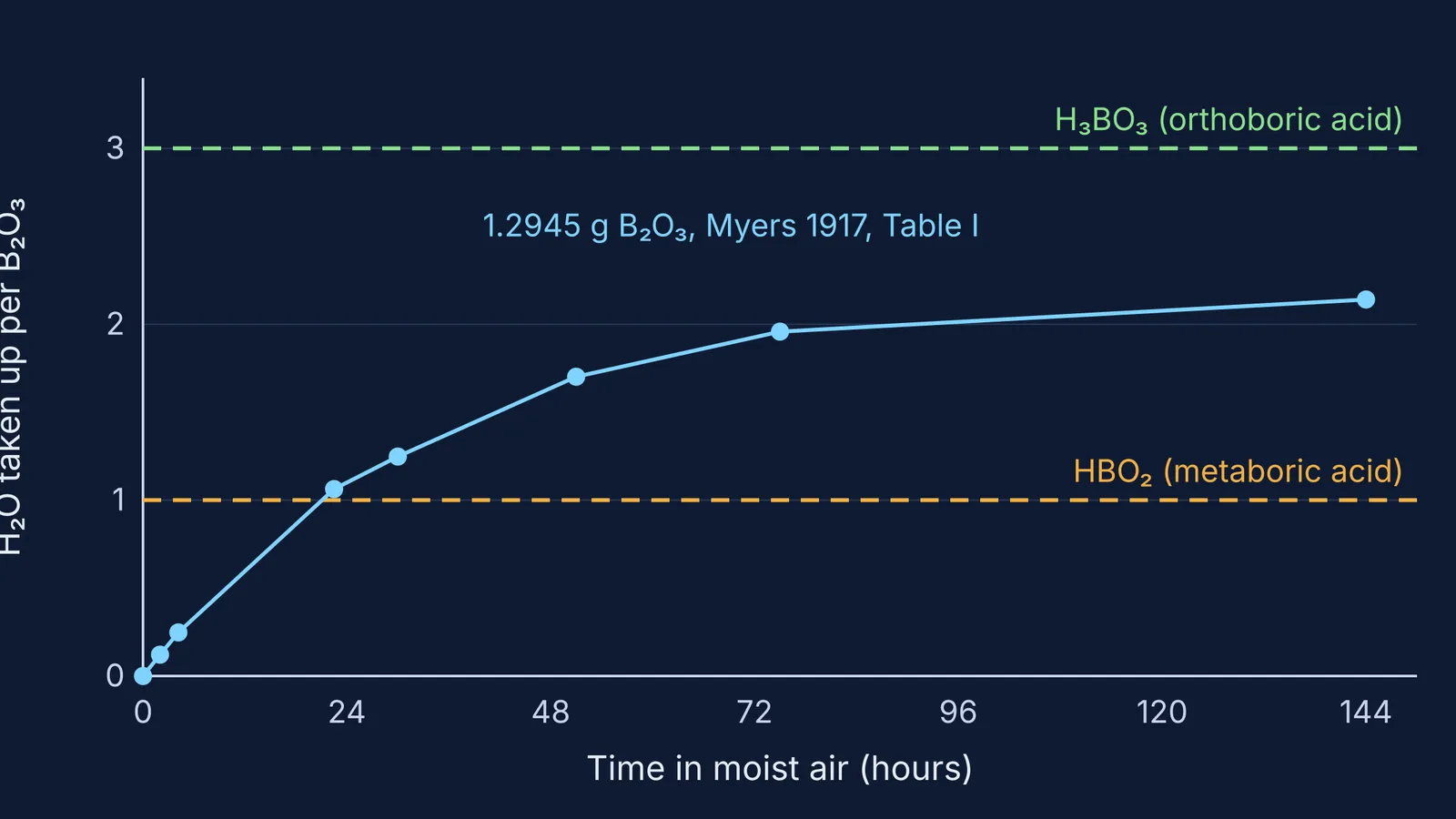
He kept 1.2945 g of B₂O₃ in a weighing bottle over water at constant temperature and weighed it from time to time. His Table I gives the total gain:
120 min: 0.0405 g
1350 min (22.5 h): 0.356 g
3060 min (51 h): 0.570 g
8640 min (6 days): 0.717 g
In his words, after about twenty hours "sufficient water has been taken up to transform the whole of the boron trioxide into metaboric acid", but "the further hydration to orthoboric acid requires a very much longer period".
The two steps, both balanced in atoms:
B₂O₃ + H₂O → 2HBO₂ (fast)
HBO₂ + H₂O → H₃BO₃ (slow)
A separate test, with a potassium iodide–iodate mixture used "for the purpose of detecting hydrogen ions", gave colour within minutes with orthoboric acid but sometimes took two or three hours with fresh B₂O₃ or HBO₂ solutions. Myers read this as metaboric acid surviving for a while in water.
Why did the freezing point not change?
Myers dissolved 0.218 g of B₂O₃ in water and measured the freezing point at once and a day later, "when the solution would undoubtedly consist of orthoboric acid". It was unchanged: a depression of 0.47°.
That is exactly what colligative properties predict. Depression of freezing point depends on the number of solute particles, not on what they are. Each HBO₂ that takes up water becomes one H₃BO₃. Both are weak acids, so ions add little. The number of particles stays the same, and so does ΔTf.
Worked example: water uptake, particle count and a rate constant
Use B = 10.81, H = 1.008, O = 16.00. Molar masses: B₂O₃ 69.62, HBO₂ 43.82, H₃BO₃ 61.83, H₂O 18.02 g/mol.
Moles of oxide. 1.2945 ÷ 69.62 = 0.01859 mol B₂O₃.
Gain needed for each stage. To HBO₂ (1 H₂O per B₂O₃): 0.01859 × 18.02 = 0.335 g. To H₃BO₃ (3 H₂O): 1.005 g.
Read Table I as H₂O per B₂O₃. At 22.5 h, 0.356 ÷ 18.02 ÷ 0.01859 = 1.06. At 51 h, 1.70. At 6 days, 2.14. So the metaboric stage is passed within a day, but even after six days the solid is short of 3. (His first printed gain, 0.0405 g, does not match 1.334 − 1.2945 = 0.0395 g; either way it is 0.12 H₂O per B₂O₃.)
Count particles in the freezing-point test. 0.218 g ÷ 69.62 = 3.13 mmol B₂O₃, which gives 6.26 mmol HBO₂ (0.274 g) and then 6.26 mmol H₃BO₃ (0.387 g). Myers printed 0.274 and 0.387. Same count, same ΔTf.
What water mass does 0.47° imply? With Kf = 1.86 K kg/mol, m = 0.47 ÷ 1.86 = 0.253 mol/kg, so 6.26 mmol needs about 24.8 g of water. The paper does not state the water mass, so this is our back-calculation, and we cannot independently check his claim that metaboric acid is a single molecule in solution.
His rate constant. Table II follows 1.451 g of metaboric acid in moist air. Full conversion needs 1.451 ÷ 43.82 × 18.02 = 0.597 g. Myers used the first-order formula with common logs, k = (1/t) log₁₀[a ÷ (a − x)]. At 30 min, x = 0.027 g: k = log₁₀(0.597 ÷ 0.570) ÷ 30 = 0.00067 per minute, his printed value. At 403 min, x = 0.290 g, k = 0.00072. Half-life = 0.301 ÷ 0.00072 ≈ 420 min, about 7 hours; the 403-minute point is indeed 49% converted.
Does a constant freezing point prove the reaction is first order?
No. Myers wrote that "since the freezing point remains constant during the hydration to orthoboric acid, the reaction may be stated to be one of the first order." This is the step to question.
The freezing point stayed constant because the particle count did not change. That would be true for any rate law, and whether the change took a day or a second. A measurement that cannot tell reactant from product cannot time the change. To find an order you need a property that changes as the reaction runs.
His Table II is that kind of evidence: mass gain against time in moist air. His k values stay within a 25% band, from 0.00067 to 0.00084. Myers himself noticed "the general rising tendency of the values for k", which he took as a sign that the state of the metaboric acid affects the rate. So the first-order claim rests on the weighing, not on the freezing point.
What happens when boric acid is heated at 103° and at 135°?
Myers also ran the forward step. At 103° samples of 0.456 g and 0.464 g of H₃BO₃ fell to 0.320 g and 0.329 g, close to the 0.323 g and 0.329 g expected for HBO₂. At 135°, 0.582 g fell to 0.396 g, below the 0.412 g for HBO₂, and the product was "distinctly granular". For the full heating ladder and its mass-loss numericals, see what boric acid gives on heating.
Where does this come up in JEE and NEET?
Class 11 p-block: orthoboric acid, metaboric acid and B₂O₃.
Class 12 Solutions: ΔTf = Kf·m and the particle count; see colligative properties and the van 't Hoff factor.
Class 12 Kinetics: following a reaction by mass change and testing the order from k; see reading reaction order from integrated rate law graphs.
To revise colligative properties or first-order kinetics from the ground up, the Concept Library covers every concept in chemistry. For more rate-constant problems, the Fermi Problem Library has a step-by-step solver that explains the reasoning.
Quick checklist
Myers, Manchester 1917: B₂O₃ + H₂O → 2HBO₂ is fast; HBO₂ + H₂O → H₃BO₃ is slow.
In moist air, 1.2945 g B₂O₃ passed 1 H₂O per B₂O₃ in about 20 hours and reached only 2.14 in six days.
0.218 g B₂O₃ gave a 0.47° depression that did not change as HBO₂ became H₃BO₃: one particle in, one particle out.
A constant freezing point shows the particle count is unchanged, not the reaction order.