

On this page
Ask "what happens when boric acid is heated?" and many students write H₃BO₃ → B₂O₃ and stop. That is the end point, but the acid gets there in steps, losing water each time. JEE Advanced lists boric acid by name in its inorganic syllabus, so you should know each step, its rough temperature, and how to turn the mass lost into a numerical. The method is the same one you use for hydrates such as CuSO₄·5H₂O.
What does boric acid give on heating, step by step?
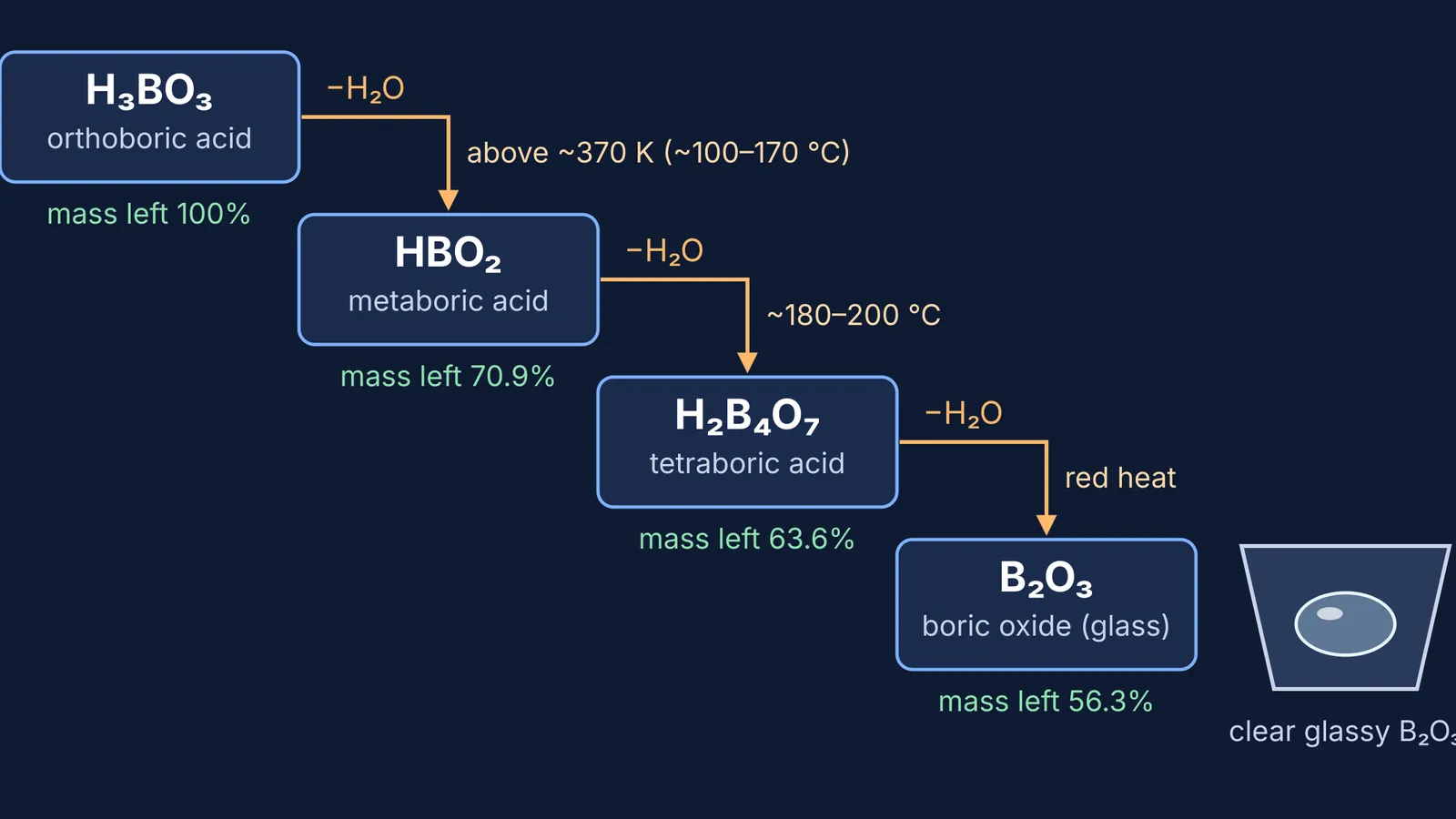
Orthoboric acid, H₃BO₃ (often written B(OH)₃), loses water in three stages:
Orthoboric acid → metaboric acid. H₃BO₃ → HBO₂ + H₂O. NCERT gives this as happening above 370 K.
Metaboric acid → tetraboric acid. 4HBO₂ → H₂B₄O₇ + H₂O. Tetraboric acid is also called pyroboric acid.
Tetraboric acid → boric oxide. H₂B₄O₇ → 2B₂O₃ + H₂O. This needs strong (red) heat, and the product is a clear glass.
Adding them up gives the overall change: 2H₃BO₃ → B₂O₃ + 3H₂O. Check it: 2 B, 6 H and 6 O on the left; 2 B, 6 H and 3 + 3 = 6 O on the right.
NCERT's Class 11 p-block chapter skips the middle step and writes H₃BO₃ → HBO₂ → B₂O₃. That is fine for a two-mark answer. Treat H₂B₄O₇ as an intermediate you should recognise, not a step every examiner expects.
At what temperature does each step happen?
Sources disagree here, so learn ranges, not single numbers. NCERT's figure for the first step is "above 370 K", about 97 °C. Data compilations such as the boric acid entry on Wikipedia put the change to metaboric acid at roughly 140–170 °C and tetraboric acid at around 180–200 °C. The spread comes from how fast you heat, whether the vessel is open, and the fact that metaboric acid exists in several crystal forms with different stabilities.
Boric oxide needs much stronger heating, several hundred degrees, before the last water leaves and the melt sets to a glass. For exam purposes:
HBO₂: above about 370 K (NCERT), often quoted up to about 170 °C
H₂B₄O₇: roughly 180–200 °C
B₂O₃: red heat
If a question gives its own temperatures, use those.
Why does boric acid lose water in stages?
Each step is a condensation. Two B–OH groups on neighbouring boron atoms join to make a B–O–B bridge and push out one H₂O. In H₃BO₃ every boron carries three OH groups, held in flat layers by hydrogen bonds. Losing one water per boron gives HBO₂, whose B₃O₃ rings each still carry OH groups. More condensation joins the rings into larger units (H₂B₄O₇) and finally into B₂O₃, a network of BO₃ triangles with no OH left at all.
Because every step is just loss of H₂O, the boron count never changes. That is what makes the mass-loss arithmetic simple.
How much mass is left at each stage? A worked example
Use B = 10.81, H = 1.008, O = 16.00. The molar masses are H₃BO₃ 61.83, HBO₂ 43.82, H₂B₄O₇ 157.26 and B₂O₃ 69.62 g/mol.
Step 1: write each change per fixed amount of boron.
H₃BO₃ → HBO₂: 61.83 g gives 43.82 g
4H₃BO₃ → H₂B₄O₇ + 5H₂O: 4 × 61.83 = 247.34 g gives 157.26 g
2H₃BO₃ → B₂O₃ + 3H₂O: 2 × 61.83 = 123.67 g gives 69.62 g
Step 2: turn each into a percentage of the starting mass.
HBO₂: 43.82 ÷ 61.83 × 100 = 70.9% left (29.1% lost)
H₂B₄O₇: 157.26 ÷ 247.34 × 100 = 63.6% left
B₂O₃: 69.62 ÷ 123.67 × 100 = 56.3% left
Step 3: apply it to a real sample. Question: 6.18 g of boric acid is heated strongly to constant mass. What mass of B₂O₃ remains, and how much water is lost?
Moles of H₃BO₃ = 6.18 ÷ 61.83 = 0.100 mol
Moles of B₂O₃ = 0.100 ÷ 2 = 0.0500 mol
Mass of B₂O₃ = 0.0500 × 69.62 = 3.48 g
Water lost = 6.18 − 3.48 = 2.70 g, which is 0.150 mol of H₂O, as the 2 : 3 ratio predicts
Step 4: run it backwards. A 2.00 g sample of boric acid is heated gently and leaves 1.42 g. What is the residue? 1.42 ÷ 2.00 = 71%, which matches HBO₂ (70.9%), not B₂O₃ (56.3%). The heating stopped at metaboric acid.
The same "moles of starting solid, then the ratio, then the molar mass" routine works for any thermal decomposition. Our post on what KMnO₄, K₂Cr₂O₇ and AgNO₃ give on heating uses it on oxygen-releasing salts. If you want to check each line of a problem like this, the Fermi Problem Library has a step-by-step solver that explains the reasoning, not just the final number.
Is B₂O₃ acidic, and does it turn back into boric acid?
Yes on both counts. B₂O₃ is an acidic oxide, the anhydride of boric acid. It dissolves slowly in water and re-forms H₃BO₃:
B₂O₃ + 3H₂O → 2H₃BO₃
So the dehydration can be reversed, which is why B₂O₃ glass is kept dry. With a base it gives a metaborate:
B₂O₃ + 2NaOH → 2NaBO₂ + H₂O
Check: 2 B, 2 Na, 5 O and 2 H on each side. Boric acid itself is weak and monobasic because boron accepts OH⁻ rather than donating H⁺; we explain that in why boric acid is a monobasic Lewis acid.
How does this connect to the borax bead test?
The glass in a borax bead is the same B₂O₃. When borax is heated it first loses its water of crystallisation and then splits:
Na₂B₄O₇ → 2NaBO₂ + B₂O₃
The clear bead is a mix of sodium metaborate and boric oxide. Acidic B₂O₃ then reacts with a basic metal oxide to form a coloured metaborate, for example CoO + B₂O₃ → Co(BO₂)₂, which is blue. Boric acid itself can make a bead in the same way, because heating it also leaves B₂O₃. For the structure of borax and the full list of bead colours, read structure of borax and the borax bead test.
Quick checklist
H₃BO₃ → HBO₂ (above about 370 K) → H₂B₄O₇ (about 180–200 °C) → B₂O₃ (red heat). Temperatures vary between sources.
Each step is loss of water by condensation of B–OH groups; boron is never lost.
Overall: 2H₃BO₃ → B₂O₃ + 3H₂O.
Mass left: 70.9% as HBO₂, 63.6% as H₂B₄O₇, 56.3% as B₂O₃.
H₂B₄O₇ is an acid; borax is Na₂B₄O₇·10H₂O.
B₂O₃ is acidic, re-forms H₃BO₃ with water, and makes the glass in the borax bead.


