

On this page
NCERT mentions in one line that KMnO₄ decomposes at 513 K, and JEE and NEET questions then ask what it gives. Potassium dichromate and silver nitrate turn up in the same kind of question. All three give off oxygen when heated strongly, and all three do it the same way: oxygen that was part of the compound is oxidised to O₂, while another atom in the same compound is reduced. Spot that pattern and the equations and numericals become quick.
What happens when KMnO₄ is heated?
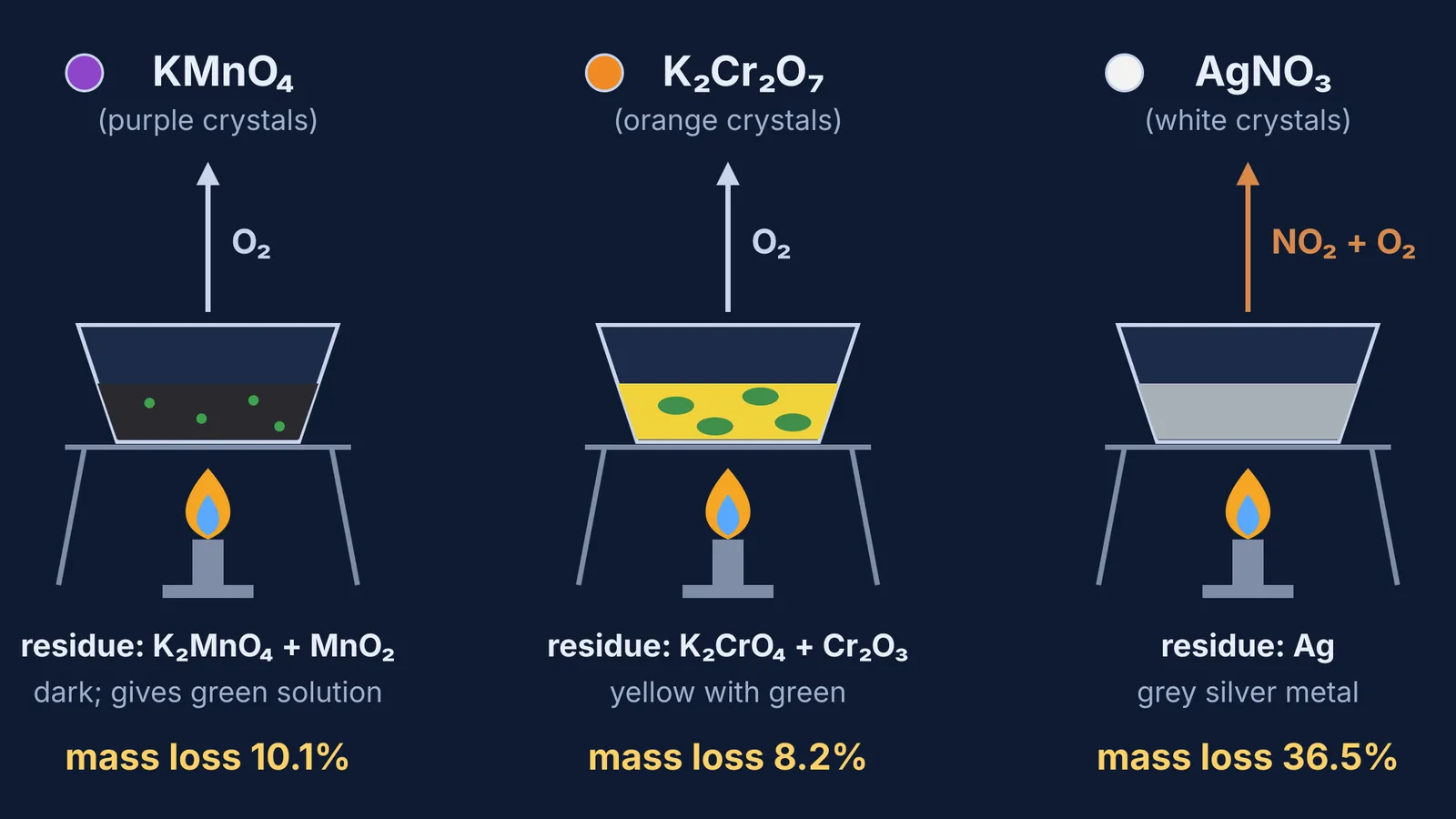
Purple crystals of potassium permanganate decompose at about 240 °C (NCERT's 513 K; sources quote values a little lower too). The products are potassium manganate, manganese dioxide and oxygen:
2KMnO₄ → K₂MnO₄ + MnO₂ + O₂
Check the atoms: 2 K, 2 Mn and 8 O on each side.
Now the electrons. Manganese starts at +7 in both permanganate ions. One Mn ends at +6 in K₂MnO₄, gaining 1 electron. The other ends at +4 in MnO₂, gaining 3 electrons. That is 4 electrons gained in total. Two oxygen atoms go from −2 to 0 in O₂, losing 2 electrons each, which is 4 electrons lost. Gain equals loss, so the equation is balanced as a redox reaction too.
This is called an internal (or intramolecular) redox reaction, because the oxidising agent (Mn⁺⁷) and the reducing agent (oxide O⁻²) sit in the same compound. It is also why NCERT lists permanganates, along with chlorates and nitrates, as salts that give oxygen on heating. The KClO₃ route is the one used in the lab, and we cover it in preparing oxygen from potassium chlorate with MnO₂.
For exams, use the equation above. On stronger heating the residue changes further, so experimental mass losses do not always match the textbook figure exactly.
What does K₂Cr₂O₇ give on heating?
Orange potassium dichromate is much more stable. It melts at about 398 °C and gives off oxygen only near or above 500 °C. The products are yellow potassium chromate, green chromium(III) oxide and oxygen:
4K₂Cr₂O₇ → 4K₂CrO₄ + 2Cr₂O₃ + 3O₂
The coefficients 4 : 4 : 2 : 3 look odd, so balance it by electrons rather than by trial.
The 4 formula units of K₂Cr₂O₇ contain 8 Cr atoms, all at +6.
Four Cr atoms stay at +6 in 4K₂CrO₄. The other four go to +3 in 2Cr₂O₃, gaining 3 electrons each: 12 electrons gained.
Each oxygen atom that becomes O₂ loses 2 electrons, so 6 oxygen atoms must be oxidised to supply 12 electrons. Six O atoms make 3O₂.
Count oxygen: 4 × 7 = 28 on the left. On the right, 16 in K₂CrO₄, 6 in Cr₂O₃ and 6 in O₂, which is 28.
Why does AgNO₃ leave silver metal, not an oxide?
Silver nitrate melts at about 212 °C and decomposes at about 440 °C. It gives brown NO₂, oxygen and a grey residue of silver metal:
2AgNO₃ → 2Ag + 2NO₂ + O₂
Compare it with a heavy-metal nitrate such as lead nitrate, which leaves the oxide: 2Pb(NO₃)₂ → 2PbO + 4NO₂ + O₂. Silver would be expected to leave Ag₂O in the same way. But Ag₂O is unstable to heat. It starts to lose oxygen above about 200 °C, well below the temperature at which silver nitrate itself breaks down. So any Ag₂O formed decomposes at once:
4AgNO₃ → 2Ag₂O + 4NO₂ + O₂
2Ag₂O → 4Ag + O₂
Add them and divide by 2, and you get the overall equation. This two-step picture is a memory aid for the products, not a claim about the mechanism.
Electron check: two Ag go from +1 to 0 (2 electrons gained) and two N go from +5 to +4 (2 electrons gained). Two O atoms go from −2 to 0 (4 electrons lost). For the full pattern across group 1, group 2 and other nitrates, see what happens when nitrates and carbonates are heated.
How much mass is lost? Worked examples
Molar masses: KMnO₄ 158.0, K₂Cr₂O₇ 294.2 and AgNO₃ 169.9 g/mol. Only gases leave the crucible, so mass loss equals mass of gas formed.
Example 1: 3.16 g of KMnO₄ is heated until no more gas is given off. Find the mass of O₂, the mass of residue and the percentage loss.
Moles of KMnO₄ = 3.16 ÷ 158.0 = 0.0200 mol.
From 2KMnO₄ → K₂MnO₄ + MnO₂ + O₂, moles of O₂ = 0.0200 ÷ 2 = 0.0100 mol.
Mass of O₂ = 0.0100 × 32.0 = 0.320 g.
Residue = 3.16 − 0.32 = 2.84 g (about 1.97 g K₂MnO₄ and 0.87 g MnO₂).
Percentage loss = 0.320 ÷ 3.16 × 100 = 10.1%.
At STP (273 K, 1 bar) the oxygen occupies 0.0100 × 22.7 L = 227 mL. If your book uses 22.4 L at 1 atm, the answer is 224 mL.
Example 2: percentage mass loss for K₂Cr₂O₇.
Four moles (4 × 294.2 = 1176.7 g) give 3 mol of O₂ (96.0 g). Loss = 96.0 ÷ 1176.7 × 100 = 8.2%. So 2.94 g of dichromate (0.0100 mol) loses 0.240 g.
Example 3: a white salt X gives brown fumes on heating, leaves a shiny grey residue and loses 36.5% of its mass. Identify X.
Brown fumes mean NO₂, so X is a nitrate. A metal residue rather than an oxide points to silver. Check: 2 mol of AgNO₃ (339.7 g) lose 2NO₂ + O₂ = 92.0 + 32.0 = 124.0 g, and 124.0 ÷ 339.7 × 100 = 36.5%. X is AgNO₃. The residue, Ag, is the other 63.5%.
To check your own steps on problems like these, the Fermi Problem Library has a step-by-step solver that explains the reasoning at each line, not just the final number.
Why does the KMnO₄ residue turn water green?
The black residue from heating KMnO₄ is a mix of K₂MnO₄ and MnO₂. When you shake it with water, the potassium manganate dissolves and gives the dark green colour of MnO₄²⁻ (manganese +6). Manganese dioxide is insoluble and stays behind as a brown-black solid.
The green does not last in plain water. Manganate is stable only in alkaline solution. In neutral water it slowly disproportionates, and the solution turns purple as permanganate re-forms:
3MnO₄²⁻ + 2H₂O → 2MnO₄⁻ + MnO₂ + 4OH⁻
Charge: −6 on the left, −2 − 4 = −6 on the right. Oxygen: 14 on each side. For the colour of each manganese oxidation state and why permanganate is purple, read our post on manganese colours from permanganate to MnO₂.
Quick checklist before the exam
KMnO₄ (about 240 °C): K₂MnO₄ + MnO₂ + O₂. Mn gains 1 + 3 = 4 electrons. Loss 10.1%.
K₂Cr₂O₇ (near or above 500 °C): 4 : 4 : 2 : 3, giving K₂CrO₄ + Cr₂O₃ + O₂. Four Cr gain 12 electrons. Loss 8.2%.
AgNO₃ (about 440 °C): Ag + NO₂ + O₂, because Ag₂O itself breaks down. Loss 36.5%.
In all three, oxide oxygen is oxidised to O₂: an internal redox reaction.
Mass loss = mass of gases. Find moles of salt, use the ratio, then multiply by the gas molar mass.
Green solution from the KMnO₄ residue means manganate. It slowly turns purple in neutral water.


