On this page
Every NCERT route that protects aniline as acetanilide ends with one word: hydrolyse. In 1946 D. D. Karve and B. W. Kelkar, at Fergusson College, Poona, measured how fast that step goes for sixteen anilides in dilute sulphuric acid. The rate was first order in anilide and proportional to the acid, so the reaction is pseudo-first order. A methyl group on the ring carbon next to the nitrogen cut acetanilide's rate to about a third. The same methyl one position further round the ring barely changed it.
What did Karve and Kelkar measure?
The paper is "Kinetics of the hydrolysis of anilides", in the Proceedings of the Indian Academy of Sciences, Section A, volume 24, pages 254 to 260 (DOI 10.1007/BF03174760; full text at ias.ac.in). It was received on 1 December 1945. The paper gives only the authors' names and their address, the Chemistry Department of Fergusson College. We could not verify anything more about either of them.
Their method was simple. They mixed equal volumes of anilide solution and sulphuric acid in a thermostat held to within 0.1 °C. From time to time they took 25 mL of the mixture and titrated the liberated acid against 0.1 N barium hydroxide, with methyl red as indicator. Many anilides dissolve poorly in water, so they also used alcohol–water mixtures, absolute alcohol and acetic acid. Alcohol esterified some of the liberated acid, and they corrected for this.
For acetanilide in acid, the overall change is:
C₆H₅NHCOCH₃ + H₂O + H⁺ → C₆H₅NH₃⁺ + CH₃COOH
It balances: C 8, H 12, N 1, O 2 and charge +1 on each side. In acid the amine comes out as its anilinium salt. You add base to get free aniline.
Why is acid hydrolysis of an anilide pseudo-first order?
The rate depends on the anilide and on H⁺: rate = k[anilide][H⁺]. Water is in huge excess and H⁺ is a catalyst, so neither changes during a run. Fold them into one constant and the run behaves as first order: rate = k₁[anilide], with k₁ = k[H⁺].
Their Table I tests this for formanilide in water at 30 °C. With acid normality b:
b = 0.05 N: k₁ = 13.2 × 10⁻⁴
b = 0.10 N: k₁ = 24.7 × 10⁻⁴
b = 0.25 N: k₁ = 61.3 × 10⁻⁴
Divide each by b and you get 264, 247 and 245 × 10⁻⁴. Fairly constant, so k₁ rises in proportion to the acid, as a pseudo-first-order reaction should. The idea itself, with ester hydrolysis and sugar inversion, is in our post on pseudo-first-order reactions.
There are two traps in the paper:
The K₂ column. The text defines K₂ = K₁/b. Table I prints 26.4, 24.7 and 24.6, which are k₁/(10b), ten times smaller. Table VI, in 50% alcohol, prints K₂ = k₁/b exactly (for example 7.1/0.045 = 158). Recompute from k₁ yourself.
The time unit. The paper never states it. Minutes are likely but not confirmed, so the half-lives below are in "the paper's time units".
One more caution: in 50% alcohol, k₁ for acetanilide fell from 12.8 to 8.9 × 10⁻⁴ as its concentration rose from 0.025 to 0.20 M. A perfect first-order reaction would not do that, and the paper does not explain it.
Worked example: how much does an ortho-methyl slow hydrolysis?
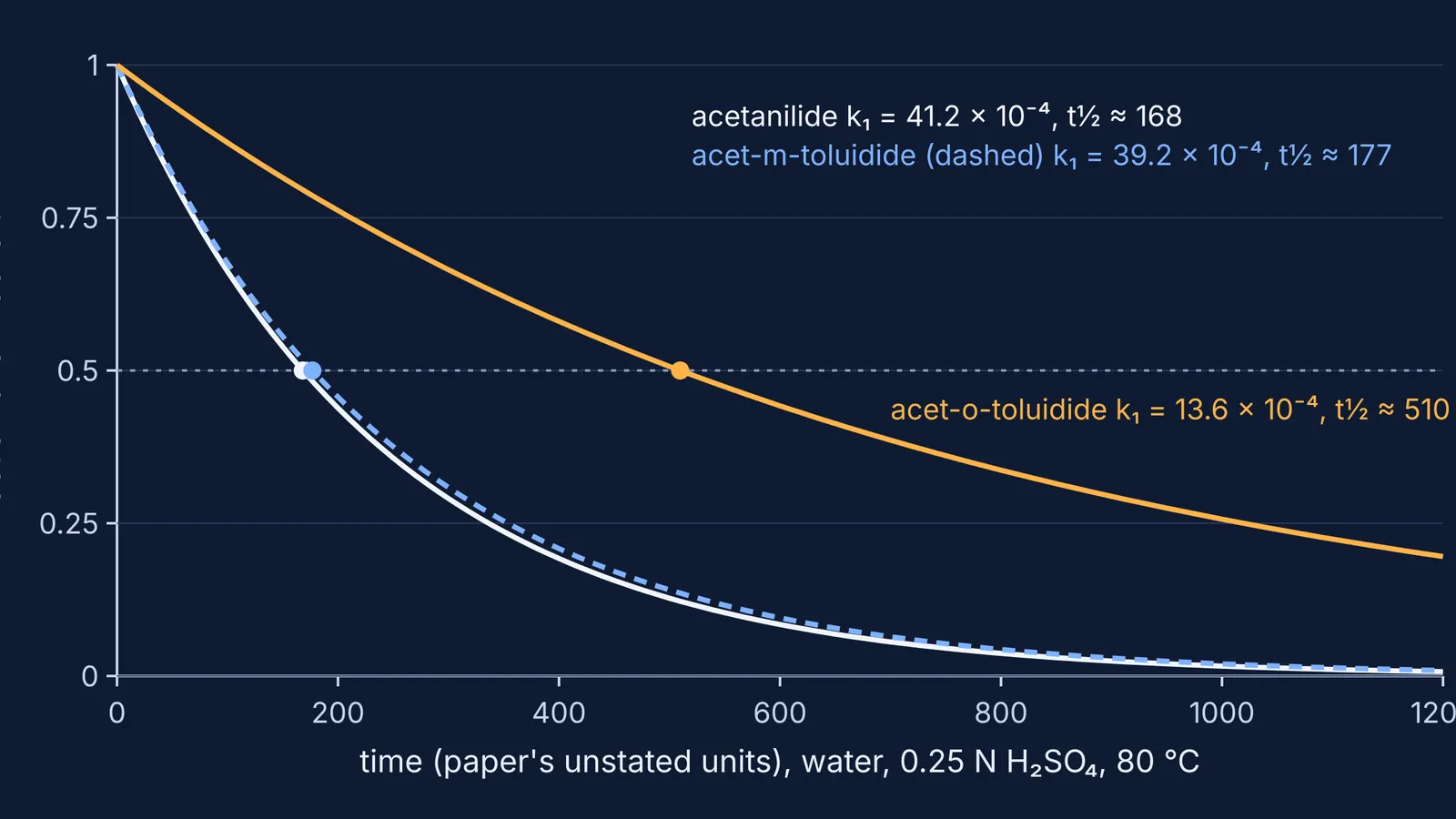
Use their Table IV: water, 0.25 N H₂SO₄, 0.10 M anilide, 80 °C. The values of k₁ × 10⁴ are acetanilide 41.22, acet-m-toluidide 39.2 and acet-o-toluidide 13.6.
Half-lives. t½ = 0.693/k₁. Acetanilide: 0.693/0.004122 = 168. Meta-methyl: 177. Ortho-methyl: 510 time units.
Rate ratios. Ortho: 13.6/41.22 = 0.33. Meta: 39.2/41.22 = 0.95.
Check at other temperatures. The ortho ratio is 7.4/20.10 = 0.37 at 70 °C and 24.6/83.0 = 0.30 at 90 °C. It holds across the table.
What is left after one acetanilide half-life? After 168 time units, e^(−0.001360 × 168) = 0.80, so 80% of the ortho compound is still there, against 50% of acetanilide.
Activation energy. Fitting ln k₁ against 1/T for acetanilide from 65 to 95 °C gives a slope that corresponds to Ea ≈ 73 kJ mol⁻¹ (17.5 kcal). The paper's graphical value is 17,940 cal, or 75.1 kJ. The rate roughly doubles for each 10 °C (41.22 to 83.00 from 80 to 90 °C).
The same pattern holds in 50% alcohol at 70 °C (Table IX): ortho 7.4/17.8 = 0.42, para 16.8/17.8 = 0.94, meta 16.1/17.8 = 0.90.
Why does an ortho-methyl slow the hydrolysis?
In acid, the carbonyl oxygen of the amide is protonated. Water then attacks the carbonyl carbon, which becomes tetrahedral. Finally the C–N bond breaks and the amine leaves. The tetrahedral step needs room around the carbonyl carbon.
A methyl group at the ortho position sits right next to the –NH–CO– group. It crowds the space the reaction needs, so the crowded intermediate forms more slowly. That is a steric effect.
The data rule out an electronic effect. A methyl group pushes electrons into the ring by about the same amount from any position. At meta and para it changed the rate by only 5 to 10%. Only at ortho, where it is physically close, did the rate drop to a third. Ortho groups change acid strength too, by different routes; see our post on the ortho effect in benzoic acids.
Not every result is about bulk. In 50% alcohol, p-nitroacetanilide hydrolysed faster than acetanilide (42.1 against 17.8). In absolute alcohol at 65 °C, benzanilide was slower than acetanilide (3.91 against 9.20), which the authors put down to a "proximity effect". Quote the solvent with every number, because the order of some anilides changes between tables.
Why can acetanilide protection be undone by hydrolysis?
The amide C–N bond is strengthened by resonance: nitrogen's lone pair is shared with the carbonyl group. That is the same resonance that tames –NH₂ during nitration, as our post on why aniline is acetylated before nitration explains. So the amide survives the nitration step but breaks when you heat it with acid or base.
Karve and Kelkar's numbers show why heat is needed. In 0.25 N acid in water, acetanilide's half-life fell from 483 time units at 65 °C to 58 at 95 °C. Formanilide, with H in place of CH₃ on the carbonyl, was faster at 30 °C (t½ = 113) than acetanilide was at 65 °C. Water also beat alcohol: at 65 °C, k₁ for acetanilide was 14.36 × 10⁻⁴ in water and 5.73 × 10⁻⁴ in absolute alcohol, 2.5 times slower.
For kinetics and amide chemistry that will not stick, the Fermi Concept Library gives every chemistry concept its own lesson. For more half-life and Arrhenius numericals, the Fermi Problem Library has a step-by-step solver that explains the reasoning.
Quick checklist
Karve and Kelkar, Poona, 1946: acid hydrolysis of sixteen anilides, first order in anilide.
k₁ is proportional to [H⁺], so it is pseudo-first order: k₁ = k[H⁺].
The printed K₂ in their water table is k₁/(10b); recompute it yourself.
Their time unit is not stated; quote half-lives in "time units".
Ortho-methyl: rate × 0.33 at 80 °C in water. Meta-methyl: × 0.95. The difference is steric.
Acetanilide in 0.25 N acid: t½ 483 at 65 °C, 58 at 95 °C. Ea ≈ 73 to 75 kJ mol⁻¹.