On this page
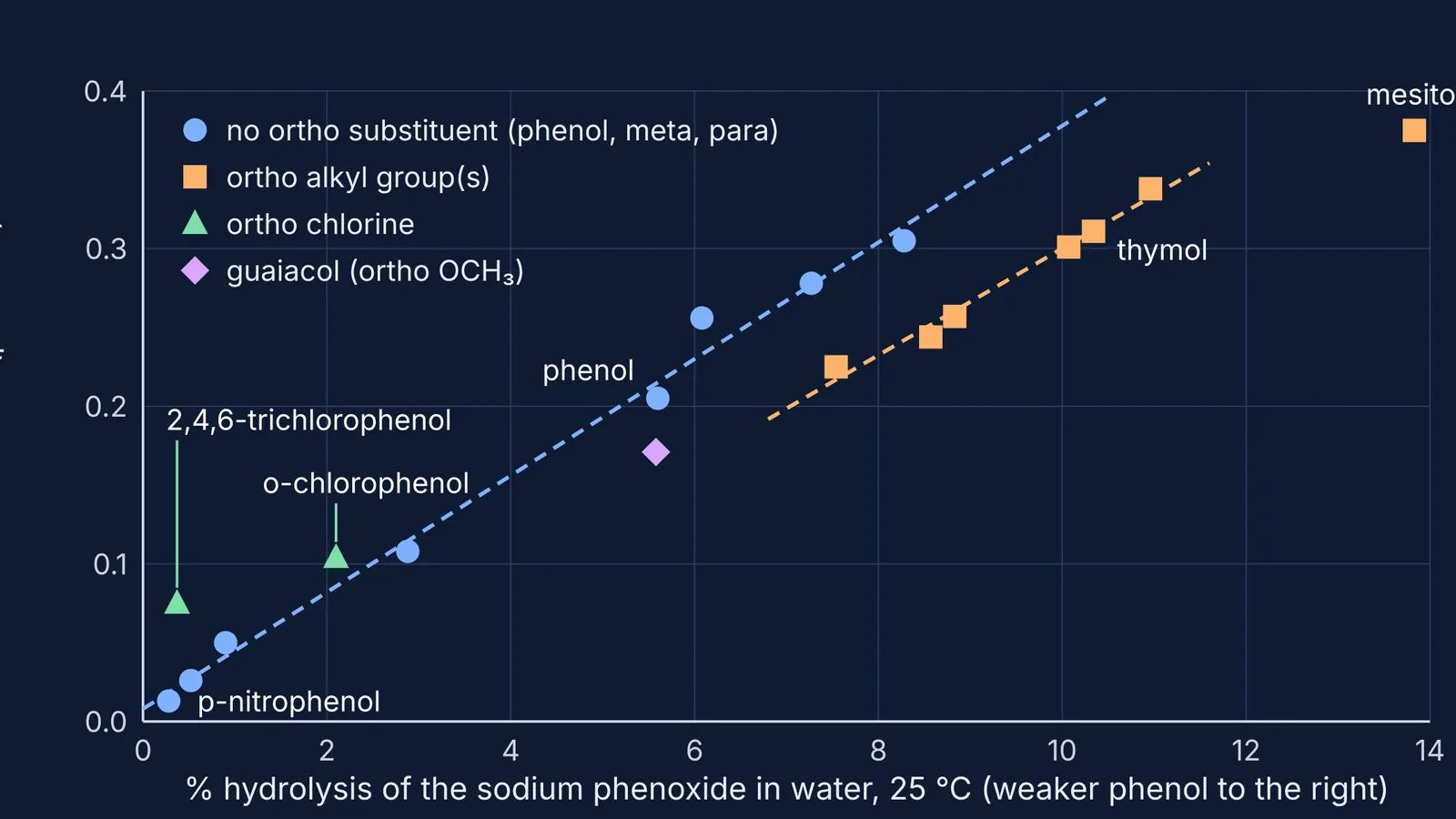
In 1919 Miss Doris Feltham Thomas and David Runciman Boyd, at the University College of Southampton, put eighteen phenols on one graph. On one axis they plotted how fast each sodium phenoxide adds to ethylene oxide. On the other they plotted how weak the phenol is as an acid. The points fell on straight lines. The weaker the phenol, the faster its anion attacks carbon. Phenols with an alkyl group next to the OH fell on a second line below the first, and ortho chlorine pushed points above it. It is the Class 12 idea "stronger acid, weaker conjugate base" measured as a rate.
Who were Doris Thomas and D. R. Boyd?
The paper is D. R. Boyd and Miss D. F. Thomas, "The Velocities of Combination of Sodium Derivatives of Phenols with Olefine Oxides. Part II", J. Chem. Soc. Trans. 115 (1919) 1239–1243, received 23 July 1919. We read it in the scanned 1919 volume and took every number below from the page images, including the figure's table. The paper prints only the two names, "Miss" before Doris Thomas's name, and the Southampton address. We have not checked other biographical details.
In Part I (1914), Boyd and Marle had noticed that the more acidic the phenol, the slower its sodium salt combined with ethylene oxide. They compared the phenoxide picking up H⁺ with it picking up ethylene oxide. Thomas and Boyd added o-4-xylenol, m-6-xylenol and mesitol, and plotted all eighteen.
Ethylene oxide is a toxic, flammable gas: this post covers history and mechanism only, with no procedure.
What reaction were they timing?
Runs were at 70.4° in 98 per cent alcohol, with the sodium phenoxide and excess phenol. The proposed path has two steps:
ArO⁻ + C₂H₄O → ArO–CH₂CH₂–O⁻
ArO–CH₂CH₂–O⁻ + ArOH → ArO–CH₂CH₂–OH + ArO⁻
Both steps balance in atoms and charge. Add them and the phenoxide cancels: C₂H₄O + ArOH → ArOCH₂CH₂OH, a glycol aryl ether. For phenol, C₂H₄O + C₆H₆O → C₈H₁₀O₂.
Step 1 is the base-catalysed epoxide opening you learn for JEE. It is SN2: the phenoxide oxygen hits a ring CH₂ from the back and the strained C–O bond breaks. With an unsymmetrical epoxide, base attacks the less hindered carbon, as shown in our post on epoxide ring opening in acid vs base.
How did the graph link acidity to speed?
The x-axis is percentage hydrolysis of the sodium salt in water at 25°:
ArO⁻ + H₂O ⇌ ArOH + OH⁻
The hydrolysis constant is Kh = Kw ÷ Ka. A weaker phenol (smaller Ka) gives a larger Kh and a more hydrolysed salt, so percentage hydrolysis measures how strongly the phenoxide holds a proton.
Their table: p-Nitrophenol: 0.28% hydrolysis, k = 0.013. Phenol: 5.60%, k = 0.205. Mesitol: 13.83%, k = 0.375. The speed "increases approximately in proportion to the degree of hydrolysis". For the same attacking atom, the stronger base is the faster nucleophile. That is the same idea behind the acidity order of substituted phenols, read backwards.
Why did ortho alkyl groups slow it and ortho chlorine speed it up?
The authors found that phenol and its meta- and para-substituted derivatives "lie approximately along a straight line". Phenols with one alkyl group ortho to OH lie "on a second straight line which runs nearly parallel with the first and some distance below it".
The raw numbers hide this. Thymol, with an ortho isopropyl group, has k = 0.311, which is 0.311 ÷ 0.205 = 1.52 times phenol's. The paper says "one and a half times". Mesitol, with two ortho methyls, has 0.375 ÷ 0.205 = 1.83 times, "nearly twice". Both beat phenol, but fall short of what their basicity predicts, mesitol most of all. The authors found steric hindrance the natural reading.
Chlorine at ortho does the opposite. 2,4,6-Trichlorophenol, with two ortho chlorines, lies far above the line, and o-chlorophenol lies somewhat above it. Given chlorine's opposite effect, they said a "final decision" on steric hindrance was not yet possible, and left open whether chlorine acts through its "residual affinity" or its "polar quality".
Hammett's equation, which made such plots a general method, came in 1937; this 1919 graph is an early example of the habit.
Worked example: rate constants, a line and a % N check
1. The rate constant. They used k = (1/t) log [100 ÷ (100 − x)], with x the percentage yield of glycol ether and t in hours. That is the first-order equation with common logs.
o-4-Xylenol: 75.3% at 2 h gives (1/2) log(100 ÷ 24.7) = 0.304. The repeat, 75.1%, gives 0.302. 51.0% at 1 h gives log(100 ÷ 49.0) = 0.310.
Mean = 0.305. The paper prints 0.3050.
Mesitol: 82.3, 81.8 and 82.5% at 2 h give 0.376, 0.370 and 0.378. Mean 0.375; the paper prints 0.3745.
Exam step: t½ = log 2 ÷ k = 0.301 ÷ 0.205 = 1.47 h for phenol; 0.80 h for mesitol.
2. How far below the line? Fit a straight line to the eight points with no ortho substituent (our fit, not theirs): k ≈ 0.008 + 0.0370 × (% hydrolysis).
Thymol at 10.34%: the line predicts 0.008 + 0.0370 × 10.34 = 0.391. Found 0.311, which is 0.80 of the line.
Mesitol at 13.83%: predicted 0.520, found 0.375, or 0.72.
Trichlorophenol at 0.37%: predicted 0.022, found 0.075, about 3.4 times the line.
3. Dumas nitrogen. The p-nitrobenzoate of glycol o-xylyl ether, C₁₇H₁₇NO₅: 0.1518 g gave 6.5 mL of moist N₂ at 23° and 762 mm.
Dry pressure = 762 − 21.1 (aqueous tension at 23 °C) = 740.9 mm.
V₀ = 6.5 × (740.9 ÷ 760) × (273.15 ÷ 296.15) = 5.85 mL at STP.
N = (5.85 ÷ 22414 × 28.014) ÷ 0.1518 × 100 = 4.81%. The paper prints 4.82.
Required: M = 315.32 g/mol, so 14.007 ÷ 315.32 × 100 = 4.44%. The paper prints "requires N = 4.62". That figure does not follow from the formula printed beside it; with 1919 atomic weights it would be 4.45.
Liebig check: 0.1621 g of glycol m-xylyl ether, C₁₀H₁₄O₂ (2C₁₀H₁₄O₂ + 25O₂ → 20CO₂ + 14H₂O), gave 0.4289 g CO₂ and 0.1252 g H₂O: C = 72.21%, H = 8.64% (paper 72.16, 8.58; required 72.26, 8.49).
For more multi-step numericals like this, the Fermi Problem Library has a step-by-step solver that explains the reasoning.
Where does this come up in JEE and NEET?
Class 12, Alcohols, Phenols and Ethers: acidity of substituted phenols, and the phenoxide as a nucleophile in Williamson-type ether formation.
JEE organic: base-catalysed epoxide opening at the less hindered carbon; nucleophilicity against basicity; steric effects.
Class 12 kinetics: first-order k and half-life.
Class 11, Organic Chemistry: Some Basic Principles: Dumas nitrogen and Liebig C, H estimation.
Compare Rhoda Johnson's 1913 nitrophenoxides, which were too weakly nucleophilic to form ethers under mild heat. For exam practice on these chapters, Fermi Test Prep is JEE Main and Advanced preparation with an AI tutor.
Quick checklist
Thomas and Boyd, 1919: k for 18 phenoxides plotted against % hydrolysis.
Phenol, meta and para: one straight line. Weaker phenol, faster phenoxide.
One ortho alkyl: a parallel line below. Mesitol, with two, sits lower still, yet is 1.83 times faster than phenol.
Ortho chlorine accelerates; 2,4,6-trichlorophenol most of all. Cause left open.
Nitrobenzoate N: found 4.81%; C₁₇H₁₇NO₅ requires 4.44%, not the printed 4.62.