On this page
Add hydrogen peroxide to acidified dichromate, shake with ether, and the ether layer turns deep blue. You learn this as the test for chromate, and you learn that the blue compound, CrO₅, does not last. In 1943 two chemists at the University of Allahabad asked how long it lasts. Satya Prakash and Ram Chandra Rai timed the fading of the blue at three temperatures and found clean first-order kinetics. Their data turn a qualitative-analysis test into a half-life and activation-energy problem you can solve.
Who were Satya Prakash and Ram Chandra Rai?
The paper is "Studies in blue perchromic acid. Part I — Kinetics of the decomposition of the blue perchromic acid in various organic media", by Satya Prakash, D.Sc., F.A.Sc., and Ram Chandra Rai, M.Sc., of the University of Allahabad. It was received on 30 April 1943 and printed in the Proceedings of the Indian Academy of Sciences, Section A, vol. 18, pp. 1–7 (doi:10.1007/BF03046506). The full text is open on the Academy's site.
Those degrees and that affiliation are all the paper tells us. We have not checked the rest of their careers, so we leave them out.
What was known about the blue compound before 1943?
The authors give the history in their first paragraph:
1847: Barreswil saw a deep blue solution when concentrated chromic acid was mixed with hydrogen peroxide. Ether shaken with it took up the blue and left the water colourless.
1889: Berthelot showed that with strong acids the colour is blue, but with weaker acids it is violet.
1895: Grosvenor found the blue compound also dissolves in ethyl acetate, amyl chloride and amyl esters, but not in benzene, toluene, carbon disulphide or oils.
They called it "blue perchromic acid" and noted that, extracted with ether or ethyl acetate, it "is stable only for a few hours; it decomposes with the evolution of oxygen". Earlier workers had studied its catalytic decomposition, but "not much work has been done on the kinetics of the decomposition of the blue perchromic acid itself."
Today we write the blue compound as CrO₅, with chromium at +6: one Cr=O oxygen and two peroxide (O–O) groups. In ether, chemists describe it as an adduct with an ether molecule bound to chromium. The 1943 authors did not have this structure. For how the +6 comes out, see oxidation numbers from structure, including CrO₅, and for the other colours, colours and oxidation states of chromium compounds. The formation and breakdown are usually written as:
Cr₂O₇²⁻ + 4H₂O₂ + 2H⁺ → 2CrO₅ + 5H₂O
4CrO₅ + 12H⁺ → 4Cr³⁺ + 7O₂ + 6H₂O
Both balance in atoms and charge. We do not give the lab method here: chromium(VI) is toxic and ether is highly flammable.
How did they measure the fading?
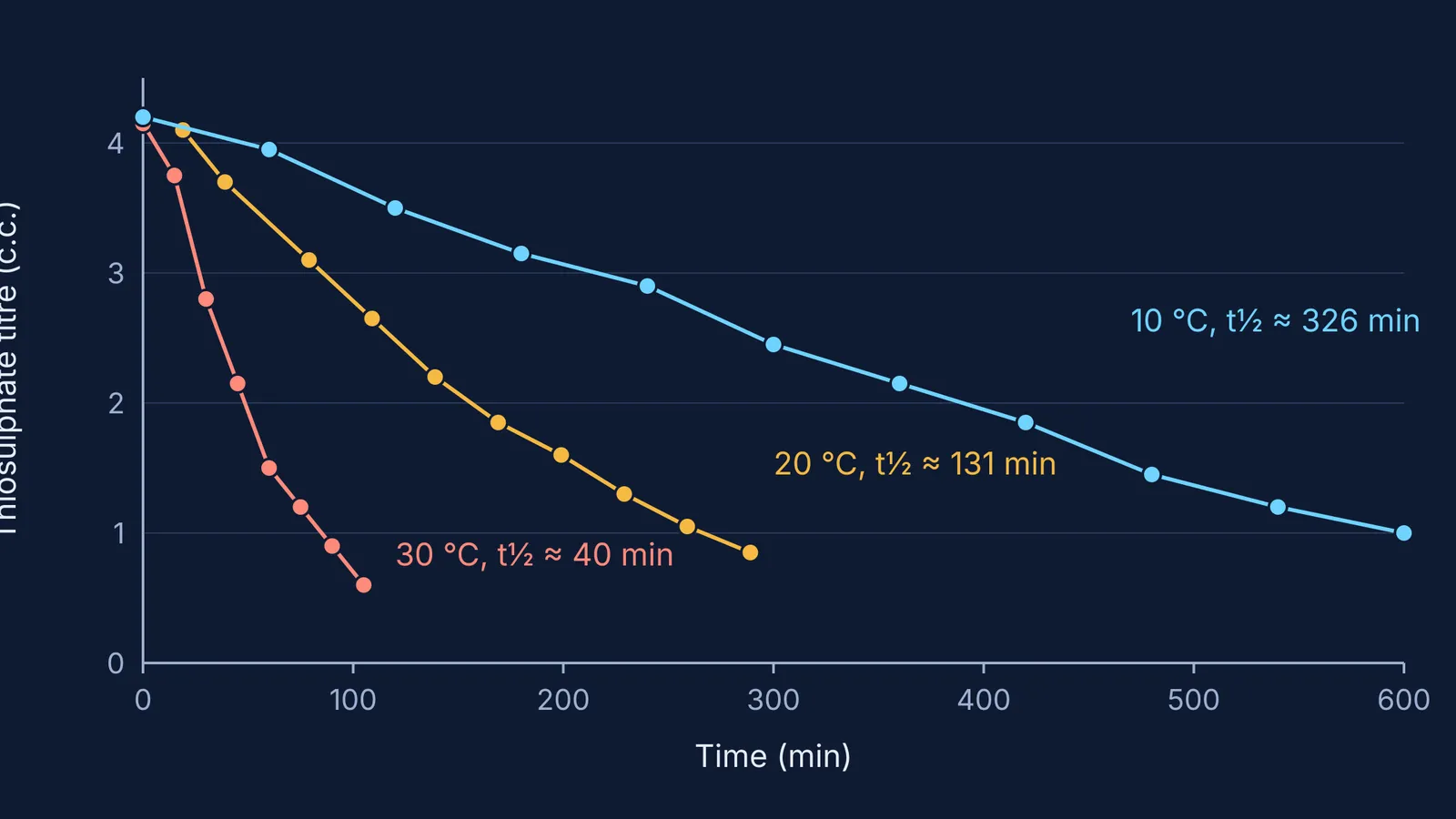
They kept portions of one ether extract in thermostats at 10, 20 and 30 °C (± 0.2). From time to time they pipetted out 2 c.c., ran it into potassium iodide acidified with dilute sulphuric acid, and titrated the iodine set free with N/20 sodium thiosulphate ("hypo"):
I₂ + 2S₂O₃²⁻ → 2I⁻ + S₄O₆²⁻
The titre measures how much oxidising agent is left. As the blue fades, the titre falls. At 30 °C it went from 4.15 c.c. at the start to 0.9 c.c. after 90 minutes.
For a first-order rate constant you only need the ratio of titres, a/(a − x), so you do not need the exact iodide equation. They used k = (2.303/t) log₁₀[a/(a − x)].
Worked example: k, half-life and activation energy
Step 1. k from their own titres. At 30 °C, a = 4.15 and a − x = 0.9 at t = 90 min.
k = ln(4.15 ÷ 0.9) ÷ 90 = 1.528 ÷ 90 = 0.0170 min⁻¹
Their summary value at 30 °C is 0.01711 min⁻¹. At 10 °C and 20 °C they give 0.002125 and 0.005273 min⁻¹.
Step 2. Half-lives. For first order, t½ = 0.693/k, whatever the starting concentration.
10 °C: 0.693 ÷ 0.002125 = 326 min, about 5.4 hours
20 °C: 0.693 ÷ 0.005273 = 131 min, about 2.2 hours
30 °C: 0.693 ÷ 0.01711 = 40.5 min
Each 10 °C rise multiplies k by about 2.5 and then 3.2.
Step 3. Activation energy from two temperatures. Use ln(k₂/k₁) = (Ea/R)(1/T₁ − 1/T₂) with T₁ = 283.15 K and T₂ = 303.15 K.
k₂/k₁ = 0.01711 ÷ 0.002125 = 8.05, and ln 8.05 = 2.086
1/283.15 − 1/303.15 = 2.330 × 10⁻⁴ K⁻¹
Ea = 8.314 × 2.086 ÷ (2.330 × 10⁻⁴) = 74,400 J/mol, about 74 kJ/mol
The paper only says that log k against 1/T is a straight line. The 74 kJ/mol is our calculation from their numbers, and it is approximate. If you use the pairs separately you get 62.7 kJ/mol (10 to 20 °C) and 87.0 kJ/mol (20 to 30 °C). A least-squares line through all three points gives 74.3 kJ/mol. For the graph method, see how to find activation energy from an Arrhenius plot.
Why do the two Ea values disagree?
The authors point to it themselves: "At lower temperatures there is a pronounced induction period". They report induction periods of 300 minutes at 10 °C, 70 minutes at 20 °C and 40 minutes at 30 °C. During that time the blue fades more slowly than first order predicts, and the calculated k creeps up.
You can see it in the 10 °C titres. Between 0 and 60 minutes the titre goes from 4.2 to 3.95, which gives k = 0.0010 min⁻¹. Between 480 and 600 minutes it goes from 1.45 to 1.0, which gives k = 0.0031 min⁻¹, three times larger. The authors' averages match the values after the induction period (our check). So the 10 °C rate constant is the least certain, and any Ea that uses it carries that error. They also note that different preparations gave k at 30 °C from 0.01711 to 0.02241 min⁻¹.
What did benzene, toluene and xylene do?
They then made the ether solution one-third hydrocarbon (10 c.c. in 30 c.c.) and repeated the runs at 30 °C. The decay sped up by 1.79 times with benzene, 2.57 times with toluene and 3.28 times with xylene. With toluene and xylene they found "traces of aldehydes", shown by Schiff's reagent. For benzene they thought it "very likely" that the hydrocarbon reacts chemically with the blue compound, and they left the products for a later paper.
Our reading, not theirs: an aldehyde from toluene points to the side-chain CH₃ being oxidised, the same kind of change as the Étard reaction, where chromyl chloride turns toluene into benzaldehyde.
If you want to drill first-order and Arrhenius numericals like these, Fermi Test Prep for JEE Main and Advanced has an AI tutor, and the Fermi Problem Library gives step-by-step solutions that explain the reasoning.
Checklist before your exam
Blue colour in ether from dichromate + H₂O₂ + acid is CrO₅, with Cr at +6.
First order: k = (2.303/t) log₁₀[a/(a − x)]; any quantity proportional to concentration, such as a titre, works.
t½ = 0.693/k, independent of starting amount.
Ea from two temperatures: ln(k₂/k₁) = (Ea/R)(1/T₁ − 1/T₂), with T in kelvin.
An induction period makes early k values too low; average only after it ends.