On this page
Chlorine's −I effect makes chloroacetic acid much stronger than acetic acid, and electron-withdrawing groups speed up the base hydrolysis of esters. So you would expect ethyl chloroacetate to hydrolyse faster than ethyl acetate in acid as well. In 1941, at Annamalai University, S. V. Anantakrishnan and S. Krishnamurti measured it. In 0.1 N hydrochloric acid at 35 °C, ethyl chloroacetate hydrolysed at only about two-thirds the rate of ethyl acetate.
What did Anantakrishnan and Krishnamurti measure?
The paper is S. V. Anantakrishnan and S. Krishnamurti, "Kinetic studies in ester hydrolysis. Part I. The hydrolysis of halogeno-aliphatic esters", Proceedings of the Indian Academy of Sciences, Section A, 14 (1941) 270–278. We read it in the Academy's scanned PDF. It is signed from the "Annamalai University Chemical Laboratories, Annamalainagar" and was received on 10 June 1941. We have not checked anything about the authors' lives beyond what the paper prints.
They hydrolysed twelve ethyl esters at decimolar strength in "exactly decinormal" hydrochloric acid in 60% dioxan (by weight), at 35, 42, 50 and 60 °C, and titrated the acid formed with N/40 baryta (or N/40 ammonia for the halogenated esters). Dioxan was chosen "to avoid a solvent taking part in the reverse reaction". Ethyl iodoacetate was made from ethyl chloroacetate and sodium iodide in dry acetone, the halogen exchange you meet in Class 12 as the Finkelstein reaction.
How much slower is ethyl chloroacetate in acid?
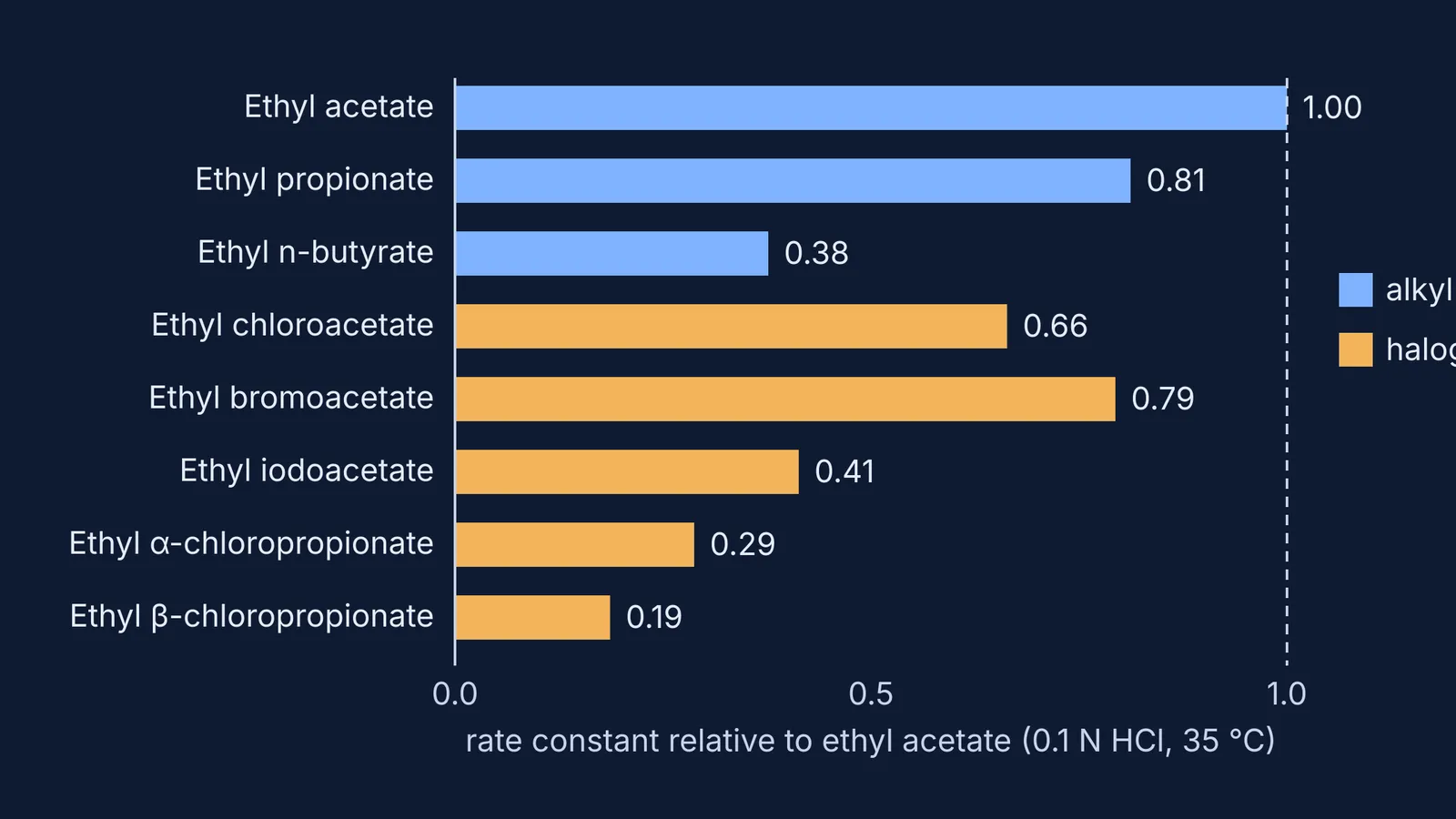
Here are their rate constants at 35 °C (printed as k × 10⁵), with our ratio to ethyl acetate:
Ethyl acetate: 13.09, ratio 1.00
Ethyl propionate: 10.63, ratio 0.81
Ethyl n-butyrate: 4.93, ratio 0.38
Ethyl chloroacetate: 8.686, ratio 0.66
Ethyl bromoacetate: 10.39, ratio 0.79
Ethyl iodoacetate: 5.408, ratio 0.41
Ethyl α-chloropropionate: 3.763, ratio 0.29
Ethyl β-chloropropionate: 2.441, ratio 0.19
The chloroacetate-to-acetate ratio is 0.66, 0.62, 0.73 and 0.75 at the four temperatures, so it is below 1 every time.
Now compare acid strength. Acetic acid has Ka = 1.75 × 10⁻⁵ and chloroacetic acid 1.3 × 10⁻³ (CRC values via LibreTexts). One chlorine makes the acid about 74 times stronger, yet the ester hydrolyses in acid 0.66 times as fast.
Why does a −I group slow acid hydrolysis but speed base hydrolysis?
This is the modern reading, and it is ours, not the paper's. In the textbook acid-catalysed mechanism (AAC2), set out in acid vs base hydrolysis of esters and the ¹⁸O test:
Protonation (fast equilibrium, constant K): the carbonyl oxygen picks up H⁺ from H₃O⁺.
Attack (slow, constant k₂): water adds to the carbonyl carbon of the protonated ester, giving a tetrahedral intermediate.
Collapse: a proton moves, ethanol leaves, and H⁺ is given back.
So rate = k₂ × K × [ester][H₃O⁺]. Chlorine pulls electron density away from the carbonyl group. That makes the carbonyl oxygen a weaker base, so K falls. The same pull makes the carbonyl carbon more electrophilic, so k₂ rises. The two effects work against each other. In this paper their product came out at 0.66, a small net slowing.
In base (BAC2), OH⁻ attacks the neutral ester directly. There is no protonation step to lose, so the −I effect only helps, and ethyl chloroacetate is hydrolysed faster than ethyl acetate. The paper has no base data, so we give no ratio.
The near-cancellation of polar effects in acid is the idea Robert Taft built on in 1952: acid-catalysed rates are controlled mostly by steric effects, as explained in why bulky acids and alcohols esterify slowly.
What did the paper itself say?
Their printed mechanism, credited to Ingold, Day and Datta's heavy-oxygen work, protonates the ester and lets R′OH leave in the slow step, giving a cation R–C⁺=O that water then captures. Like AAC2, it breaks the acyl–oxygen bond and starts with protonation. They wrote: "Taking the halogens as a whole, the −I effect diminishes the ease of formation of the activated complex while the +T acts in the opposite direction." The "+T" (tautomeric) effect is 1940s language, but the conclusion matches the modern one.
Why are ethyl propionate and butyrate slower too?
The alkyl series falls from 1.00 to 0.81 to 0.38. The authors wrote that "the drop in the value from ethylpropionate to ethyl butyrate is pronounced, while that from ethylacetate to propionate is slight", and blamed partly "the steric factor". The chloropropionates, with a larger acyl group plus a halogen, are slower still. The authors were cautious: "Any quantitative deductions on this aspect may be attempted only after a further study of a larger number of substituted aliphatic esters."
Worked example: units, half-lives and the Arrhenius split
What are the units of k? The paper prints "k₁ × 10⁵" without units. Ethyl acetate at 35 °C was 10% hydrolysed after 138 minutes. For a reaction first order in ester, k₁ = ln(1/0.90) ÷ (138 × 60 s) = 1.27 × 10⁻⁵ s⁻¹. Divide by [H⁺] = 0.1 M and you get 1.27 × 10⁻⁴, close to the table's 13.09 × 10⁻⁵. For ethyl chloroacetate (10% at 202 minutes) the same steps give 8.69 × 10⁻⁵ against the table's 8.686. So the tabulated k is most likely k₁ ÷ [H⁺] in L mol⁻¹ s⁻¹. (our inference). Because [H⁺] stays constant, the reaction behaves as pseudo first order.
Half-life in 0.1 M HCl at 35 °C. Ethyl acetate: k₁ = 13.09 × 10⁻⁵ × 0.1 = 1.309 × 10⁻⁵ s⁻¹, so t½ = 0.693 ÷ 1.309 × 10⁻⁵ = 5.30 × 10⁴ s, or 14.7 hours. Ethyl chloroacetate: k₁ = 8.686 × 10⁻⁶ s⁻¹, t½ = 22.2 hours.
Ratio. 8.686 ÷ 13.09 = 0.664.
Split it with Arrhenius, k = PZ·e^(−E/RT). From their graphs, E = 16,930 cal (70.8 kJ) for the acetate and 16,640 cal (69.6 kJ) for the chloroacetate, with PZ values of 1.47 and 0.61. The 290 cal lower barrier alone would make the chloroacetate faster by e^(290/(1.987 × 308.15)) = 1.61 times. The smaller PZ multiplies by 0.61 ÷ 1.47 = 0.41. Together: 1.61 × 0.41 = 0.67, matching the measured 0.66. The paper's own numbers are consistent.
How firm is that E difference? From only the 35 °C and 60 °C constants we get 16,600 cal (acetate) and 17,600 cal (chloroacetate), the other way round. A 290 cal gap is within the scatter, so do not argue from which barrier is lower.
Where does this come up in JEE and NEET?
Class 11 GOC: the inductive effect and haloacid strength.
Class 12 Carboxylic acids: acid- and base-catalysed ester hydrolysis.
Class 12 Chemical Kinetics: pseudo-first-order constants, half-life, Arrhenius.
For more half-life and Arrhenius numericals, the Fermi Problem Library has a step-by-step solver that explains the reasoning. For exam practice, Fermi Test Prep covers JEE Main and Advanced preparation with an AI tutor.
Quick checklist
At 35 °C, ethyl chloroacetate runs at 0.66 of ethyl acetate's rate; half-lives about 22 and 15 hours.
Chloroacetic acid is about 74 times stronger than acetic acid, but that does not carry over to acid hydrolysis.
AAC2: −I lowers the protonation constant K and raises the attack constant k₂; the net effect is small.
BAC2: no protonation step, so −I simply speeds base hydrolysis.
Their E and PZ values multiply out to the observed 0.66.