On this page
You will meet this question in Class 12 organic chemistry and again in JEE Main practice: put these acid and alcohol pairs in order of esterification rate. The short answer: the more crowded the carbon being attacked, and the bulkier the attacking alcohol, the slower the ester forms. Here is why, the real numbers, and a four-step exam method.
Why does crowding slow esterification?
Start with the mechanism in the NCERT Class 12 chapter on aldehydes, ketones and carboxylic acids. It describes esterification as a kind of nucleophilic acyl substitution: acid protonates the carbonyl oxygen, the alcohol attacks the carbonyl carbon, and a tetrahedral intermediate forms before water leaves.
That tetrahedral step is the bottleneck. The flat carbonyl carbon, with three groups in a plane, becomes a carbon with four groups squeezed together: the acid's R group, two OH groups and the alcohol's OR'. If R or the alcohol is branched, those groups bump into each other and the reaction slows.
For the full arrows, see our guide to the Fischer esterification mechanism and how to push the equilibrium.
How much slower are bulky acids?
The classic measurement comes from Robert W. Taft Jr., who in 1952 published polar and steric substituent constants from rates of esterification and hydrolysis of esters in the Journal of the American Chemical Society. His abstract states that, as a first approximation, the relative rates of acid-catalysed hydrolysis or esterification are determined by steric factors alone.
Taft's steric constant, Es, is measured relative to methyl, so methyl is 0. For acid-catalysed reactions, where polar effects are taken as negligible, Es works out as the logarithm of a group's rate relative to methyl, so every unit below zero means about 10 times slower (Taft 1952).
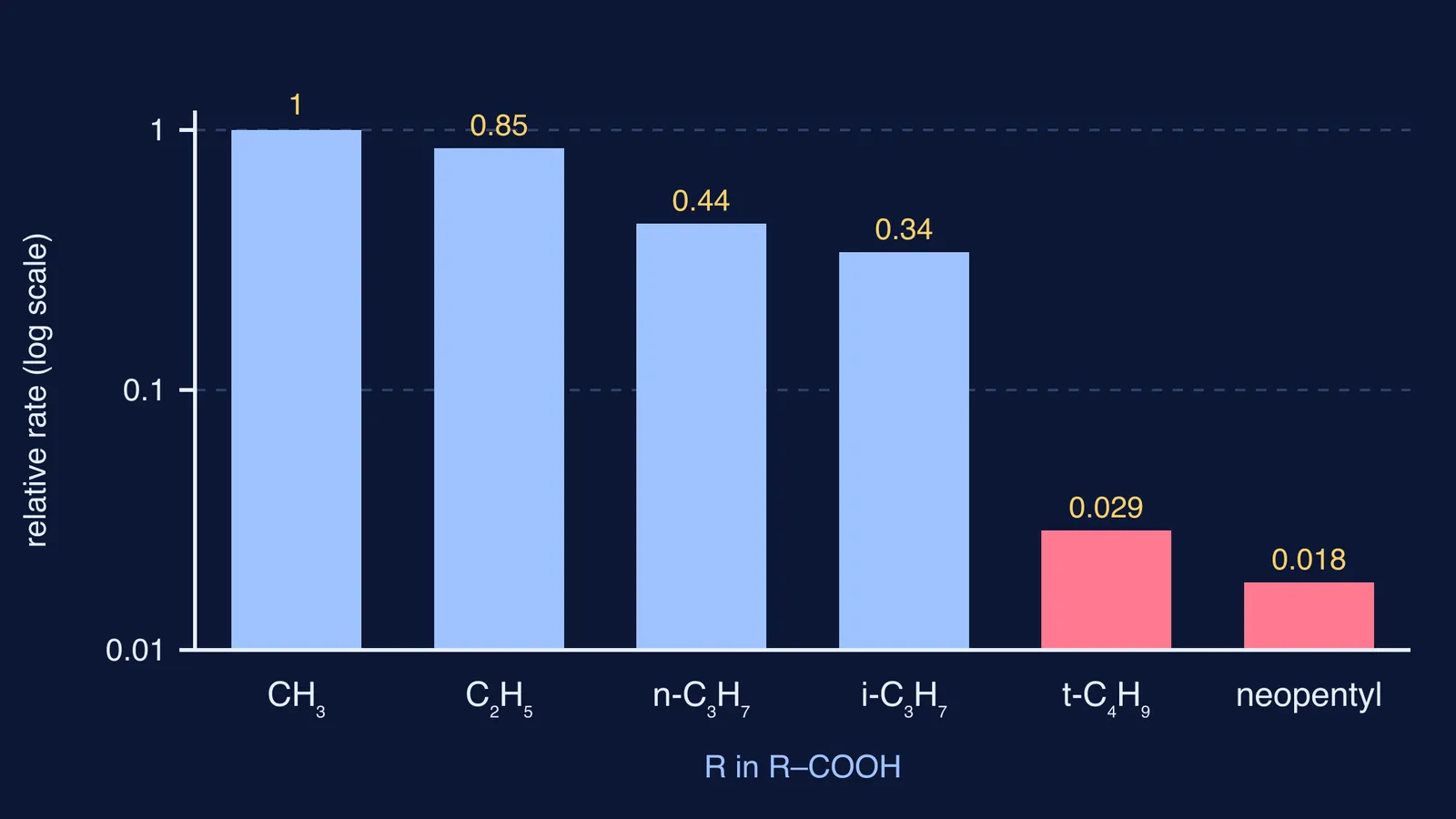
Here are his Es values for the R group of the acid, RCOOH, with the relative rate we worked out as 10 to the power Es:
CH3 (acetic acid): Es = 0.00, relative rate 1
C2H5 (propanoic acid): Es = -0.07, relative rate 0.85
n-C3H7 (butanoic acid): Es = -0.36, relative rate 0.44
i-C3H7 (2-methylpropanoic acid): Es = -0.47, relative rate 0.34
t-C4H9 (pivalic acid): Es = -1.54, relative rate 0.029, about 35 times slower
neopentyl, (CH3)3CCH2 (3,3-dimethylbutanoic acid): Es = -1.74, relative rate 0.018
One extra carbon in a straight chain barely matters; branching near the carbonyl slows things sharply. Neopentyl is a useful surprise: its branches sit one carbon further away, yet it is even slower than tert-butyl.
Does the size of the alcohol matter too?
Yes. The same Taft 1952 table lists Es for the alkyl group on the alcohol side of the ester, RCOOR'. Methyl is 0.00, ethyl is -0.09 and isopropyl is -0.42. On that scale an isopropyl group reacts at roughly 0.38 of the rate of methyl, and ethyl at about 0.81.
Methyl is the smallest group on each side, so methanol with acetic acid reacts fastest.
How do you rank esterification rates in an exam?
Find the carbon being attacked (the carbonyl carbon of the acid) and the oxygen doing the attacking (the OH of the alcohol).
Look at the groups next to each. Count branches on the first carbon, and watch for a bulky tert-butyl unit one carbon further out, as in neopentyl.
Rank by crowding: methyl, then straight chains, then one branch, then tert-butyl and neopentyl type groups.
Check both partners. A small acid with a branched alcohol can still be slower than a slightly bigger acid with methanol.
Worked example. Rank these, fastest first: (a) CH3COOH + CH3OH, (b) (CH3)3CCOOH + CH3OH, (c) CH3COOH + (CH3)2CHOH, (d) (CH3)2CHCOOH + C2H5OH.
As a rough estimate, add the two Es values from Taft's table. Taft gives the acid side and the alcohol side as separate scales, so the sum is only a guide:
(a) 0.00 + 0.00 = 0.00
(c) 0.00 + (-0.42) = -0.42
(d) -0.47 + (-0.09) = -0.56
(b) -1.54 + 0.00 = -1.54
Order: a > c > d > b. The pivalic acid pair is last even with methanol. The steps alone put a first and b last; c and d are close, which is where the numbers help.
The same idea appears in Exercises 8.12 and 8.18 of the same NCERT chapter, which ask about crowded ketones reacting with HCN. Our post on why 2,2,6-trimethylcyclohexanone resists cyanohydrin formation walks through that one.
What should you practise next?
Try the reverse reaction: acid-catalysed ester hydrolysis passes through the same tetrahedral intermediate. Our explainer on acid vs base hydrolysis of esters and the 18O test is a good next read.
If you keep picking the wrong method on ranking questions, the Fermi Problem Library has worked problems with a step-by-step solver that explains the reasoning rather than printing an answer. If nucleophilic acyl substitution itself is the gap, the Fermi Concept Library gives it its own lesson.