On this page
You learn that water is densest at about 4 °C. Add salt and that temperature moves down. Robert Wright, at Queen's University, Belfast, measured how far it moves for a set of acids and salts, in a paper received in December 1918. Unlike a freezing point, the shift depends on which ions are dissolved, and each ion adds its own fixed amount.
Who was Robert Wright, and what did he publish?
The paper is R. Wright, "The Effect of some Simple Electrolytes on the Temperature of Maximum Density of Water", J. Chem. Soc. Trans. 115 (1919) 119–126. We read it in the scanned 1919 volume and checked every number against the page images. It is signed "Chemical Laboratory, Queen's University, Belfast" and was received on 21 December 1918. We have not checked anything else about his life or career.
He quotes the law of Despretz (1839–40): the lowering of the temperature of maximum density "is directly proportional to the concentration" of the solute. Like Coppet before him, he gives "molecular lowerings": the lowering for one gram-molecule per litre. So every number here is per mol L⁻¹, not per kg.
How did he find the temperature of maximum density?
He used a dilatometer: a glass bulb of about 50 c.c. with a long, thin stem. Part of the bulb held just enough mercury for its expansion to cancel the glass's, so any movement in the stem came from the solution alone. He cooled the bath with a few shavings of ice at a time, a fraction of a degree per step, and read the level until the solution stopped contracting and began to expand. That turning point is the temperature of maximum density. Near it the volume barely changes, so his readings "are only accurate to within about 0·2°".
He measured solutions from M/16 to M/2 and scaled up to 1 M. As he put it, "the semi-molecular solutions giving twice the depression of the corresponding fourth-molecular", just as Despretz's law requires.
Is this lowering a colligative property?
No. Here are four of his molecular lowerings, all for 1:1 strong electrolytes:
HCl: 5.2 °C
KCl: 11.0 °C
NaCl: 12.4 °C
NaNO₃: 20.0 °C
At equal concentration these give nearly the same number of ions, so their freezing points fall by nearly the same amount. Their density maxima fall by amounts that differ almost fourfold. Wright put it this way: the freezing point "depends only on the concentration of the solute molecules", but the point of maximum density depends "on the nature as well as on the number of dissolved molecules".
What is Wright's additivity rule?
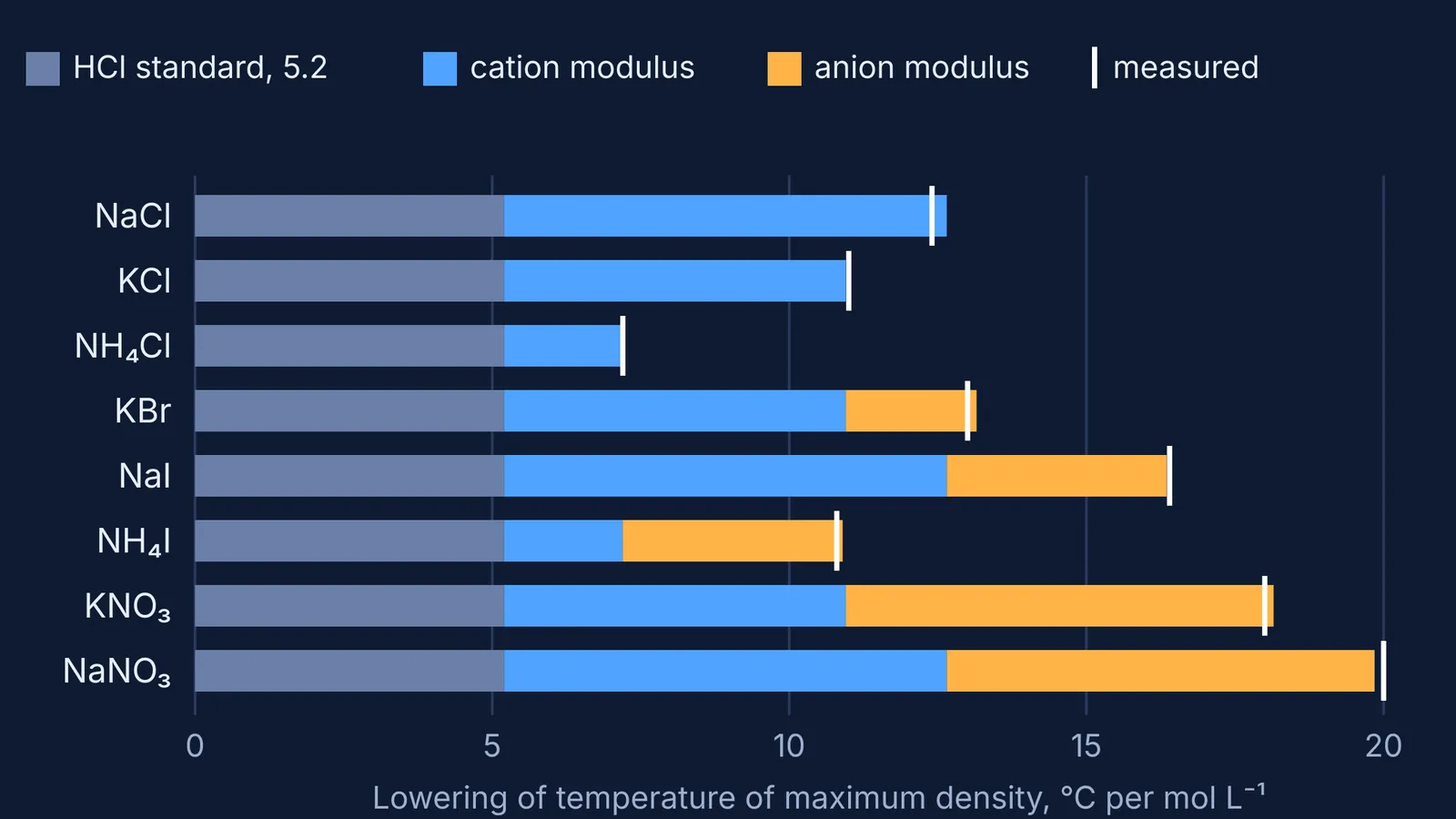
Take hydrochloric acid, which gave the smallest lowering, as the standard: 5.2 °C. Then:
Cation modulus: how much more a salt lowers than the acid with the same anion. NaCl minus HCl is 7.2, NaBr minus HBr 7.4, NaI minus HI 7.6, NaNO₃ minus HNO₃ 7.6. Average for Na⁺: 7.45. For K⁺: 5.75. For NH₄⁺: 2.0. For Li⁺: 0.3.
Anion modulus: how much more a salt lowers than the chloride with the same cation. Br⁻: 2.2 (his table average; his text says 2.1). I⁻: 3.7. NO₃⁻: 7.2.
Rule: lowering of a salt = 5.2 + cation modulus + anion modulus.
His own check: KNO₃ = 5.2 + 5.75 + 7.2 = 18.15, against 18.0 found.
The moduli are differences: cations against H⁺, anions against Cl⁻. The 5.2 for HCl is never split between its ions, so a cation modulus plus an anion modulus without the 5.2 means nothing.
Run over all twenty acids and salts in his main table (we used python), every prediction lands within 0.3 °C of his measured value. Wright likened it to Valson's law of moduli for solution densities. It also resembles Kohlrausch's law of independent migration of ions: one number per ion.
Where does the rule break?
Weak acids. Acetic acid gave 7.4 and sodium acetate 12.0, a step of 4.6, not the normal 7.6. But sodium salts minus ammonium salts came out at 5.6, 5.8 and 5.2 for formic, acetic and propionic acids, close to the inorganic value. The salts, which are highly ionised, behave. The "feebly ionised acids themselves are abnormal".
Sodium hydrogen sulphate. H₂SO₄ gave 24.4 and NaHSO₄ 32.0, a normal step of 7.6. From this he concluded that NaHSO₄'s ions are mainly Na⁺ and HSO₄⁻, not H⁺ and NaSO₄⁻.
Bivalent metals. BaCl₂ gave 24.6 and Ba(NO₃)₂ 32.8. Working his rule backwards gives two different barium moduli, 14.2 and 8.0. (24.6 − 2 × 5.2, and 32.8 − 2 × 5.2 − 2 × 7.2.) He blamed "complex ions".
Worked example: predict a density maximum
Question. Using Wright's figures, find the temperature of maximum density of 0.20 M KBr. Compare it with the freezing point. Take pure water's maximum as 3.98 °C.
Molecular lowering of KBr: 5.2 + 5.75 (K⁺) + 2.2 (Br⁻) = 13.15 °C per mol L⁻¹. Wright measured 13.0.
Scale to 0.20 M (Despretz's law): 13.15 × 0.20 = 2.63 °C.
Density maximum: 3.98 − 2.63 = 1.35 °C.
Freezing point, for contrast: ΔTf = i·Kf·m. Take i ≈ 1.9, Kf = 1.86 K kg mol⁻¹ and molality ≈ molarity: 1.9 × 1.86 × 0.20 = 0.71. The solution freezes near −0.71 °C.
Reverse step: find the NO₃⁻ modulus from KNO₃ (18.0) and KCl (11.0). The difference is 7.0, close to his average of 7.2.
The density maximum fell 2.63 °C; the freezing point only 0.71 °C.
Why does salty water have no 4 °C layer?
For NaCl, Wright's density maximum falls 12.4 °C per mol L⁻¹. The freezing point falls only about 1.9 × 1.86 ≈ 3.5 °C per mol L⁻¹. Our python estimate puts the crossing near 0.44–0.45 M NaCl, about 26 g of salt per litre, at roughly −1.5 °C. Above that strength, the water freezes before it ever reaches a density maximum.
In a lake, water near 4 °C collects at the bottom because it is densest, as our post on why water is densest at 4 °C explains. Sea water, treated as NaCl, is about 0.6 M, as worked out in estimating the molarity of salt in sea water. That is above our crossing, so cooled sea water keeps getting denser all the way down to its freezing point. Treat this as an estimate. It extends Wright's data past M/2, and sea water also holds Mg²⁺ and SO₄²⁻, the very ions he found break his rule.
Where does this come up in JEE and NEET?
It links three chapters: Class 11 (anomalous expansion of water), Class 12 Solutions (what makes a property colligative) and Class 12 Electrochemistry (additive ion contributions).
If the line between colligative and non-colligative properties feels blurry, the Fermi Concept Library gives each concept in physics and chemistry its own lesson and its place in the map.
Quick checklist
Robert Wright, Queen's University, Belfast, received December 1918: salts lower water's temperature of maximum density.
Not colligative: HCl 5.2, KCl 11.0, NaCl 12.4, NaNO₃ 20.0 °C per mol L⁻¹.
Rule: 5.2 (HCl) + cation modulus (against H⁺) + anion modulus (against Cl⁻). KNO₃: 18.15 predicted, 18.0 found.
It fails for weak acids, bivalent metals and neutral salts of dibasic acids.
Above about 0.45 M NaCl, by our estimate, water freezes before reaching a density maximum.