

On this page
Open ocean seawater is not pure water, but a saline solution carrying dissolved minerals from continental runoff and seafloor hydrothermal activity. According to the NOAA National Ocean Service, the global average salinity of seawater is approximately 35 parts per thousand, corresponding to 35 grams of dissolved salts per kilogram of seawater, or 3.5% by weight.
The NOAA ocean facts note that sodium and chloride make up about 85% of all dissolved ions by mass, while magnesium and sulfate account for another 10%. Understanding this baseline composition is essential before simplifying seawater into an idealized single-solute solution.
How do you calculate the molarity of salt in sea water?
In introductory chemistry and exams, numerical problems often simplify seawater by treating all dissolved solids exclusively as sodium chloride (NaCl). According to PubChem's compound summary, sodium chloride has a molar mass of 58.44 g/mol.
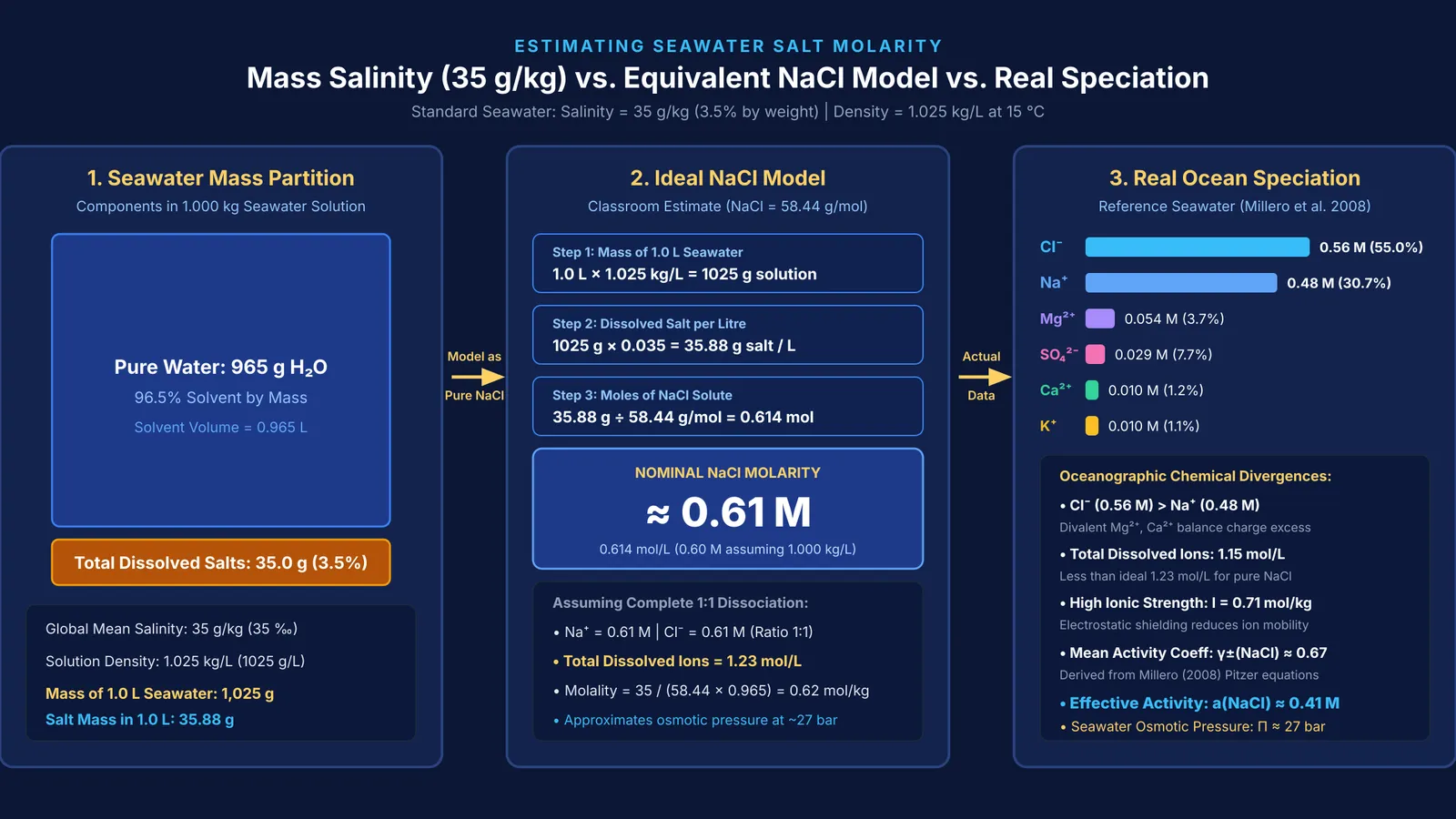
Under the international standards compiled by TEOS-10, standard surface seawater with a salinity of 35 g/kg at 15 °C has a density of approximately 1.025 kg/L (1025 kg/m³).
You can estimate the molarity in four clear steps:
Find the mass of 1 L of seawater: 1 L × 1.025 kg/L = 1.025 kg (1025 g of solution).
Calculate the salt mass per litre: 1025 g × 0.035 = 35.88 g of salt per litre.
Compute equivalent moles of NaCl: 35.88 g ÷ 58.44 g/mol = 0.614 mol.
Conclude nominal molarity: the resulting concentration is approximately 0.61 M (or 0.60 M assuming a density of 1.000 kg/L).
When tackling concentration conversions and multi-solute equilibria, the Fermi Problem Library offers worked problems with a step-by-step solver that explains the reasoning rather than printing an answer.
Why is the true ion concentration different from 0.6 M NaCl?
Although treating seawater as 0.61 M NaCl is an effective benchmark, the actual chemical reality is more complex. In their study on reference seawater, oceanographer Frank J. Millero and colleagues (Millero et al., 2008) catalogued the precise ionic breakdown of standard ocean water at 35 g/kg salinity.
The major dissolved ions in one kilogram of seawater include:
Chloride (Cl⁻): 19.35 g/kg (approximately 55.0% of total salt mass), giving a molarity of 0.56 M.
Sodium (Na⁺): 10.78 g/kg (approximately 30.7% of total salt mass), giving a molarity of 0.48 M.
Sulfate (SO₄²⁻): 2.71 g/kg (approximately 7.7% of total salt mass), yielding 0.029 M.
Magnesium (Mg²⁺): 1.28 g/kg (approximately 3.7% of total salt mass), yielding 0.054 M.
Calcium (Ca²⁺): 0.41 g/kg (approximately 1.2% of total salt mass), yielding 0.010 M.
Potassium (K⁺): 0.40 g/kg (approximately 1.1% of total salt mass), yielding 0.010 M.
Crucially, chloride concentration (0.56 M) exceeds sodium concentration (0.48 M). In pure NaCl solution, the sodium-to-chloride ratio is exactly 1:1. In seawater, electroneutrality is maintained because divalent cations like magnesium (Mg²⁺) and calcium (Ca²⁺) balance both chloride and sulfate (SO₄²⁻). Summing all dissolved species documented by Millero et al. (2008) gives a total dissolved ion molarity of roughly 1.15 mol/L, compared to 1.22 mol/L for fully dissociated ideal 0.61 M NaCl.
How does salinity differ from molality and ionic strength?
Students often confuse molarity with molality in solution chemistry. While molarity measures moles per litre of solution, molality measures moles of solute per kilogram of pure solvent. In 1 kg of seawater with 35 g of salt, the mass of pure water is 965 g (0.965 kg). As derived from data in NOAA ocean facts, the molality of NaCl equivalent is 35 g ÷ (58.44 g/mol × 0.965 kg) = 0.62 mol/kg of solvent.
Charged ions also interact electrostatically, reducing their effective chemical reactivity. Oceanographers quantify this via ionic strength, I = 0.5 × Σ(cᵢ × zᵢ²), where cᵢ is molarity and zᵢ is ionic charge. From Millero et al. (2008), seawater has an ionic strength of approximately 0.71 M.
From the Pitzer equations in Millero et al. (2008), this high ionic strength lowers the mean activity coefficient of dissolved NaCl to approximately 0.67. Consequently, sodium chloride in seawater acts chemically as if its concentration were roughly 0.41 M rather than 0.61 M. For students mapping how ionic strength alters activity coefficients and colligative properties, the Fermi Concept Library covers every concept in physics, chemistry, biology, mathematics and computing, each with its own lesson and its place in the map.
What are the practical applications in exams and desalination?
Estimating seawater salt concentration is essential for laboratory methods and industrial separations. In analytical chemistry, procedures for mixing and diluting solutions to find molarity depend directly on these mass-to-volume relationships.
In commercial desalination, reverse osmosis facilities rely on these values to calculate operating thresholds. Applying van 't Hoff's law, as explored when calculating osmotic pressure in solutions and in Wilhelm Pfeffer's early osmotic pressure experiments, shows that seawater at 25 °C exerts an osmotic pressure of approximately 27 atmospheres (roughly 27 bar). Desalination plants must apply operating pressures of 55 bar to 70 bar to overcome this osmotic barrier and drive pure water across semi-permeable membranes, based on thermodynamic models compiled at TEOS-10.


