On this page
In January 1936, D. S. Narayanamurthi and T. R. Seshadri of Andhra University, Waltair, published a short paper on a practical nuisance. Potassium dichromate is the titrant you can use for iron in hydrochloric acid, but it does not show its own end point. They found that ten drops of brucine sulphate solution turn the flask red with the first excess drop of dichromate. The red stays easy to see against green Cr³⁺ and yellow Fe³⁺. Their iron results with brucine agreed with permanganate titrations to within 0.5 mg.
Who were Narayanamurthi and Seshadri?
The paper is "Brucine sulphate as an internal indicator in titrations with standard dichromate solution", in the Proceedings of the Indian Academy of Sciences, Section A, volume 3, pages 38 to 42 (DOI 10.1007/BF03046234; full text at ias.ac.in). It was received on 2 May 1935.
The paper gives only the authors' names and their address: the Department of Chemistry, Andhra University, Waltair. We could not verify anything else about D. S. Narayanamurthi, so we do not guess. T. R. Seshadri was head of chemistry at Waltair at the time. His life and his work on flower pigments are in our profile of T. R. Seshadri and the chemistry of flower pigments.
A footnote signed "T.R.S." is honest about priority: Seikichi Miyagi had suggested brucine in a Japanese journal in 1933, but "had not examined the scope of the method in detail".
Why does a dichromate titration need an indicator at all?
Dichromate (E° about +1.33 V) sits just below chlorine (+1.36 V), so it does not oxidise chloride and can be used in HCl. Permanganate can, an error measured in Newton Friend's 1909 timed titrations.
The catch is colour. Orange Cr₂O₇²⁻ becomes green Cr³⁺, and a drop of excess orange is lost against the green. For years analysts used an external indicator: drops taken out and tested on a spot plate with potassium ferricyanide, which turns blue while Fe²⁺ remains. The paper calls this a "disadvantage".
Internal indicators followed:
Diphenylamine (Knop, 1924) gives an intense blue. The authors found that in the green of chromic salt and the yellow of ferric salt "the end point frequently ceases to be sharp", even after phosphoric acid is added.
Phenanthroline (Walden and Edmonds, 1935) worked very well, but they noted "the difficulty with which it is synthesised".
How did brucine work in their titrations?
The recipe was 1 g of brucine in 100 mL of 3 N sulphuric acid, 10 drops per titration. Within three drops of the end point the solution turned "a dirty green". With the first excess drop of dichromate it became red, and "the faintest trace of red is easily detected in the presence of the green chromic salt". The acid strength must not fall below 2 N. No phosphoric acid was needed. Back titration with Fe²⁺ was "not quite sharp".
The paper does not say what the red compound is, so we do not draw one. Brucine is a toxic alkaloid, a close relative of strychnine, and it is not a routine school indicator today. Modern labs use diphenylamine sulphonate or ferroin, the iron complex of phenanthroline.
They tested the indicator in five ways:
Against permanganate. Six samples of Mohr's salt, from 0.2025 g to 1.8050 g, gave iron by both methods within 0.5 mg.
With lots of Fe³⁺. Adding up to 80 mL of 0.2 N FeCl₃ to 25 mL of 0.1 N Fe²⁺ (16 mmol of Fe³⁺ against 2.5 mmol of Fe²⁺) moved the titre only from 25.00 to 25.05 mL, or 0.2%.
After SnCl₂ and HgCl₂ reduction. The reduction route is the one in our guide to finding Fe²⁺ and Fe³⁺ in a mixture. Pure iron wire gave 99.82 to 100.1% Fe.
With permanganate in HCl. Any chlorine formed "acts as so much permanganate" on the indicator.
In soil analysis. After oxidising organic carbon with excess chromic acid, they added excess Fe²⁺ and titrated what was left with dichromate. Two soils gave 2.53% and 5.01% carbon.
How do you find % Fe from a dichromate titre?
Take the first row of their Table I: 0.2025 g of Mohr's salt needed 5.15 mL of 0.1 N K₂Cr₂O₇.
The balanced equation is:
Cr₂O₇²⁻ + 6Fe²⁺ + 14H⁺ → 2Cr³⁺ + 6Fe³⁺ + 7H₂O
Check it. Atoms: 2 Cr, 6 Fe, 7 O and 14 H on each side. Charge: −2 + 12 + 14 = +24 on the left, 6 + 18 = +24 on the right.
Molarity of the titrant. Each Cr goes from +6 to +3, so one Cr₂O₇²⁻ takes 6 electrons. 0.1 N ÷ 6 = 0.01667 M.
Moles of dichromate. 5.15 mL × 0.01667 M = 0.0858 mmol.
Moles of Fe²⁺. 6 × 0.0858 = 0.515 mmol. With normality you get this in one line: 5.15 × 0.1 = 0.515 meq, and Fe²⁺ → Fe³⁺ is one electron, so 0.515 mmol.
Mass of iron. 0.515 mmol × 55.845 = 28.76 mg = 0.0288 g, as printed.
Check against the formula. (NH₄)₂Fe(SO₄)₂·6H₂O (M = 392.12) is 14.24% Fe, so 0.2025 g should hold 0.0288 g. The titre gives 99.7% of that.
Iron wire works the same way: 0.1143 g needed 20.50 mL, so Fe = 2.050 mmol × 55.845 = 0.1145 g, or 100.16% (paper: 100.1%). Slightly over 100% is within titration and weighing error.
Why must a redox indicator change at the right potential?
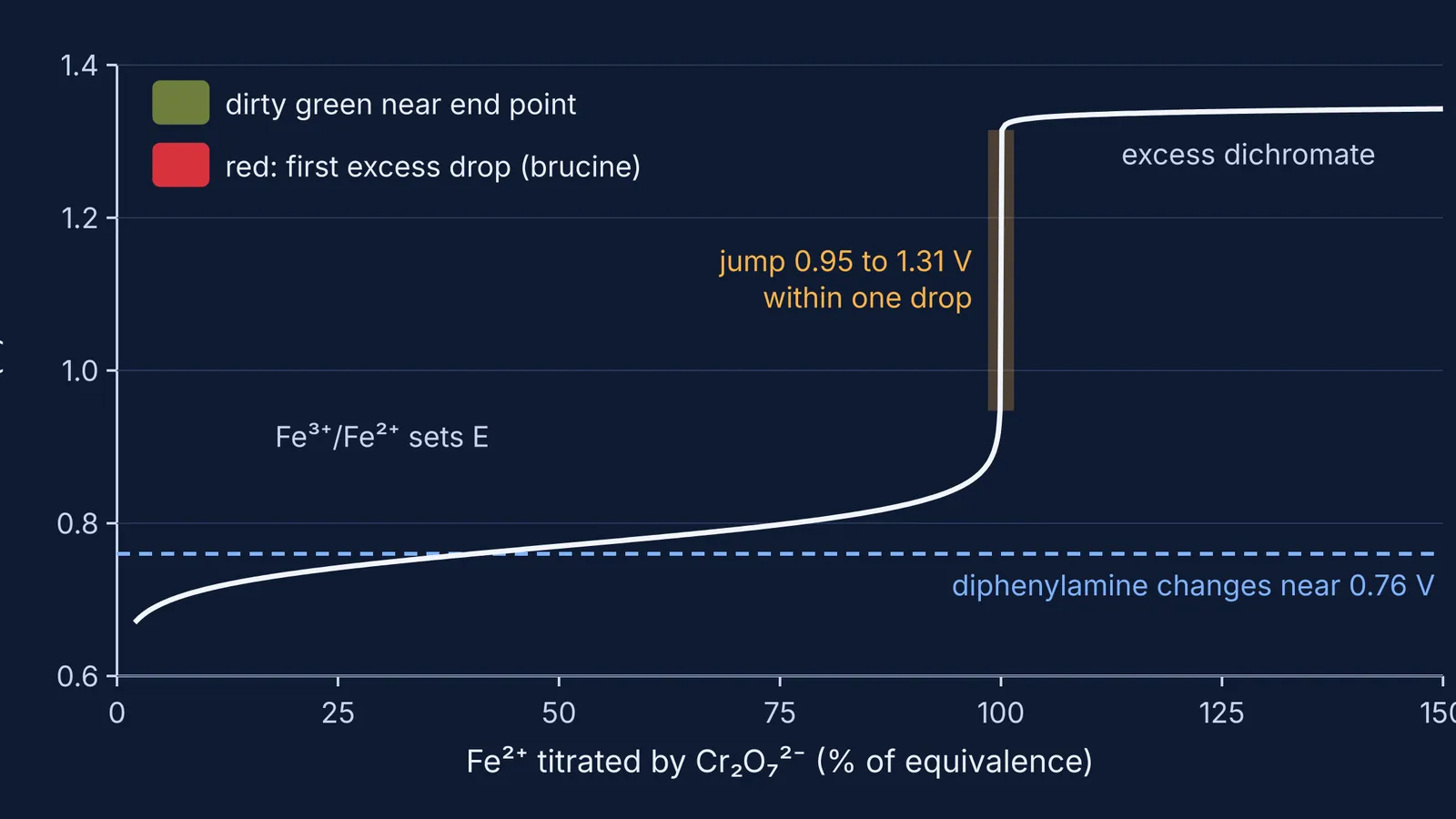
Before the end point, the potential is set by the iron couple: E = 0.77 + 0.0592 log([Fe³⁺]/[Fe²⁺]), using the standard value (real acid solutions differ a little).
50% titrated: 0.77 V.
99% titrated: 0.89 V.
99.9% titrated: 0.95 V.
After the end point the dichromate couple takes over: for 25 mL of 0.1 N Fe²⁺ in 1 M acid, 0.1% excess gives about 1.31 V. So the potential jumps from 0.95 to 1.31 V within about one drop (0.05 mL).
An indicator with n = 2 changes over about E°(In) ± 0.03 V. It gives a small error only if that window falls inside the jump. Diphenylamine changes at about 0.76 V, below 0.95 V. That is why phosphoric acid is added with it: H₃PO₄ binds Fe³⁺ as a colourless complex. This lowers the iron potential so the jump starts lower, and it removes the yellow.
Narayanamurthi and Seshadri did not measure brucine's transition potential. Their evidence is practical agreement with permanganate.
Where does this come up in JEE and NEET?
Class 12 d-block: why K₂Cr₂O₇ works in HCl and KMnO₄ does not.
Redox titrations: n-factor 6, and 1 : 6 with Fe²⁺.
Practicals and viva: Mohr's salt titrations; external against internal indicators.
For more titration numericals, Fermi Test Prep is JEE Main and Advanced preparation with an AI tutor. If a redox calculation keeps going wrong, the Fermi Problem Library has a step-by-step solver that explains the reasoning.
Quick checklist
Narayanamurthi and Seshadri, Waltair, 1936: brucine sulphate goes red with the first excess drop of dichromate.
No phosphoric acid needed; the acid must stay above 2 N; back titration is not sharp.
Up to 6.4 times as much Fe³⁺ as Fe²⁺ moved the titre by only 0.2%.
Cr₂O₇²⁻ + 6Fe²⁺ + 14H⁺ → 2Cr³⁺ + 6Fe³⁺ + 7H₂O, charge +24 each side.
0.1 N dichromate is 0.01667 M; mmol Fe = mL × N.
An indicator must change inside the jump, about 0.95 to 1.31 V here.