

On this page
In 1909 John Albert Newton Friend, of the Technical College, Darlington, put a stopwatch on a titration every student meets: ferrous iron against potassium permanganate, in hydrochloric acid. In 2 M HCl, finishing the titration in 15 seconds took 25.35 mL of N/10 KMnO₄. The correct volume was 23.52 mL, so the result was 7.8% too high. The same titration spread over 110 seconds took 23.85 mL. Textbooks say "use H₂SO₄, not HCl". Friend showed the size of the HCl error depends on time, not only on E°.
His paper, "Estimation of Iron by Permanganate in the Presence of Hydrogen Chloride", is in the Journal of the Chemical Society, Transactions, volume 95, pages 1228 to 1235. The scanned 1909 volume is on the Internet Archive. The paper gives only his degree (Ph.D.) and his college.
What did Friend measure in his timed titrations?
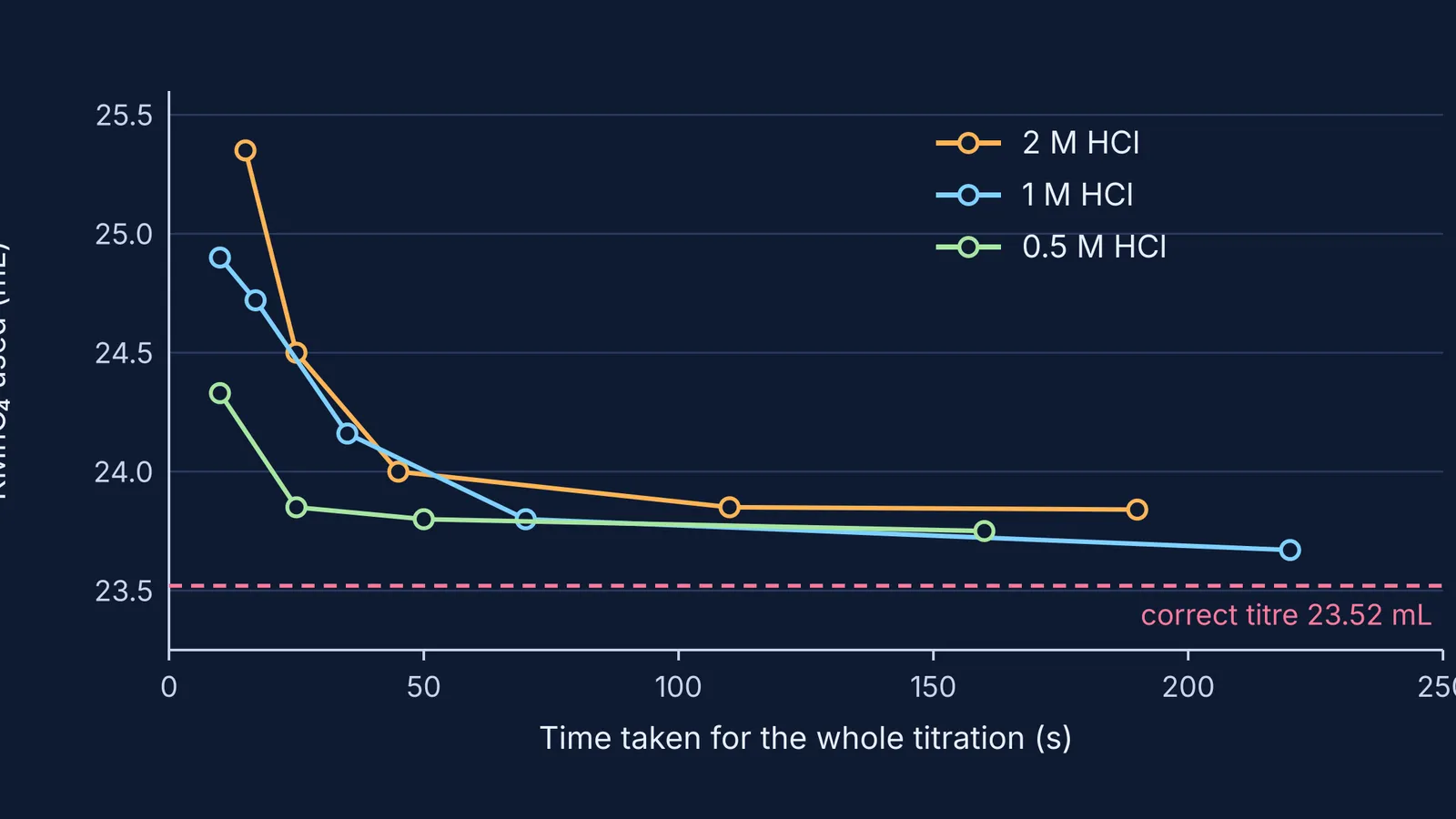
Each run used 5 mL of ferrous sulphate, 50 mL of hydrochloric acid and one drop of manganese sulphate solution. Permanganate ran from the burette at a steady rate while he shook the flask. In his tables "m" means moles per litre, so "2m HCl" is 2 M. The correct titre was 23.52 mL.
2 M HCl: 25.35 mL (15 s), 24.50 (25 s), 24.00 (45 s), 23.85 (110 s), 23.84 (190 s).
1 M HCl: 24.90 mL (10 s), 24.72 (17 s), 24.16 (35 s), 23.80 (70 s), 23.67 (220 s).
0.5 M HCl: 24.33 mL (10 s), 23.85 (25 s), 23.80 (50 s), 23.75 (160 s).
The error falls as the titration time rises "until the latter reaches about 100 seconds, after which the effect is negligible", and it grows with HCl concentration. A footnote credits Skrabal (1903) with noticing that slow addition gives better results.
Do the first drops or the last drops cause the error?
Friend then split the titration in two. With 25 mL of 2 M HCl and a correct titre of 23.23 mL:
whole titration in 15 seconds: 24.40 mL, error 1.17 mL;
first 22 mL added in 7 seconds, the rest slowly: 23.50 mL, error 0.27 mL;
whole titration slowly, over 100 seconds: 23.40 mL, error 0.17 mL.
Rushing the first 22 mL did little harm; waiting 60 or 300 seconds before finishing changed nothing. His words: "it is the rate at which the last few drops of permanganate are added to the ferrous solution which affects the value of the titration most."
His explanation was a two-stage reaction. Permanganate first forms an "unstable perchloride of manganese", which then oxidises Fe²⁺ only slowly. If the last drops go in fast, pink appears before all the iron has reacted, and you overshoot. The "perchloride" is his 1909 hypothesis, not settled chemistry. The general idea that survives: short-lived manganese species form while MnO₄⁻ is reduced, and some can oxidise chloride before the iron reaches them.
Why can permanganate oxidise HCl at all?
Compare standard reduction potentials (approximate values):
MnO₄⁻ + 8H⁺ + 5e⁻ → Mn²⁺ + 4H₂O, E° = +1.51 V
Cl₂ + 2e⁻ → 2Cl⁻, E° = +1.36 V
Fe³⁺ + e⁻ → Fe²⁺, E° = +0.77 V
For iron, E°cell = 1.51 − 0.77 = +0.74 V. For chloride, E°cell = 1.51 − 1.36 = +0.15 V. Both are positive, so both reactions are feasible:
MnO₄⁻ + 5Fe²⁺ + 8H⁺ → Mn²⁺ + 5Fe³⁺ + 4H₂O (charge +17 on each side)
2MnO₄⁻ + 10Cl⁻ + 16H⁺ → 2Mn²⁺ + 5Cl₂ + 8H₂O (charge +4 on each side)
E° says chloride can be oxidised. It does not say how fast. Friend's data are a clean case of thermodynamics against kinetics: the same E° values gave a 7.8% error in 15 seconds and a 1.4% error in 110 seconds. The E° and ΔG side is worked through in why permanganate is a stronger oxidant than dichromate.
A common explanation says added Mn²⁺ "lowers the permanganate potential". The Nernst equation shows this cannot be the main effect. For the five-electron couple, a tenfold rise in [Mn²⁺] lowers E by only 0.059/5 = 0.012 V. Removing the whole 0.15 V margin would need about 10¹² times more Mn²⁺. Friend's 2 g of MnSO₄·4H₂O in 200 mL is only about 0.045 M. So Mn²⁺ must work on the route, the short-lived intermediates, which fits his finding that speed matters.
How big is the error? A worked example from his data
Iron in the sample. Fe²⁺ → Fe³⁺ is one electron, so n = 1. 23.52 mL × 0.1 N = 2.352 meq = 2.352 mmol Fe. Mass = 2.352 × 55.85 = 131.3 mg.
Molarity of the titrant. N/10 KMnO₄ with n = 5 is 0.1/5 = 0.02 M.
Error at 15 s in 2 M HCl. 25.35 − 23.52 = 1.83 mL. Percentage error = 1.83/23.52 × 100 = 7.78%. You would report 131.3 × 25.35/23.52 = 141.6 mg of iron.
Error after slow titration. At 110 s: 0.33 mL, 1.40%. In 1 M HCl at 220 s: 0.15 mL, 0.64%. In 0.5 M HCl at 160 s: 0.23 mL, 0.98%.
Upper limit on chlorine. If all 1.83 mL had gone to chloride: 0.183 meq = 0.0915 mmol Cl₂ = 6.5 mg. Friend did not measure this.
How did Friend make the titration accurate, and was he first?
He studied manganous sulphate (MnSO₄·4H₂O) in 65 mL of M/3 HCl, correct titre 23.48 mL: no MnSO₄ gave 23.75 mL (1.15% high); 0.1 g gave 23.60; 0.5 g gave 23.52; 1 g gave 23.50; 2 g gave 23.48. But at 2 g the end point was "fugitive", at 3 g "momentary", and at 5 g there was no clear end point. Too much MnSO₄ in a small volume hides the pink.
So he combined three conditions: slow addition with constant shaking, enough MnSO₄, and a volume large enough for a clear end point. With 200 mL, 2 to 3 g of MnSO₄·4H₂O and HCl from M/4 to M/8, he got 27.50 mL against 27.47 (0.11% high) and 25.38 against 25.34 (0.16%). The largest error was 0.06 mL (0.24%). Near the end he let each drop decolourise before adding the next, and reported "no odour of chlorine perceptible".
He was not first. He cites Kessler (1863) and Zimmermann (1881) among those who added manganous sulphate. His contribution was the timing data. Mn²⁺ also changes the speed of permanganate reactions in the slow start of the KMnO₄–oxalic acid titration.
Where does this come up in JEE and NEET?
Redox and d-block: choice of acid in KMnO₄ titrations; the short version is in why dilute H₂SO₄ is used in KMnO₄ titration, not HCl.
Electrochemistry: E°cell from two half-reactions, and what a positive value does and does not mean.
Kinetics: competing reactions of one reagent, and catalysis by Mn²⁺.
Fermi Test Prep is JEE Main and Advanced preparation with an AI tutor. For more titration numericals, the Fermi Problem Library has a step-by-step solver that explains the reasoning.
Quick checklist
Friend: 7.78% high at 15 s in 2 M HCl, 1.40% at 110 s.
The last few drops matter most; rushing the start did little harm.
Mn²⁺ cannot work through Nernst alone: 0.012 V per tenfold change.
His fix: slow, shaken, at least 2 g MnSO₄, HCl up to M/4, about 200 mL.
Errors then fell to about 0.1 to 0.2%.


