On this page
Lab manuals warn you not to dry alcohols or amines over anhydrous calcium chloride. A 1917 paper shows that acetone belongs in the same discussion. While drying acetone over CaCl₂, Lancelot Salisbury Bagster of the University of Queensland found that the salt swallows acetone into two solid compounds, CaCl₂·2C₃H₆O and CaCl₂·C₃H₆O. Working out those formulas from his weighings is a standard Class 11 calculation, and the reason behind them is Lewis acid–base chemistry.
What did Bagster notice while drying acetone?
The paper is L. S. Bagster, "Compounds of Calcium Chloride and Acetone", Journal of the Chemical Society, Transactions, volume 111 (1917), pages 494–497 (DOI 10.1039/CT9171100494; scan on the Internet Archive). The printed address is The University of Queensland, Brisbane, and it was received on 4 May 1917. We have not checked Bagster's biography, so this post uses only the paper. The numbers below were checked against the page images.
He was adding dehydrated calcium chloride to acetone in several portions:
The first portion looked moist on the surface. It had taken up water, as a drying agent should.
Later portions behaved differently. The lumps swelled a lot and became powdery.
Taken out and apparently "dry", the lumps still smelled of acetone and caught fire when a flame was brought near, burning "for a considerable time".
Calcium chloride is practically insoluble in acetone, so this was not a solution. He suspected a solid compound, like the magnesium compounds Menschutkin had described and "analogous to the hydrate of calcium sulphate". He could find no description of one, even though papers often mentioned drying acetone with calcium chloride.
How did he prove the compounds were real?
He added excess dry acetone to powdered dehydrated CaCl₂, which gave out "considerable heat", and pumped the vapour away while reading a mercury manometer at 20°.
While liquid was present, the pressure stayed at 18 cm, the vapour pressure of acetone.
When the liquid had gone, it fell quickly to 4 cm and stayed there during further pumping.
After some time it fell again, to about 1 mm, and stayed there.
Each flat stretch means two solids and the vapour are in equilibrium, just like the steps when a salt hydrate loses water:
CaCl₂·2C₃H₆O(s) ⇌ CaCl₂·C₃H₆O(s) + C₃H₆O(g)
CaCl₂·C₃H₆O(s) ⇌ CaCl₂(s) + C₃H₆O(g)
Pure solids do not appear in the equilibrium expression, so Kp = p(acetone). At a fixed temperature the pressure stays constant for as long as both solids are present, whatever their amounts. It is the same idea as CaCO₃(s) ⇌ CaO(s) + CO₂(g), and the same staircase seen in why copper sulphate pentahydrate loses water in stages.
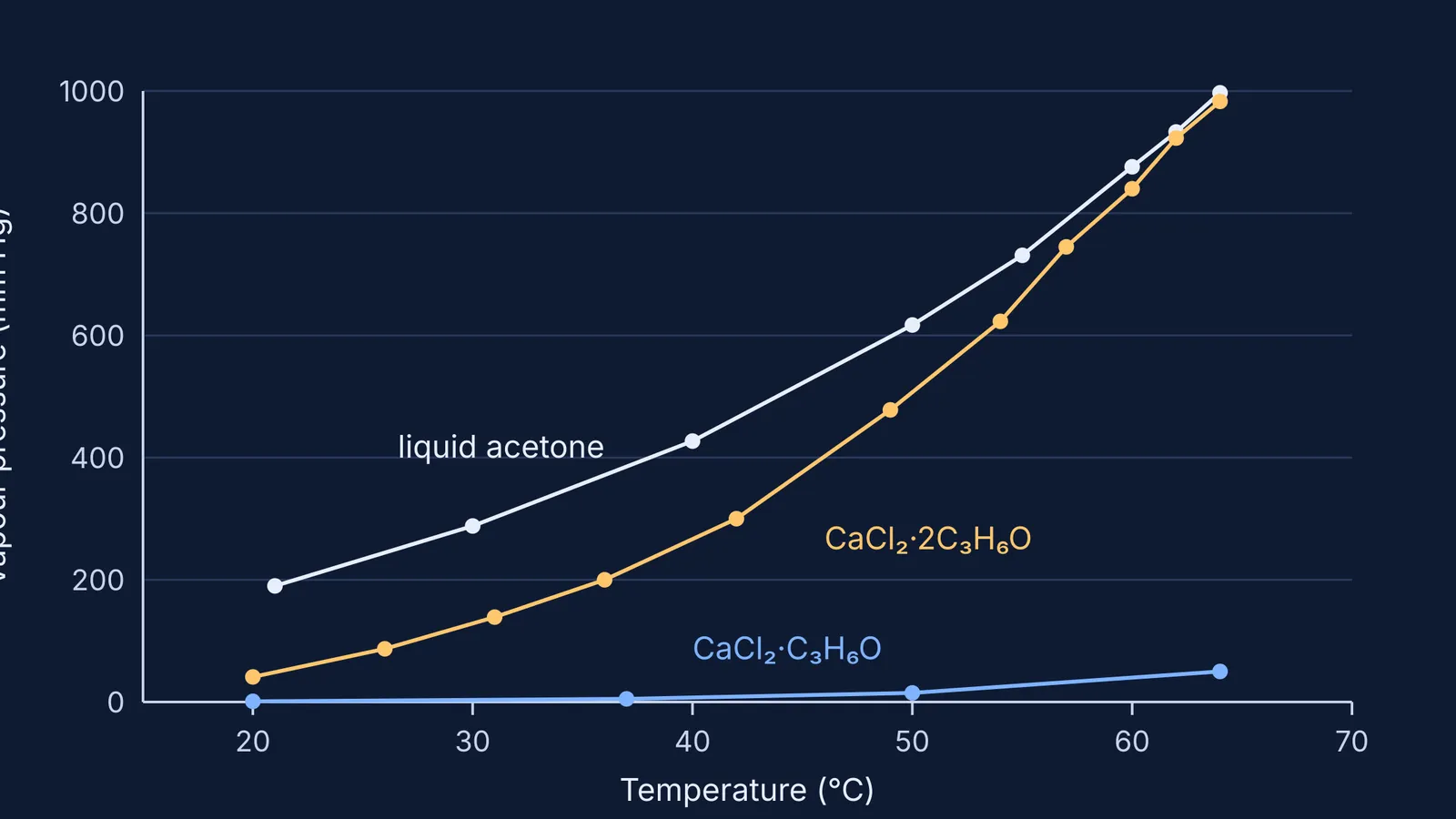
His table, plotted in the figure above, shows how tightly each compound holds acetone. At 20°, CaCl₂·2C₃H₆O has a pressure of 41 mm and CaCl₂·C₃H₆O about 1 mm, against 190 mm for liquid acetone at 21°. At 64° the values are 983 mm, 50 mm and 997 mm. A sample of CaCl₂·2C₃H₆O sealed in a thick glass tube and heated to 132° showed no liquid, and he concluded the compound "had not decomposed at 130°".
How do you work out the formula from mass loss?
He heated each sample to constant weight. Only acetone leaves; anhydrous CaCl₂ is the residue. Use CaCl₂ = 110.98 g/mol and C₃H₆O = 58.08 g/mol.
Sample 1 (taken at the 4 cm plateau): 0.687 g lost 0.349 g.
Percentage acetone = 0.349 ÷ 0.687 × 100 = 50.80%.
Residue CaCl₂ = 0.687 − 0.349 = 0.338 g, which is 0.338 ÷ 110.98 = 0.003045 mol.
Acetone = 0.349 ÷ 58.08 = 0.006009 mol.
Ratio = 0.006009 ÷ 0.003045 = 1.97, so 2. Formula: CaCl₂·2C₃H₆O.
Check: molar mass = 110.98 + 2 × 58.08 = 227.14 g/mol, and acetone = 116.16 ÷ 227.14 = 51.14%. Bagster printed 50.8% found and 51.1% required.
Sample 2 (taken at the 1 mm plateau): 0.291 g lost 0.100 g.
Percentage acetone = 0.100 ÷ 0.291 × 100 = 34.36%.
Residue = 0.191 g, which is 0.001721 mol CaCl₂.
Acetone = 0.100 ÷ 58.08 = 0.001722 mol.
Ratio = 1.00. Formula: CaCl₂·C₃H₆O, which requires 58.08 ÷ 169.06 = 34.35% acetone. He printed 34.4% found and 34.3% required.
In the 2-adduct, 1 g of CaCl₂ holds 116.16 ÷ 110.98 = 1.05 g of acetone. That is acetone lost from your flask.
For the water version of this calculation, see how to find x in a hydrate from heating mass-loss data.
Why does calcium chloride grab acetone?
Think of it as a Lewis acid–base reaction. Ca²⁺ is a small, doubly charged cation, so it attracts electron pairs: it is a Lewis acid. Water binds to it through the lone pairs on oxygen. The C=O oxygen of acetone also carries two lone pairs, so acetone can act as a Lewis base in the same way:
CaCl₂(s) + 2(CH₃)₂CO(l) → CaCl₂·2(CH₃)₂CO(s)
The same reasoning explains the warnings you already know. Alcohols have an O–H oxygen with lone pairs, amines have a nitrogen lone pair, and ammonia forms CaCl₂·8NH₃, which is why quicklime, not CaCl₂, dries ammonia.
Two honest limits. First, Bagster measured only ratios and pressures; he did not determine how the acetone sits in the crystal. Second, he showed this for acetone only. Do not stretch it to "CaCl₂ cannot dry any ketone" without checking a lab manual's drying-agent table.
Bagster also noted that the compound did not form while water was still present, because the salt took up water first. So CaCl₂ does dry acetone a little, but any extra salt starts taking the acetone itself, and the solid left behind holds a flammable liquid.
How should you choose a drying agent?
Ask three questions about the liquid you are drying:
Does it have lone-pair donors (O or N) that a small metal cation could bind? Alcohols, amines, phenols and, from this paper, acetone. Then avoid CaCl₂.
Will the drying agent react with it? A basic drying agent with an acid, or an acidic one with a base, is a bad match.
How much water, and how fast? Capacity and speed decide how much you need.
For general organic solvents, anhydrous sodium sulphate and magnesium sulphate are the usual first choices. Our comparison of Na₂SO₄, MgSO₄ and CaCl₂ as drying agents covers capacity and the clumping test.
If Lewis acids and bases still feel abstract, the Concept Library has a lesson for every chemistry concept. For practice on exam-style questions like these, Fermi's AI tutor for JEE prep works through them with you.
Where is this in the JEE and NEET syllabus?
Class 11, Some Basic Concepts: mass percentage and formula from a heating loss.
Class 11, Equilibrium: heterogeneous equilibria, where Kp equals a single gas pressure, and Lewis acids and bases.
Practical chemistry: choosing a drying agent and explaining why CaCl₂ is wrong for some liquids.
Quick checklist
CaCl₂·2C₃H₆O is 51.14% acetone; CaCl₂·C₃H₆O is 34.35%.
Bagster's 0.687 g → 0.349 g loss gives a 1.97 : 1 ratio; 0.291 g → 0.100 g gives 1.00 : 1.
A constant pressure plateau means two solids plus vapour at equilibrium; Kp = p(acetone).
Ca²⁺ is a Lewis acid; acetone's carbonyl oxygen is a Lewis base.
CaCl₂ is a poor choice for acetone, alcohols, amines and ammonia.