On this page
Shake an alkene with bromine water and the orange colour fades. The colour tells you a C=C bond is there. It does not tell you what the flask now contains. In 1917 John Read and Margaret Mary Williams, at the University of Sydney, bubbled ethylene through ice-cold bromine water and weighed the products. From 200 g of bromine they got 85 g of ethylene bromohydrin and 88 g of ethylene dibromide. More than half the bromine ended up in the bromo-alcohol, not the dibromide.
Who were Read and Williams, and what did they publish?
The paper is J. Read and M. M. Williams, "The Action of Bromine Water on Ethylene", J. Chem. Soc. Trans. 111 (1917) 240–244. We read it in the scanned 1917 volume and checked the numbers below against the page images. It is signed "Department of Organic Chemistry, University of Sydney" and was received on 5 March 1917. We have not checked anything else about either author's life or career.
They wanted an easier way to make ethylene bromohydrin, BrCH₂CH₂OH. The usual route then added hypobromous acid, HOBr, made from bromine and freshly precipitated mercuric oxide. In 1912 Pope and Read had used a simpler trick with indene: shaking it with successive portions of bromine water gave 85 per cent of the bromohydrin. Nobody seemed to have tried this with ethylene. As they put it, "in all the available references to the reaction, the assumption seems to be that the sole product is ethylene dibromide."
Bromine and 1,2-dibromoethane are hazardous. This post covers the history and the arithmetic only, not a procedure.
What did 200 g of bromine give?
Ethylene was passed into ice-cooled water holding 7.2 g of bromine in 500 c.c. When that bromine was used up, another 7.2 g portion went in, until 200 g had reacted, about 28 portions. The bromine was "never above 1·5" per cent of the water.
Lower layer: ethylene dibromide, 88 g, distilling at 129–135 °C.
Water layer: ethylene bromohydrin, extracted with ether, 85 g, distilling at 145–149 °C.
Hydrogen bromide: 70.0 g, found by titration with silver solution.
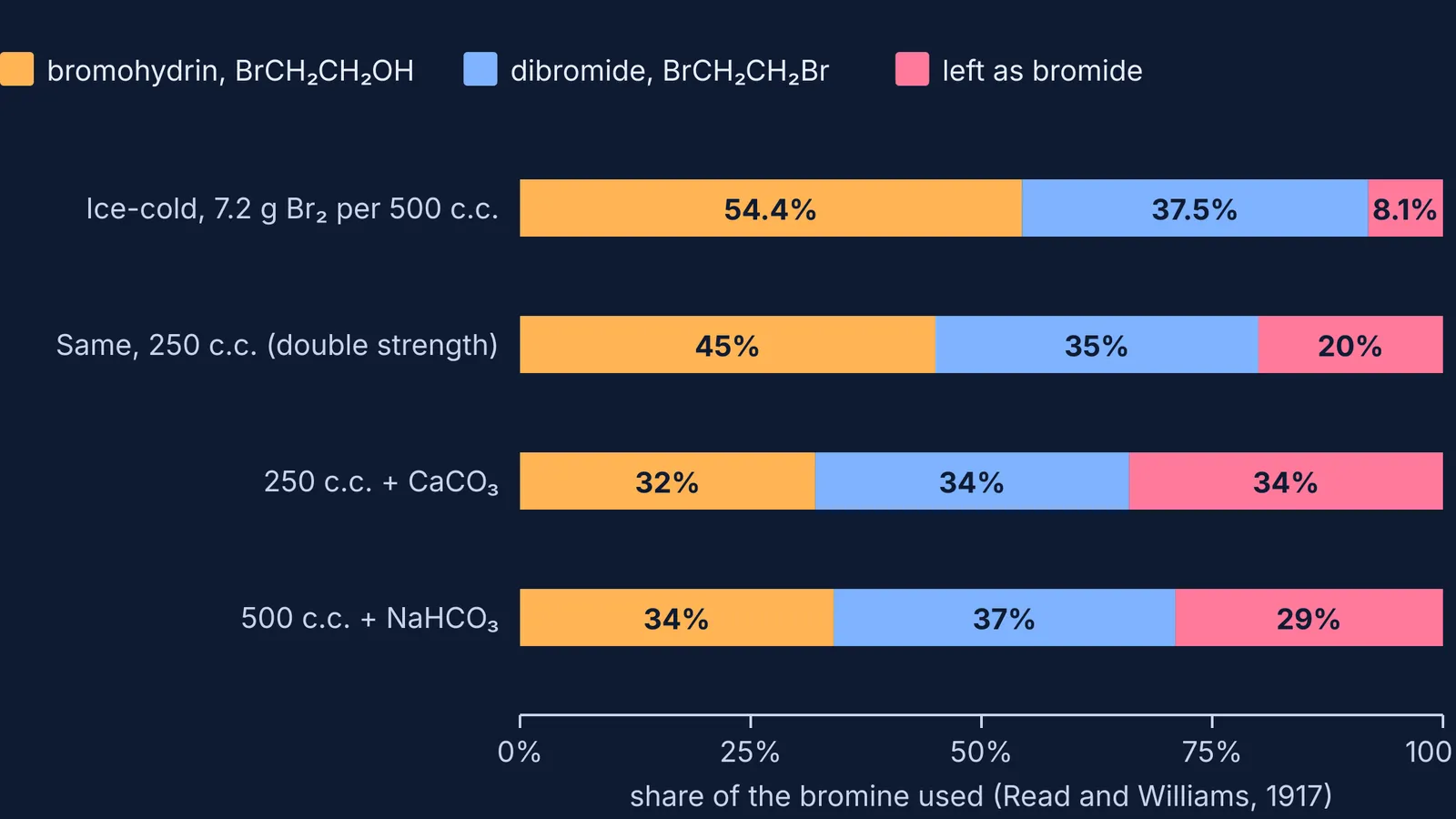
Their split of the bromine: 54.4 per cent into bromohydrin, 37.5 per cent into dibromide, and the remaining 8.1 per cent "accounted for by the decomposition of hypobromous acid into hydrogen bromide and oxygen". Our python figures below differ in the last digit, which looks like rounding.
Why does bromine water give two products?
Read and Williams wrote a scheme of competing paths:
Br₂ + H₂O ⇌ HOBr + HBr
CH₂=CH₂ + HOBr → BrCH₂CH₂OH (the bromohydrin)
CH₂=CH₂ + Br₂ → BrCH₂CH₂Br (the dibromide)
2HOBr → 2HBr + O₂ (the loss)
Each equation balances in atoms. The share of each product depends on how fast ethylene takes up HOBr compared with Br₂. They noted that indene's ratio "is more favourable to bromohydrin formation than in the case of ethylene".
Today's textbooks explain it differently. Bromine attacks the double bond to form a cyclic bromonium ion, and water, far more plentiful than bromide ion, opens the ring. That is how the bromonium ion explains anti addition, and it is the same intermediate behind halohydrin formation from alkenes. That mechanism was proposed by Roberts and Kimball in "The Halogenation of Ethylenes" (J. Am. Chem. Soc., 1937), twenty years after this paper. It is not Read and Williams's idea, and they should not be credited with it.
Either way, the overall change for the bromohydrin is the same: CH₂=CH₂ + Br₂ + H₂O → BrCH₂CH₂OH + HBr. One HBr forms for every bromohydrin. That is the fact the worked example uses.
What changed the bromohydrin share?
Doubling the bromine strength (same 7.2 g portions in 250 c.c.): bromohydrin fell to 45 per cent, dibromide 35 per cent, and about 20 per cent went to hydrogen bromide.
Adding calcium carbonate under those stronger conditions: ethylene was absorbed faster, but bromohydrin fell from 45 to 32 per cent. Dibromide stayed at 34 per cent.
Adding sodium hydrogen carbonate under the first conditions: bromohydrin fell from 54.4 to 34 per cent, with 37 per cent dibromide.
Room temperature: the bromohydrin yield was "materially less".
In both carbonate runs "the balance of the bromine was found in the aqueous layer as bromide". Their reading was that faster HOBr formation only increased its decomposition. Notice that the dibromide hardly moved, at 34–37 per cent, in every run. The changes came from the bromohydrin and the loss.
Worked example: does the bromine add up?
Use Br = 79.904, C = 12.011, H = 1.008 and O = 15.999.
Bromine in. M(Br₂) = 159.81. 200 ÷ 159.81 = 1.2515 mol.
Bromohydrin. M(C₂H₅BrO) = 124.97. 85 ÷ 124.97 = 0.6802 mol. One Br₂ per bromohydrin, so 0.6802 ÷ 1.2515 = 54.3% of the bromine.
Dibromide. M(C₂H₄Br₂) = 187.86. 88 ÷ 187.86 = 0.4684 mol, which is 37.4% of the bromine.
The rest. 1.2515 − 0.6802 − 0.4684 = 0.1029 mol of Br₂, or 8.2%.
Predict the HBr. Each bromohydrin releases one HBr: 0.6802 mol. Each Br₂ lost through HOBr gives two HBr (one when HOBr forms, one when it decomposes): 2 × 0.1029 = 0.2058 mol. Total 0.886 mol, or 71.7 g at M(HBr) = 80.91.
Compare. They found 70.0 g, which is 0.865 mol, about 98% of the prediction.
Bromine atoms. In: 2 × 1.2515 = 2.503 mol. Out: 0.6802 + 2 × 0.4684 + 0.865 = 2.482 mol, which is 99.2%.
Product ratio. 0.6802 ÷ 0.4684 = 1.45 mol of bromohydrin per mol of dibromide.
This is the same thinking as a percentage yield. If every Br₂ had become bromohydrin, you would get 1.2515 × 124.97 = 156.4 g. 85 g is 54.3% of that.
Where does this come up in JEE and NEET?
Class 11 Hydrocarbons: alkenes with bromine water as a test for unsaturation. Our post on tests for unsaturation with bromine water and Baeyer's reagent covers how to write it up.
Class 12 Haloalkanes and Alcohols: halohydrins and why water opens the halonium ion.
Class 11 Some Basic Concepts: moles from mass, percentage yield and atom balance.
If the mole bookkeeping in steps 5 to 7 feels shaky, the Fermi Problem Library has a step-by-step solver that explains the reasoning rather than printing an answer. For exam practice, Fermi Test Prep covers JEE Main and Advanced preparation with an AI tutor.
Quick checklist
Read and Williams, University of Sydney, 1917: ethylene through ice-cold bromine water.
200 g Br₂ gave 85 g bromohydrin and 88 g dibromide: about 54% and 37% of the bromine.
The rest, about 8%, ended as HBr after HOBr decomposed; 70.0 g HBr was found against 71.7 g predicted.
Stronger bromine water, added carbonate or room temperature all lowered the bromohydrin share; the dibromide stayed near 34–37%.
Overall: C₂H₄ + Br₂ + H₂O → C₂H₅BrO + HBr.
The bromonium ion is Roberts and Kimball, 1937, not Read and Williams.