

On this page
What is halohydrin formation and how does HOCl react with alkenes?
A halohydrin is a stable organic compound containing a halogen atom and a hydroxyl group on adjacent (vicinal) saturated carbon atoms. When an alkene reacts with hypochlorous acid (HOCl) or aqueous halogen (such as chlorine or bromine water), an electrophilic addition occurs across the carbon-carbon double bond to yield a vicinal halo-alcohol.
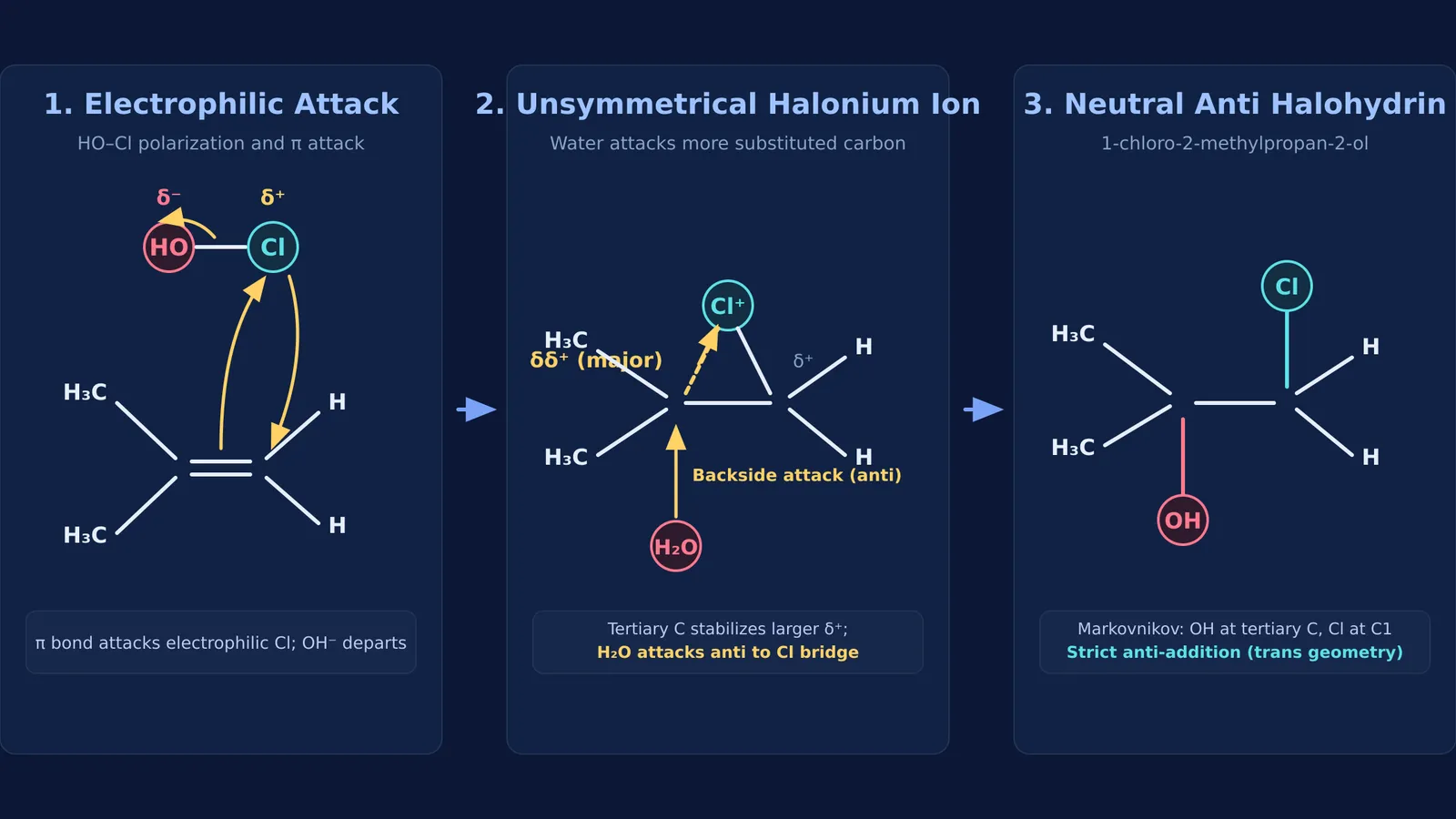
The reaction begins with the polarisation of the hypohalous bond. Because oxygen is significantly more electronegative than chlorine, oxygen carries a partial negative charge (δ⁻) while chlorine bears a partial positive charge (δ⁺). When the electron-rich π bond of an alkene approaches hypochlorous acid, the π electrons attack the electrophilic chlorine atom. In 1937, D. Stanley Tarbell and Paul D. Bartlett demonstrated the electrophilic nature and stereochemical constraints of halogen additions in the Journal of the American Chemical Society.
This electrophilic attack does not yield a free open carbocation. Instead, a lone pair from chlorine simultaneously bonds with the neighboring alkene carbon, forming a three-membered cyclic chloronium ion. This bridged intermediate prevents free rotation and dictates the regiochemical and stereochemical path of the reaction.
Why does water attack the more substituted carbon in a chloronium ion?
The three-membered cyclic halonium intermediate was first proposed by Irving Roberts and George E. Kimball in their 1937 paper in the Journal of the American Chemical Society. George Olah and co-workers later confirmed the existence of stable cyclic halonium ions in the Journal of the American Chemical Society using low-temperature nuclear magnetic resonance spectroscopy in superacid solutions.
Once the cyclic chloronium ion forms, a nucleophile must open the ring. In dilute aqueous solution, water functions as the solvent at a concentration of approximately 55.5 mol/L, outnumbering generated halide ions by thousands to one. Consequently, water captures the intermediate before chloride can.
In an unsymmetrical alkene such as propene or 2-methylpropene, the two carbons in the three-membered ring are not equivalent. In typical bimolecular substitution (SN2) reactions on neutral substrates, nucleophiles attack the less crowded carbon. In a bridged halonium ion, however, the ring carbons carry partial positive charge. The more substituted carbon stabilizes a larger partial positive charge (δ⁺) through alkyl inductive donation and hyperconjugation.
This electronic stabilization elongates and weakens the carbon-chlorine bond at the more substituted position, imparting substantial carbocation character to that carbon. Because the ring-opening transition state is governed primarily by electrostatic attraction to the developing positive charge rather than steric hindrance, water preferentially attacks the more substituted carbon. Loss of a proton yields the halohydrin, placing the -OH group at the more substituted carbon and the -Cl atom at the less substituted position.
Why is halohydrin formation strictly anti-stereospecific?
Halohydrin formation yields exclusively anti-addition products, meaning the halogen and hydroxyl groups add to opposite faces of the original double bond. The three-membered halonium ion locks the stereochemistry:
The bridged halogen atom sits on one face of the carbon-carbon bond, shielding that entire side from incoming nucleophiles.
Water must approach from the opposite face, directly anti to the departing carbon-halogen bond, in an SN2-type backside attack.
Backside attack inverts the stereocenter at the attacked carbon while the halogen remains anchored on the original face.
For cycloalkenes such as cyclohexene or 1-methylcyclopentene, the reaction produces trans-halohydrins exclusively.
The bridged intermediate also explains why halohydrin synthesis avoids skeletal rearrangements. In ordinary additions of hydrogen halides, secondary open carbocations frequently undergo carbocation rearrangements via hydride or methyl shifts. Because halohydrin formation proceeds via a cyclic halonium ion rather than an open carbocation, adding HOCl to 3,3-dimethylbut-1-ene gives 1-chloro-3,3-dimethylbutan-2-ol with an intact carbon framework. This clean stereocontrol mirrors other non-carbocation additions like hydroboration-oxidation, while contrasting with the competing substitution and elimination pathways seen in aqueous vs alcoholic KOH.
How do you solve halohydrin problems on JEE and NEET?
Curricula published by the NCERT and exam syllabi for JEE Advanced routinely evaluate halohydrin regiochemistry and stereochemistry. A systematic five-step approach ensures accurate predictions:
Identify the alkene double bond and classify each carbon by degree of substitution.
Identify the electrophilic halogen atom carrying the δ⁺ charge in HOCl or aqueous Br₂.
Draw the bridged halonium ion bridging the two double-bond carbons.
Direct water to attack the more substituted carbon from the opposite face of the halonium bridge.
Deprotonate the oxonium intermediate to yield the neutral anti halohydrin.
For example, when 2-methylbut-2-ene reacts with bromine water, the double bond connects tertiary C2 and secondary C3. In the cyclic bromonium intermediate, C2 bears greater partial positive charge than C3. Water attacks C2 from the backside, yielding 3-bromo-2-methylbutan-2-ol after deprotonation.
When working through multi-step mechanisms, the Fermi Problem Library provides worked problems with a step-by-step solver that explains the reasoning rather than printing an answer, helping students verify regiochemical and stereochemical assignments. To explore how cyclic onium intermediates relate to the broader principles of electrophilic addition, the Fermi Concept Library maps every concept in physics, chemistry, biology, mathematics and computing, each with its own lesson and its place in the map.


